

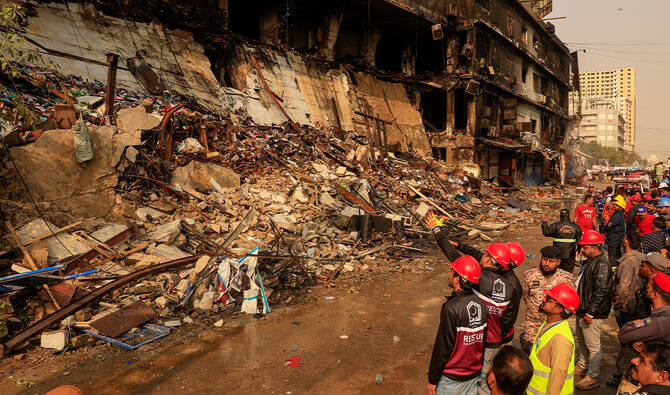

KARACHI: Sarfaraz, a 42-year-old laborer who only gave his first name, stood outside a smoke-darkened Gul Plaza as he desperately scanned his surroundings for his 13-year-old son, Hamza, who worked at a shop inside the multi-story commercial building in the southern Pakistani city of Karachi.
He has visited the site multiple times since a fire broke out there last week, but authorities did not let the 42-year-old enter the premises out of safety concerns, forcing him to return home where his wife continues to question him about their son.
Hamza, 13, is one of more than 70 people missing whom rescue agencies have been searching underneath the rubble of the collapsed building since the incident, one of the deadliest fires since a 2012 infamous garment factory inferno that killed over 260 people in Baldia Town.
Sarfaraz says that his wife has stopped speaking or eating and has been waiting for their 13-year-old son who worked at a flower shop at Gul Plaza. Two of Hamza’s brothers, who also worked at Gul Plaza, were fortunate enough to survive the inferno.
“When I come home, his mother asks, ‘What happened to my son?’” Sarfaraz told Arab News on Monday. “She is not speaking nor eating anything, even with food placed in front of her. She has turned to stone.”
The blaze broke out late Saturday at Gul Plaza in the city’s Saddar business district and spread tore through multiple floors, trapping shoppers and workers inside the densely packed building.
“When I reached there, my son was not there. I got mad, the fire was there, there was smoke, but it had not yet turned into flames,” Sarfaraz said, recalling how it all started.
On Monday, Rescue 1122 officials said more than 20 bodies had been recovered from the building so far, but stressed that an exact figure could not yet be confirmed because some remains were found in fragments and required forensic verification to determine whether they belonged to the same individuals.
“We have registered 74 people as missing so far in line with the complaints of their families,” said Fida Hussain, in-charge at the Missing Persons Information Desk set up at the site by the Sindh provincial government.
“Those missing also include seven women and as many children,” the official told Arab News, but he wasn’t sure if those found dead were registered in the list he was compiling.
Muhammad Ameen, in-charge of the Edhi rescue service control room, said they had retrieved five bodies from the rubble on Sunday night.
“One of them is a woman,” he told Arab News. “But those bodies had only organs left and their identification is not possible.”
Many traders and families of those missing were seen standing in front of the demolished building on Monday, hoping to hear from the authorities about the safety of their loved ones.
Fazal Malik was one such person from the city’s Keamari area whose wife and two other family members were still missing.
“I don’t know why they (authorities) are taking so much time in clearing this debris,” Malik said, with teary eyes. “They should have allowed us and our men would have done it much faster.”
Muhammad Humayun Khan, the chief fire officer at Karachi Municipal Corporation (KMC), said the bigger the fire, the longer it takes to douse it and clear the area.
“The building has collapsed. It is spread over more than two acres,” he said, adding the plaza housed around 1,200 shops.
Khan said they still had 12 fire tenders, three snorkels and one bowser deployed to fully douse the fire which was “under control” now.
“You can’t see the flames anywhere. The cooling process is going on,” he said.
Deadly fires in commercial buildings are a recurring problem in Karachi, a city of more than 20 million people, where overcrowding, outdated infrastructure and weak enforcement of fire safety regulations have repeatedly resulted in mass casualties and heavy economic losses.
A massive arson attack at one of Karachi’s oldest Bolton Market destroyed hundreds of shops and disrupted supply chains across the city in 2009, while more recently fires at the Cooperative Market and Victoria Building areas wiped out clusters of small traders.
“If you are doing a business, then try to get a fire extinguisher or consult with someone, there is no harm in that,” the chief fire officer said.
Khan would not say what caused Saturday’s inferno.
“When the investigation department investigates, they will bring it to us,” he added.
The provincial government has ordered a formal inquiry into the incident and would take measures, including immediate implementation of a 2024 fire safety audit covering 145 buildings and mandatory installation of fire safety equipment in commercial markets across the city.
But Sarfaraz, whose 13-year-old son supported him with his meagre earnings, has only one demand to make from the government: “I want my son [back].”


