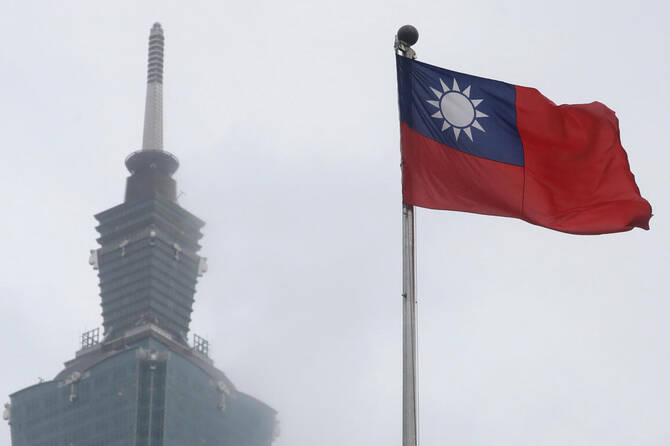
Taiwanese reporter accused of bribing military officers to leak information to China

China and Taiwan have been governed separately since 1949, when the Communist Party rose to power in Beijing following a civil war. (AP)
Short Url
Updated 18 January 2026
Follow

Taiwanese reporter accused of bribing military officers to leak information to China

  • District court orders detention of television reporter surnamed Lin and five current and retired military officers

TAIPEI: A journalist in Taiwan was detained Saturday on allegations of bribing army officers to provide military information to people from mainland China, as the self-ruled island cracks down on potential infiltration from China.
Taiwan’s Qiaotou District Prosecutors Office said in a statement that a district court ordered the detention of a television reporter surnamed Lin and five current and retired military officers. The statement didn’t identify the journalist, but CTi TV issued a statement about the detention of its reporter Lin Chen-you.
The company said that it does not know the details of the case, but called for a fair judicial process, adding “God bless Taiwan.”
While Taiwan regularly pursues espionage cases within the government and military, allegations against journalists are unusual.
Beijing, which claims Taiwan as its own territory and threatens to take control of the island by force if necessary, has been increasing military pressure against the island. Last month, China’s military launched large-scale drills around it for two days after a Washington announcement of large-scale arms sales to Taiwan.
Prosecutors accuse Lin of paying amounts ranging from several thousand to tens of thousands of Taiwan dollars (tens to hundreds of US dollars) to current military officers in exchange for their providing information to “Chinese individuals.” The office didn’t specify who the Chinese people were or whether they were linked to the Chinese government.
Authorities raided the premises of the reporter and nine current and retired military personnel on Friday as part of an investigation into violations of Taiwan’s national security and corruption laws and disclosure of confidential information. CTi said that its offices were not raided.
According to Lin’s Facebook page, he was a political reporter and anchor covering the island’s legislature.
China and Taiwan have been governed separately since 1949, when the Communist Party rose to power in Beijing following a civil war. Defeated Nationalist Party forces fled to Taiwan, which later transitioned from martial law to multiparty democracy.


Modi’s rooftop solar push slowed by reluctant lenders, states

Updated 5 sec ago
Follow

Modi’s rooftop solar push slowed by reluctant lenders, states

  • The shortfalls represent the latest challenge to India’s efforts to nearly double clean energy capacity to 500 gigawatts by 2030

SINGAPORE/MUMBAI/BHUBANESWAR, India: Indian Prime Minister Narendra Modi’s push to accelerate the rollout of rooftop solar power is falling short of targets despite ​heavy subsidies due to loan delays and limited support from state utilities, vendors and analysts say.
The shortfalls represent the latest challenge to India’s efforts to nearly double clean energy capacity to 500 gigawatts by 2030, and come as the government plans to suspend clean energy tendering targets amid a mounting backlog of awarded projects yet to be built.
Challenges to plans to increase solar uptake may mean India maintains its reliance on coal-fired power.
India’s Ministry for New and Renewable Energy created its subsidy program for residential solar panel installations in February 2024, covering up to 40 percent of the costs.
But residential installations at 2.36 million are well below the ministry’s target of 4 ‌million by March, ‌according to data from the program’s website.
“Banks’ reluctance to lend and states’ ​hesitance ‌to ⁠promote the schemes ​could ⁠derail India’s efforts to transition away from coal,” said Shreya Jai, the lead energy analyst at research firm Climate Trends in New Delhi.
Roughly three in five rooftop solar applications filed on the scheme’s website are yet to be approved while about 7 percent have been rejected, according to government data on the program, known as the PM Surya Ghar.
In a statement to Reuters about the pending applications, the renewable energy ministry pointed to accelerating installations which have benefited over 3 million households, and said the scheme enables state-owned utilities to reduce subsidy payouts to keep residential power bills in ⁠check.
“The loan rejection rate varies across states,” the statement said.
Under PM Surya Ghar, ‌consumers apply and select a vendor who handles paperwork and arranges bank ‌financing for solar panels. After loan approval and installation, the vendor ​submits proof, after which the government subsidy is credited ‌to the bank.

BANK DELAYS
However, banks have been rejecting or delaying loans for numerous reasons including lack of ‌documentation, which they say is necessary to protect public funds.
“We are working with the government to push for some standard documentation, because it is necessary to avoid bad loans. Currently if loans go bad, banks can take away these panels but what will we do with these panels?” said a senior official at a major government-owned bank.
Chamrulal Mishra, a solar vendor in ‌the eastern Indian state of Odisha, said applications are often rejected because the customer has missed electricity payments or because land records are still in the name ⁠of deceased relatives.
Residents there dispute ⁠the claims that they have missed payments, which they attribute to administrative errors after a change in utility ownership decades prior.
A spokesperson for India’s Department of Financial Services, which regulates the country’s banks, said they have responded to consumer feedback to allow co-applicants for loans to clear up title claims and the simplification of documentation requirements.
The Renewable Energy Association of Rajasthan said some banks are making collateral demands for loans under 200,000 Indian rupees ($2,208.87), despite scheme guidelines not requiring them to, which is constraining solar power additions.
State Bank of India and Punjab National Bank, some of the country’s largest lenders, did not reply to requests for comment on the matter.
State-owned utilities are also not promoting rooftop solar as much, as they are concerned about the loss of revenue as sales move off the electric grid.
“Wealthier households typically have high electricity consumption, tariffs and reliable roof access. When they shift from ​the grid, it leaves a larger financial burden,” ​said Niteesh Shanbog, an analyst at Rystad Energy.