

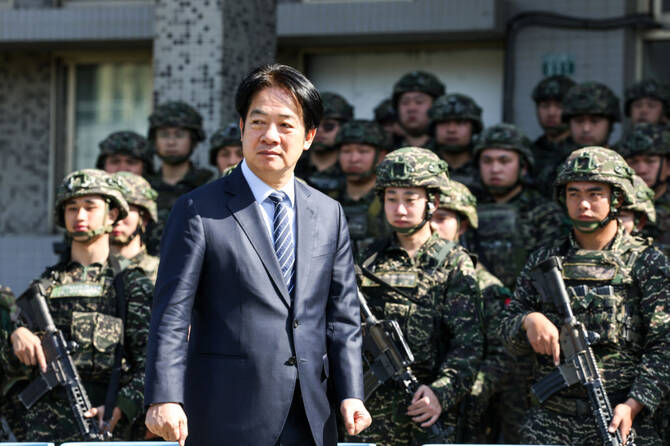
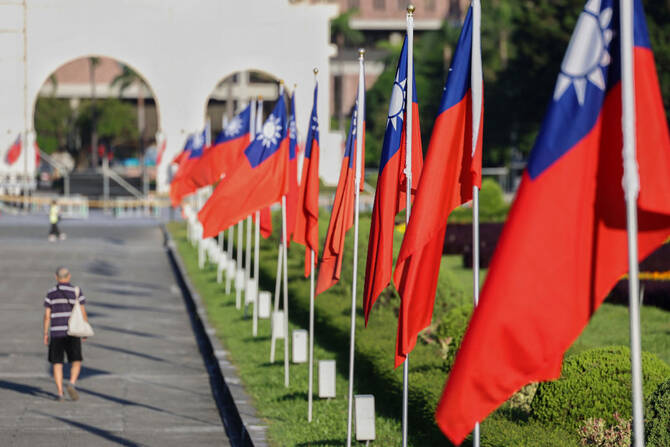

TAIPEI: Taiwan is vetting hundreds of thousands of military service members, public school teachers and civil servants in a bid to root out potential homegrown Chinese sympathizers, as Beijing intensifies espionage on the island.
Alarm is growing in Taiwan over the extent of China’s infiltration on the self-ruled island, which Beijing claims is part of its territory and has threatened to seize by force.
Prosecutors last week charged four recently expelled members of the ruling Democratic Progressive Party — including a former staffer in President Lai Ching-te’s office — for sharing state secrets with Beijing.
While Taipei and Beijing have spied on each other for decades, analysts warn the threat to Taiwan is more serious given the risk of a Chinese attack.
The main targets of Chinese infiltration have been retired and active members of the military, persuaded by money, blackmail or pro-China ideology.
Lai, an outspoken defender of Taiwan’s sovereignty and loathed by Beijing, has branded China a “foreign hostile force” and sought to raise public awareness about Chinese actions he says threaten national security.
After a sharp rise in the number of people prosecuted for spying for China in recent years, the government is trying to identify people within its own departments, military and public schools with a possible allegiance to Beijing.
Anyone on the public service payroll found with Chinese residence or other identification cards risks losing their Taiwanese household registration, effectively their citizenship.
“The reason we started to survey (for Chinese IDs) is because China uses this way to coerce Taiwanese people, to penetrate our system, especially the public service,” DPP lawmaker Wang Ting-yu told AFP.
“The threat is getting worse and worse and we have to deal with that.”
In the first round held recently, 371,203 people, or nearly all of those surveyed, signed statements declaring they did not hold any Chinese ID documents prohibited by Taiwanese law.
Two people admitted having Chinese ID cards and 75 having residence permits, which were annulled, Taiwan’s top policy body on China, the Mainland Affairs Council, said.
The second round of vetting is underway, but the government has said the general public will not be targeted.
Concern over Taiwanese people holding Chinese ID documents flared after a YouTube video last year alleged there were tens of thousands of cases.
A senior Taiwanese security official said recently China was issuing ID papers to a growing number of people from Taiwan, but it was “difficult to estimate” how many or track down offenders without Beijing’s cooperation.
“The idea is to define Taiwanese citizens as Chinese citizens under their legal framework,” the official said.
Legal scholar Su Yen-tu said there were limits on the government’s “investigatory power” to find out who held Chinese ID cards in Taiwan.
If Taiwanese people did not voluntarily disclose the information, “there’s not much the government can do,” said Su, a research professor at Academia Sinica.
Collecting records was still “potentially useful,” Jamestown Foundation president Peter Mattis told AFP, particularly if someone under investigation in the future is found to have lied about their documents.
Taiwan has also asked around 10,000 Chinese spouses and their China-born children for proof they have given up their Chinese household registration, a decades-old requirement under Taiwanese law.
The notices sparked criticism that the government was being heavyhanded, but Wang said stricter enforcement was needed because some “new immigrants” from China had spied for Beijing and interfered in Taiwan’s elections.
“I personally feel that it’s a bit disturbing for the people,” said Li I-ching, a 23-year-old graduate student in Taipei, who was born in China to a Chinese mother and a Taiwanese father.
Like many others, Li has to obtain evidence from China that she no longer holds permanent residence status.
The Beijing-friendly main opposition Kuomintang party (KMT) has accused the government of conducting “loyalty” tests.
“At a time when our country is facing so many difficulties... the government is only thinking about how to cleanse the population,” said KMT lawmaker Chen Yu-jen.
The dispute between Taiwan and China dates back to 1949 when Chiang Kai-shek’s nationalist forces lost the Chinese civil war to Mao Zedong’s communist fighters and fled to the island.
China has vowed to annex Taiwan and in recent years has ramped up its military pressure on the island.
Taiwan says China also uses disinformation, cyberattacks and espionage to weaken its defenses.
“It’s a fight every day for the Taiwanese against this sort of stuff,” said Mark Harrison, a senior lecturer in Chinese studies at the University of Tasmania.
“I think their democracy has tremendous integrity, but it does have to be defended, and when you defend something, it certainly generates a lot of discourse, a lot of debate.”


