CAIRO: Egypt and Sudan welcomed on Saturday President Donald Trump’s offer to resume US mediation efforts with Ethiopia to resolve a long-running Nile River water dispute following Addis Ababa’s construction of a giant dam.
Ethiopia inaugurated the Grand Ethiopian Renaissance Dam, or GERD, last fall.
It is Africa’s largest and is meant to produce more than 5,000 megawatts, doubling Ethiopia’s electricity generation capacity. Egypt sees the dam as a “grave violation of international law” that poses “an existential threat,” fearing a severe effect on Nile water flow.
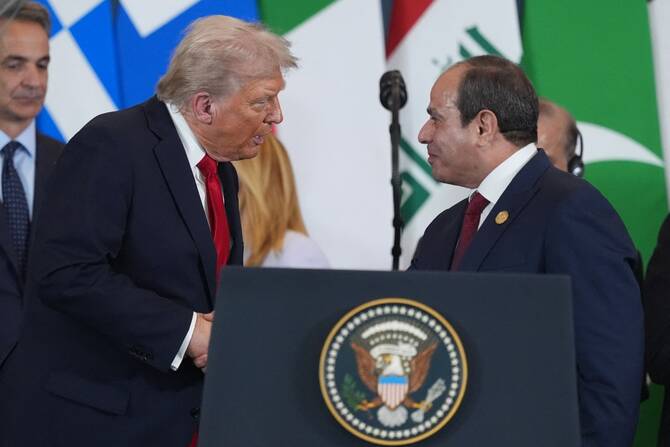
Egypt’s President Abdel-Fattah El-Sisi said in a social media post that he valued “President Trump’s attention to the central importance of the Nile River issue for Egypt,” adding that his country is committed to “serious and constructive cooperation with the Nile Basin countries, based on the principles of international law, in a manner that achieves shared interests without causing harm to any party.”
He said that Egypt supports the US efforts to resolve the dispute with Ethiopia.
In a post on X, Gen. Abdel-Fattah Burhan, chairman of Sudan’s ruling Sovereign Council and its military chief, hailed Trump’s initiative as a step “to find sustainable and satisfactory solutions that preserve everyone’s rights.”
There was no immediate comment from Ethiopia.
On Friday, Trump posted on social media a letter he sent to El-Sisi, saying: “I am ready to restart US mediation between Egypt and Ethiopia to responsibly resolve the question of ‘The Nile Water Sharing’ once and for all.”
Washington-led mediations began during Trump’s first term, but they effectively collapsed in 2020, when Ethiopia withdrew — though some discussions later continued under the African Union without reaching a settlement.
Cairo and Khartoum call for a legally binding agreement on how GERD, located on the Blue Nile near Ethiopia’s border with Sudan, will be filled and operated, while Addis Ababa insists on guidelines.
Egypt, a mostly desert country, depends on the Nile River to supply its booming population of 110 million with fresh water. It fears that the dam will drastically reduce the Nile’s flow, with potentially severe effects on its agriculture and other sectors. El-Sisi has said that his country’s share of Nile water is ” untouchable,” though he favored resolving the dispute through negotiations.
Sudan, meanwhile, wants coordination of the operation and replenishment of the GERD’s reservoir to avert unexpected impacts on its dams.
Ethiopia says the $5 billion dam is essential, arguing the vast majority of its population lacks electricity.
The dispute now centers on how the dam’s annual replenishment is conducted, the amount of water Ethiopia will release downstream if a multi-year drought occurs and the method the three countries will use to settle future disputes.


![]()

Egypt and Sudan welcome Trump’s offer to mediate Nile River dam dispute
Short Url
https://arab.news/ny5wx
Egypt and Sudan welcome Trump’s offer to mediate Nile River dam dispute
- El-Sisi said he valued “President Trump’s attention to the central importance of the Nile River issue for Egypt”
- He said that Egypt supports the US efforts to resolve the dispute with Ethiopia


Latest updates


Recommended


© 2026 SAUDI RESEARCH & PUBLISHING COMPANY, All Rights Reserved And subject to Terms of Use Agreement.