

Tensions flare in Minnesota as protesters and federal agents repeatedly square off

1 / 5
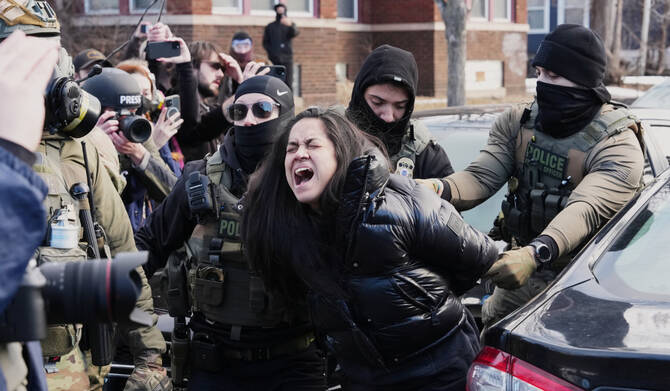
A protester is detained by Federal agents near the scene where Renee Good was fatally shot by an ICE officer last week, Tuesday, Jan. 13, 2026, in Minneapolis. (AP)
2 / 5
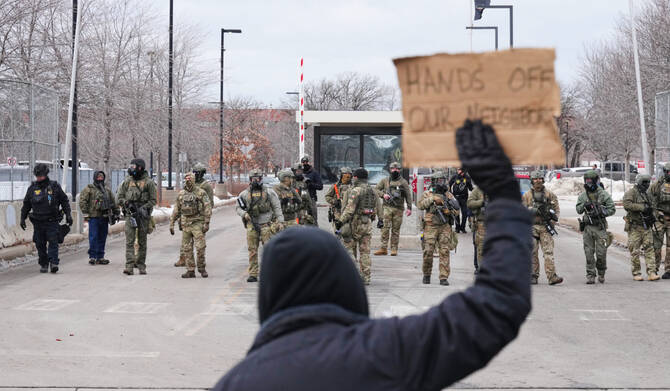
Protesters confront federal immigration officers outside the Bishop Henry Whipple Federal Building, Tuesday, Jan. 13, 2026, in Minneapolis. (AP)
3 / 5
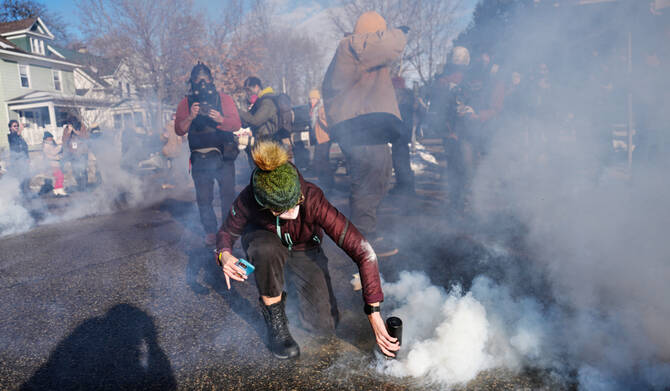
A protester covers a tear gas canister deployed by federal immigration officers near the scene where Renee Good was fatally shot by an ICE officer last week, Tuesday, Jan. 13, 2026, in Minneapolis. (AP)
4 / 5
A man is taken into custody as federal immigration agents clash with residents following a house raid on January 13, 2026 in Minneapolis, Minnesota. (AFP)
5 / 5
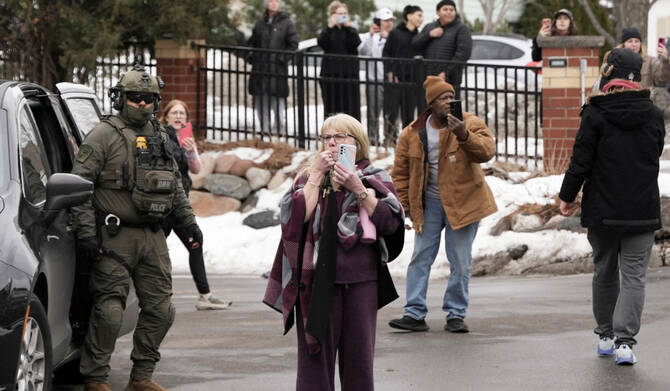
Observers use mobile phones to document, as one of them uses a whistle to alert people of the presence of Border Patrol commander Greg Bovino's convoy at a gas station, days after an ICE agent fatally shot Renee Nicole Good in Minneapolis, in Columbia Heights, Minnesota, U.S., January 13, 2026. (REUTERS)
Short Url
Updated 14 January 2026
Follow

Tensions flare in Minnesota as protesters and federal agents repeatedly square off

  • The Trump administration has repeatedly defended the immigration agent who shot Good, saying he acted in self-defense
  • With the Department of Homeland Security pledging to send more than 2,000 immigration officers into Minnesota, the state, joined by Minneapolis and St. Paul, sued President Donald Trump’s administration Monday to halt or limit the surge

MINNEAPOLIS: Federal officers dropped tear gas and sprayed eye irritant at activists Tuesday during another day of confrontations in Minneapolis while students miles away walked out of a suburban school to protest the Trump administration’s bold immigration sweeps.
The government’s immigration crackdown is next headed to a federal court where Minnesota and two mayors are asking a judge to immediately suspend the operation. No hearing has been set on the request.
Gas clouds filled a Minneapolis street near where Renee Good was fatally shot in the head by an immigration agent last week. A man scrubbed his eyes with snow and screamed for help while agents in an unmarked Jeep sprayed an orange irritant and drove away.
It’s common for people to boo, taunt and blow orange whistles when they spot heavily armed agents passing through in unmarked vehicles or walking the streets, all part of a grassroots effort to warn the neighborhood and remind the government that they’re watching.
“Who doesn’t have a whistle?” a man with a bag of them yelled.
Brita Anderson, who lives nearby and came to support neighborhood friends, said she was “incensed” to see agents in tactical gear and gas masks, and wondered about their purpose.
“It felt like the only reason they’d come here is to harass people,” Anderson said.
Separately, a judge heard arguments and said she would rule by Thursday or Friday on a request to restrict the use of force, such as chemical irritants, on people who are observing and recording agents’ activities. Government attorneys argued that officers are acting within their authority and must protect themselves.
In Brooklyn Park, Minnesota, students protesting the immigration enforcement operation walked out of school, as students in other communities have done this week.
With the Department of Homeland Security pledging to send more than 2,000 immigration officers into Minnesota, the state, joined by Minneapolis and St. Paul, sued President Donald Trump’s administration Monday to halt or limit the surge.
The lawsuit says the Department of Homeland Security is violating the First Amendment and other constitutional protections by focusing on a progressive state that favors Democrats and welcomes immigrants.
“This is, in essence, a federal invasion of the Twin Cities in Minnesota, and it must stop,” state Attorney General Keith Ellison said.
Minneapolis Mayor Jacob Frey said: “What we are seeing is thousands — plural — thousands of federal agents coming into our city. And, yeah, they’re having a tremendous impact on day-to-day life.”
Dozens of protests or vigils have taken place across the US to honor Good since the 37-year-old mother of three was killed.
Homeland Security says it has made more than 2,000 arrests in the state since early December and is vowing to not back down. Spokesperson Tricia McLaughlin, responding to the lawsuit, accused Minnesota officials of ignoring public safety.
“President Trump’s job is to protect the American people and enforce the law — no matter who your mayor, governor, or state attorney general is,” McLaughlin said.
The Trump administration has repeatedly defended the immigration agent who shot Good, saying he acted in self-defense. But that explanation has been widely panned by Frey, Minnesota Gov. Tim Walz and others based on videos of the confrontation.
Two Democratic lawmakers from Massachusetts announced Tuesday they are sponsoring a bill to make it easier for people to sue and overcome immunity protections for federal officers who are accused of violating civil rights. The bill stands little chance of passage in the Republican-controlled Congress.
In Wisconsin, Lt. Gov. Sara Rodriguez is proposing that the state ban civil immigration enforcement around courthouses, hospitals, health clinics, schools, churches and other places. She is hoping to succeed Gov. Tony Evers, a fellow Democrat, who is not running for a third term.
“We can take a look at that, but I think banning things absolutely will ramp up the actions of our folks in Washington, D.C.,” Evers said, referring to the Trump administration. “They don’t tend to approach those things appropriately.”


Guatemalans enter state of siege over surge in gang violence

Updated 2 sec ago
Follow

Guatemalans enter state of siege over surge in gang violence

GUATEMALA CITY: Streets were half-empty Monday in the capital city of Guatemala, where outrage and fear lingered during the first day of the 30-day state of emergency decreed by the government in response to the murder of nine police officers and riots in several prisons.
On Sunday, suspected members of the notorious Barrio 18 gang carried out a wave of attacks on the police after security forces put down a prison mutiny.
Eight officers were killed on Sunday and a ninth died of his injuries on Monday.
President Bernardo Arevalo declared a 30-day emergency on Sunday over the violence, which caused deep shock among Guatemalans.
On Monday, he presided over a memorial ceremony for the slain police officers at the interior ministry.
The streets of the capital Guatemala City were semi-deserted and private schools, courts and universities remained shuttered.
Sitting on a bench in the historic center of Guatemala City, an octogenarian told AFP that he believed the only way to stamp out criminal gangs was by “burning them.”
“A criminal caught, a criminal killed, because there’s no other way...It’s like a tree; if you don’t pull out the roots, it will sprout again,” the man, who gave only his last name, Espana, said.
He called for Guatemala’s government to emulate the iron-fisted policies of President Nayib Bukele of neighboring El Salvador.
Bukele has imprisoned tens of thousands of men without charge, as part of a war on gangs which has led to a sharp drop in El Salvador’s murder rate but caused an outcry over human rights abuses.
Alejandra Donis, a 30-year-old shopkeeper, also held Bukele up as an example of leadership.
“There was a point in El Salvador where it was scary to just go out, right? And now it’s a place that’s quite touristy; you can go there, and it feels peaceful,” she said.

- ‘The Wolf’ -

The unrest in Guatemala began when inmates at three prisons took 45 guards and a psychiatrist hostage on Saturday to demand gang leaders be transferred from a maximum-security prison to more lenient facilities.
On Sunday, the police and army stormed all three penitentiaries and restored control.
After the first prison raid, the interior ministry published a video on X showing officers handcuffing and leading away Barrio 18’s alleged leader in Guatemala, whom authorities identified as Aldo Dupie, alias “El Lobo” (The Wolf).
In response to the crackdown, gang members attacked police stations and patrols.
The coffins of the slain police officers were draped in Guatemalan blue-and-white flags at the interior ministry and flanked by colleagues in uniform, standing to attention.
Arevalo, dressed in a black suit, greeted the grieving relatives, hugging some.

- FBI help sought -

Barrio 18 and the rival gang Mara Salvatrucha (MS-13) are blamed for much of the drug trafficking and criminal violence that plague Central America.
Washington has declared both to be terrorist organizations.
Arevalo said the declared state of emergency would allow the police and army to act against organized crime, but soldiers remained in their barracks on Monday, awaiting orders.
Since mid-2025, gang members have staged several uprisings in Guatemalan prisons to demand their leaders be held in less restrictive conditions.
In October, 20 leaders of Barrio 18 escaped from prison.
Only six have been recaptured, while another was shot and killed.
The government at the time asked for the help of the FBI to track down the remaining escapees.
Across Latin America, gang members continue to run criminal enterprises, from drug trafficking rings to extortion rackets, from behind bars — often with the collusion of corrupt prison officials.