

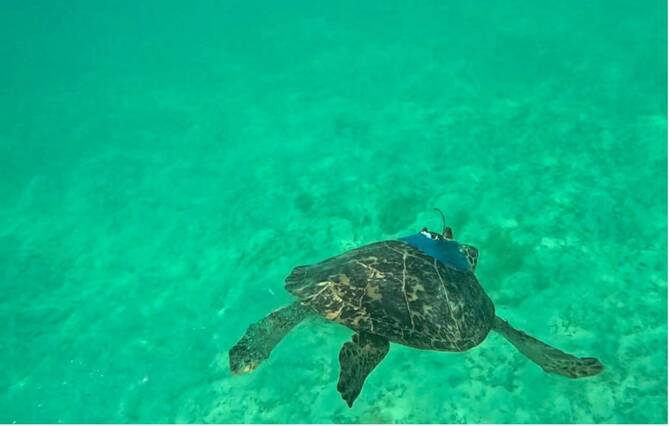

JEDDAH: Hawksbill turtles are among the world’s most endangered marine species and are listed as Critically Endangered by the International Union for Conservation of Nature.
Their populations have plummeted due to hunting for their shells and mounting pressures from climate change, pollution, fishing activities, and coastal development. Effective protection depends on understanding where these turtles feed, nest, and migrate.
In response, Saudi Arabia has intensified conservation efforts. In 2021, the government established the General Organization for the Conservation of Coral Reefs and Turtles in the Red Sea, known as SHAMS. The organization is mandated to protect, manage, and sustain coral reef ecosystems and marine turtle populations, including their nesting sites along the Red Sea coastline.
FASTFACT
Did you know?
- The Prince Mohammed bin Salman Royal Reserve is home to five of the world’s seven sea turtle species.
- Sea turtles return to the very beaches where they hatched to lay their eggs - a remarkable behavior known as natal homing.
- All marine turtle species found in the Red Sea are protected under the Convention on Migratory Species.
- Hawksbill turtles can spend decades traveling the oceans before returning to their nesting sites.
The Red Sea’s distinctive hydrology and relative isolation make it a globally significant biodiversity hotspot. Five of the world’s seven sea turtle species — green, loggerhead, olive ridley, hawksbill, and leatherback — use its waters.
Hawksbill and green turtles face persistent threats, including bycatch in fishing gear, direct harvesting of turtles and their eggs for meat and shells, illegal wildlife trade, and the loss or degradation of nesting and foraging habitats driven by coastal development, pollution, and climate change.
Additional risks include predation of eggs and hatchlings by native and invasive species, vessel strikes, and entanglement in or ingestion of marine debris.
Environmental change compounds these pressures. Rising sand and sea temperatures, sea-level rise, and increasingly intense storms affect hatchling survival, nesting success, and the availability of suitable habitats, posing long-term challenges to turtle populations.
Against this backdrop, the Prince Mohammed bin Salman Royal Reserve launched a live satellite tracking program for hawksbill and green turtles in December 2025, marking a milestone for marine conservation in the region.
The initiative includes the first known tagging of a pre-nesting, egg-carrying green turtle in the Red Sea. The resulting data will address a critical regional knowledge gap and support coordinated, cross-border conservation strategies for globally endangered turtle species.

Led by Dr. Ahmed Mohammed, a senior marine ecologist at the reserve, in collaboration with Dr. Hector Barrios-Garrido, a senior marine megafauna specialist with KAUST Beacon Development, the program successfully captured and tagged three critically endangered hawksbill turtles and seven green turtles.
The satellite tags transmit real-time movement data, identifying foraging areas, migratory corridors, and the nesting site of the egg-carrying green turtle, enabling targeted protection and management.
The initiative builds on the reserve’s long-term commitment to marine conservation, including turtle nest monitoring and protection programs launched in 2023.
The reserve safeguards 4,000 sq. km of Red Sea waters -1.8 percent of Saudi Arabia’s marine area - and manages 170 km of coastline, the longest stretch overseen by a single entity in the Kingdom.
Together with Neom and the Red Sea Global, this creates an 800-km corridor of protected coastline.

Prince Mohammed bin Salman Royal Reserve female sea rangers record a turtle sighting. (SUPPLIED)
The area serves as a refuge for five of the world’s seven turtle species and as a breeding ground for green and hawksbill turtles.
Ranger teams monitor turtle activity both onshore and at sea, protecting nesting sites essential to natal homing, the instinct that draws turtles back to the beaches where they were born.
Andrew Zaloumis, CEO of the reserve, told Arab News that tagging a pre-nesting, egg-carrying green turtle offers rare insight into the most critical phase of a turtle’s reproductive cycle.

A Green turtle’s data is recorded by the Reserve’s marine team. (SUPPLIED)
“It enables tracking immediately before and after nesting, revealing the staging areas she relies on for feeding and recovery. These often-overlooked habitats are essential for successful reproduction and need identification, monitoring, and protection. Understanding her movements ensures that nesting beaches and staging habitats are safeguarded at the right time, optimizing breeding success, whether within the reserve or elsewhere in the Red Sea.”
Live satellite tracking also sheds light on how turtles navigate vast distances across the Red Sea. Although sea turtles are nomadic, they follow instinct-driven migrations between feeding grounds, breeding areas, and natal nesting beaches, guided by the Earth’s magnetic field and ocean currents.
“Satellite tracking reveals their critical corridors, feeding, and staging areas needed to secure species survival,” Zaloumis said. “This data enables practical conservation, including creating vessel-free or low-speed zones, adjusting shipping lanes seasonally, protecting key habitats, and managing light pollution during nesting and hatching periods. Understanding these turtles’ movements informs conservation strategies at the Reserve, national, and international levels.”
Real-time tracking data helps translate scientific research into tangible conservation action. Sea turtles have a complex life cycle that spans both land and ocean. Females lay eggs on sandy beaches, where warmth from the sun incubates them over several months. Hatchlings then emerge and instinctively move toward the sea, beginning an early-life oceanic phase often described as the “lost years.”

A satellite tagged adult female Hawksbill turtle is returned to the Red Sea. (Supplied)
“We cannot effectively protect what we do not know,” Zaloumis said. “Real-time data accelerates conservation from observation to evidence-based action. Instead of waiting months or years to analyze stored data, scientists and managers can respond immediately to unusual behaviors.
For example, an unexplained shift in a turtle’s migratory route across a shipping lane, or an unexpected stationary turtle, may indicate a need for rapid intervention by sea rangers,” he added.
“Smarter science also delivers greater impact in a financially stretched conservation sector. Knowing where turtles are allows patrols, zoning measures, and awareness programs to be deployed efficiently, resulting in stronger protection outcomes and more sustainable use of conservation resources.”
Because turtles routinely travel thousands of kilometers each year — feeding in one country’s waters and nesting in another — effective conservation requires international cooperation.
All five turtle species in the Red Sea cross multiple jurisdictions, oblivious to political boundaries.
“Red Sea countries such as Saudi Arabia, Egypt, Sudan, Yemen, and Jordan are signatories to the Convention on the Conservation of Migratory Species of Wild Animals, acknowledging that conservation must extend beyond borders.
Holistic management requires shared data, aligned policies, unified plans, and coordinated action, which is why the reserve is committed to open collaboration and data sharing with regional partners and the global conservation community,” Zaloumis said.
Green turtles also play a crucial role as sentinel species for marine ecosystems. Often described as “ocean lawnmowers,” they graze on seagrass meadows, indirectly guiding scientists to these habitats.


“With satellite tracking, they can reveal previously unknown seagrass ecosystems, including deepwater meadows at 30–50 meters, which then require follow-up surveys using remotely operated vehicles,” Zaloumis said.
Mapping these ecosystems highlights their importance for turtles and dugongs, as well as their role in carbon sequestration. Seagrass meadows are among the most effective blue carbon sinks on the planet, making turtle tracking a valuable tool for protecting biodiversity and enhancing climate resilience.
Tagging and monitoring turtles also underscores the Red Sea’s ecological connectivity, linking seagrass meadows, coral reefs, and migratory routes into a single, living system. This understanding supports adaptive, evidence-based conservation at national, regional, and global levels.
“By providing access to real-time data, the Reserve allows other agencies to enhance management effectiveness, improve Red Sea-wide ecosystem alignment, and support turtle population recovery across the region, securing a sustainable future for both turtles and the Red Sea as a shared, living ecosystem,” Zaloumis said.


