

‘We can’t make ends meet’: civil servants protest in Ankara

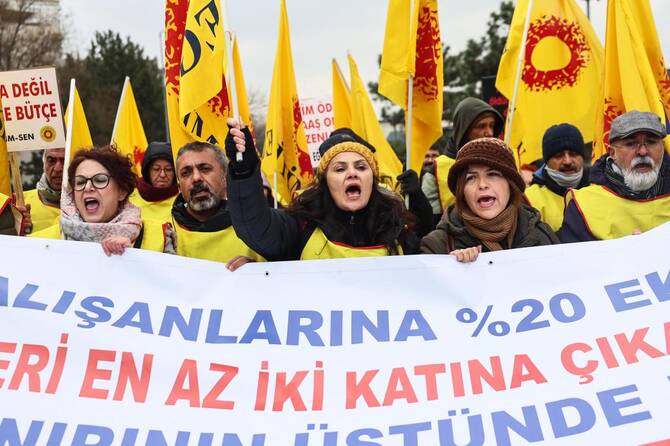
Protesters chant slogans and hold placards and banners reading “20 percent extra increase now!” as they take part in a demonstration called by Turkish Unions to protest against inadequate pay rises, near the Ministry of Labour and Social Affairs in Ankara, on Jan. 14, 2026. (AFP)
Short Url
Updated 14 January 2026
Follow

‘We can’t make ends meet’: civil servants protest in Ankara

  • Some 800 civil servants from the Confederation of Public Employees’ Unions joined a march to the labor ministry
  • “The increase in rents is almost three times higher than the pay rise we received,” Kocak told demonstrators

ANKARA: Hundreds of angry civil servants marched through Ankara Wednesday demanding a realistic pay rise as they battle poverty amid the soaring prices and double-digit inflation.
Some 800 civil servants from the Confederation of Public Employees’ Unions (KESK) joined a march to the labor ministry in the Turkish capital, carrying banners demanding an immediate pay rise.
“The increase in rents is almost three times higher than the pay rise we received, meaning our salaries are not even enough to cover the rent increases alone,” Ayfer Kocak, KESK’s co-chair, told demonstrators outside the ministry.
“We are experiencing growing poverty and insecurity.”
Turkiye’s annual inflation rate fell to 30.89 percent in December from 44.38 percent a year earlier, official figures showed, but independent economists and unions say real numbers remain much higher.
According to December figures released by the Confederation of Turkish Trade Unions (TURK-IS), the absolute minimum needed to feed a family of four was just over 30,000 liras ($690).
At the same time, Turkiye’s poverty threshold — the sum required to cover the basic needs for a family of that size — had risen to 98,000 liras ($2,270), it said.
Food inflation approached 43 percent annually, it added.

- ‘We can’t make ends meet’ -

“The government is condemning civil servants to live in degrading conditions by relying on misleading data” from the official statistics agency TUIK, Tulay Yildirim, head of a local teachers’ union branch, told AFP.
“We workers’ voices to be heard, saying we can no longer make ends meet and want to receive our fair share of a budget created through taxes paid by all citizens,” she added.
Earlier this month, public sector wages were hiked by 18.6 percent for the next six months, an increase unions said was insufficient.
“There are not only workers here, but also pensioners. The salary increase granted falls below the poverty line,” said Osman Seheri, head of a local branch of the municipal workers’ union.
“We cannot even afford proper clothes to go to work, let alone a suit and tie. With such wages, it is impossible to live in a major city.”
According to the independent Inflation Research Group (ENAG), which challenges the official data, annual inflation in Turkiye reached 56.14 percent in December 2025, with prices rising 2.11 percent in December alone.


Lebanese finance minister denies any plans for a Kushner-run economic zone in the south

Updated 5 sec ago
Follow

Lebanese finance minister denies any plans for a Kushner-run economic zone in the south

  • Proposal was made by US Envoy Morgan Ortagus but was ‘killed on the spot’
  • Priority is to regain control of state in all aspects, Yassine Jaber tells Arab News

DAVOS: Lebanon’s finance minister dismissed any plans of turning Lebanon’s battered southern region into an economic zone, telling Arab News on the sidelines of the World Economic Forum’s meeting in Davos that the proposal had died “on the spot.”

Yassine Jaber explained that US Envoy to Lebanon Morgan Ortagus had proposed the idea for the region, which has faced daily airstrikes by Israel, and it was immediately dismissed.

Jaber’s comments, made to Arab News on the sidelines of the World Economic Forum in Davos, were in response to reports which appeared in Lebanese media in December which suggested that parts of southern Lebanon would be turned into an economic zone, managed by a plan proposed by Jared Kushner, US President Donald Trump’s son in law.

Meanwhile, Jaber also dismissed information which had surfaced in Davos over the past two days of a bilateral meeting between Lebanese ministers, US Middle East Envoy Steve Witkoff and Kushner.

Jaber said that the meeting on Tuesday was a gathering of “all Arab ministers of finance and foreign affairs, where they (Witkoff and Kushner) came in for a small while, and explained to the audience the idea about deciding the board of peace for Gaza.”

He stressed that it did not develop beyond that.

When asked about attracting investment and boosting the economy, Jaber said: “The reality now is that we need to reach the situation where there is stability that will allow the Lebanese army, so the (Israeli) aggression has to stop.”

Over the past few years, Lebanon has witnessed one catastrophe after another: one of the world’s worst economic meltdowns, the largest non-nuclear explosion in its capital’s port, a paralyzed parliament and a war with Israel.

A formal mechanism was put in place between Lebanon and Israel to maintain a ceasefire and the plan to disarm Hezbollah in areas below the Litani river.

But, the minister said, Israel’s next step is not always so predictable.

“They’re actually putting pressure on the whole region. So, a lot of effort is being put on that issue,” he added.

“There are still attacks in the south of the country also, so stability is a top necessity that will really succeed in pushing the economy forward and making the reforms beneficial,” he said.

Lawmakers had also enacted reforms to overhaul the banking sector, curb the cash economy and abolish bank secrecy, alongside a bank resolution framework.

Jaber also stressed that the government had recently passed a “gap law” intended to help depositors recover funds and restore the banking system’s functionality.

“One of the priorities we have is really to deal with all the losses of the war, basically reconstruction … and we have started to get loans for reconstructing the destroyed infrastructure in the attacked areas.”

As Hezbollah was battered during the war, Lebanon had a political breakthrough as the army’s general, Joseph Aoun, was inaugurated as president. His chosen prime minister was the former president of the International Court of Justice, Nawaf Salam.

This year marks the first time a solid delegation from the country makes its way to Davos, with Salam being joined by Jaber, Economy and Trade Minister Amr Bisat, and Telecoms Minister Charles Al-Hage.

“Our priority is to really regain the role of the state in all aspects, and specifically in rebuilding the institutions,” Jaber said.