

Le Pen appeal trial opens with French presidential bid at stake

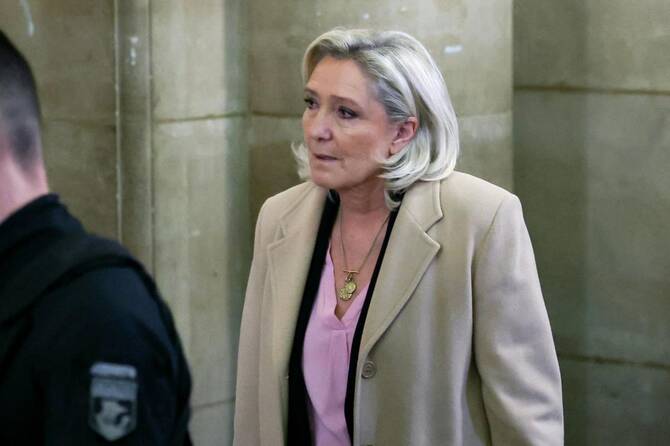
President of the parliamentary group of the French far-right Rassemblement National (RN) party, Marine Le Pen arrives for a hearing in her appeal trial on suspicion of embezzlement of European public funds, at Paris courthouse, on Jan. 13, 2026. (AFP)
Short Url
Updated 13 January 2026
Follow

Le Pen appeal trial opens with French presidential bid at stake

  • Le Pen, 57 entered the packed courtroom on Tuesday afternoon flanked by two lawyers
  • If the court upholds the first ruling, Le Pen will be barred from running in the 2027 election

PARIS: The appeal trial of Marine Le Pen opened Tuesday, with the French far-right leader hoping to overthrow a graft conviction and save her 2027 run for president.
The appeal comes after a French court last year barred her from running for office for five years over a European Parliament fake jobs scam involving her and other officials from her National Rally party.
The three-time presidential candidate was also handed a four-year prison sentence, with two years suspended, and fined 100,000 euros ($116,000).
Le Pen, 57, who has always maintained her innocence, entered the packed courtroom on Tuesday afternoon flanked by two lawyers, in the hopes of clearing the way for a fourth bid to become president.
If the court upholds the first ruling, Le Pen will be barred from running in the 2027 election, widely seen as her best — and possibly last — chance to win the country’s top job.
She again risks the maximum sentence — 10 years in prison and a one-million-euro ($1.16 million) fine — if the appeal fails.
She could, however, still be a candidate if she is sentenced to a shorter ban and no time to serve under house arrest.
Earlier on Tuesday, Le Pen said she was hopeful the court would listen to her side of the story.
The hearing is expected to last a month, with a decision expected this summer.
Twelve of the accused, as well as the far-right party itself, have appealed against the verdict.
Another 12 people — including one of Le Pen’s sisters — have decided to accept their convictions without appealing. Another person sentenced has since died.

- Risk of reoffending -

The initial verdict dealt a heavy blow to Le Pen and the RN, which has surged in French politics in recent years.
The court found her guilty — along with 24 former European Parliament lawmakers, assistants and accountants as well as the party itself — of operating a “system” from 2004 to 2016 using European Parliament funds to employ RN staff in France.
Le Pen walked out of the courtroom during the sentencing, later slamming the verdict as a “political decision.”
The judges defended the decision to bar her from running, saying elected officials should not benefit from “preferential treatment” and citing the risk of reoffending.
The news sparked shock among Le Pen supporters in France, while the US President Donald Trump and the Kremlin expressed concern.
Former Trump adviser Steve Bannon said last week he hoped Le Pen could run for president despite her legal troubles so her election could help “break” the European Union.

- Bardella in the wings -

Le Pen took over the former National Front (FN) from her father Jean-Marie Le Pen in 2011 and has since sought to clean up the party’s image.
Her father, who died in January, was often accused of making racist and antisemitic comments.
After coming third in the 2012 presidential polls, Marine Le Pen made the run-off in 2017 and 2022 but was beaten by Emmanuel Macron on both occasions.
Yet 2027 could see a different outcome for the far right, with Macron barred from standing again under France’s constitution.
Some 42 percent of French people said they agreed with “ideas defended by the RN,” up from 29 percent before the 2022 vote, according to a poll by consultancy firm Verian for Le Monde published on Sunday.
If she cannot be a candidate, Le Pen has said her top lieutenant Jordan Bardella — the RN party’s president who is not a defendant in the trial — can run in her place.
“Bardella can win instead of me,” Le Pen said in December.
A poll in November predicted that Bardella would win the second round of the 2027 elections, no matter who stands against him.
But Bardella said on Monday that a ruling preventing Le Pen from running “would be deeply worrying for democracy” and insisted he was not so far a candidate for president but prime minister.


94 million need cataract surgery, but access lacking: WHO

A Somali patient undergoes free cataract surgery at Al Nuur eye Hospital in Mogadishu, on February 16, 2015. (AFP)
Updated 11 February 2026
Follow

94 million need cataract surgery, but access lacking: WHO

  • Of the 94 million affected, fewer than 20 percent are blind, while the rest suffer from impaired vision

GENEVA: More than 94 million people suffer from cataracts, but half of them do not have access to the surgery needed to fix it, the World Health Organization said Wednesday.
Cataracts — the clouding of the eye’s lens that causes blurred vision and can lead to blindness — are on the rise as populations get older, with age being the main risk factor.
“Cataract surgery — a simple, 15-minute procedure — is one of the most cost-effective medical procedures, providing immediate and lasting restoration of sight,” the WHO said.
It is one of the most frequently performed surgeries undertaken in high-income countries.
However, “half of the world’s population in need of cataract surgery don’t have access to it,” said Stuart Keel, the UN health agency’s technical lead for eye care.
The situation is worst in the WHO’s Africa region, where three in four people needing cataract surgery remain untreated.
In Kenya, at the current rate, 77 percent of people needing cataract surgery are likely to die with their cataract blindness or vision impairment, said Keel.
Across all regions, women consistently experience lower access to care than men.
Of the 94 million affected, fewer than 20 percent are blind, while the rest suffer from impaired vision.

- 2030 vision -

The WHO said that over the past two decades, global cataract surgery coverage had increased by 15 percent.

In 2021, WHO member states set a target of a 30-percent increase by 2030.
However, current modelling predicts that cataract surgery coverage will rise by only about 8.4 percent this decade.
To close the gap, the WHO urged countries to integrate eye examinations into primary health care and invest in the required surgical equipment.
States should also expand the eye-care workforce, training surgeons in a standardised manner and then distributing them throughout the country, notably outside major cities.
The WHO was on Wednesday launching new guidance for countries on how to provide quality cataract surgery services.
It will also issue guidance to help support workforce development.
Keel said the main issue was capacity and financing.
“We do need money invested to get rid of this backlog, which is nearly 100 million people,” he told a press conference.
While age is the primary risk factor for cataracts, others include prolonged UV-B light exposure, tobacco use, prolonged corticosteroid use and diabetes.
Keel urged people to keep up regular eye checks as they get older, with most problems able to be either prevented or diagnosed and treated.
The cost of the new lens that goes inside the eye can be under $100.
However, out-of-pocket costs can be higher when not covered by health insurance.
“Cataract surgery is one of the most powerful tools we have to restore vision and transform lives,” said Devora Kestel, head of the WHO’s noncommunicable diseases and mental health department.
“When people regain their sight, they regain independence, dignity, and opportunity.”