

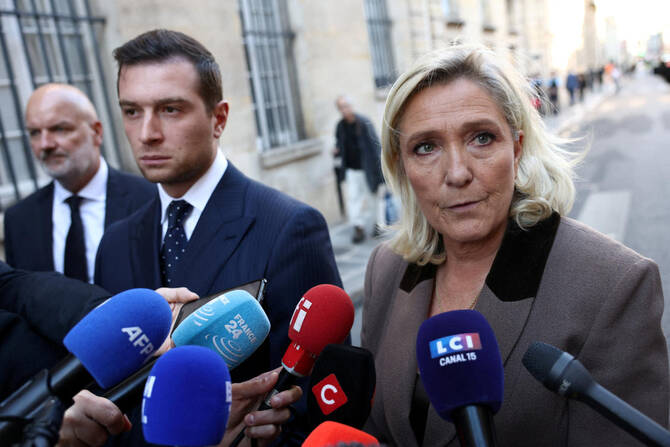

PARIS: Far-right leader Marine Le Pen, who needs to have a graft conviction overturned to seize her best chance at the French presidency, risks seeing her life’s work upended if she loses her appeal.
Le Pen took over leadership of the National Front (FN) in 2011 from her father Jean-Marie, who co-founded France’s main postwar far-right movement.
In a move to distance it from the legacy of her father, who openly made antisemitic and racist statements, she renamed the party the National Rally (RN) and embarked on a policy she dubbed “de-demonization.”
The work bore fruit. In snap legislative polls in summer 2023, the RN emerged as the largest single party in the National Assembly — although without the outright majority it had targeted.
That gave Le Pen’s party power over French politics it had never before enjoyed, which she used by backing a no-confidence vote that toppled the government of prime minister Michel Barnier later in the year.
Critics accuse the party of still being inherently racist, taking too long to distance itself from Russia after its invasion of Ukraine and resorting to corrupt tactics to ease its strained finances, allegations Le Pen denies.
But by playing on people’s day-to-day concerns about immigration and the cost of living, Le Pen was seen as having her best chance to become France’s president in 2027 after three unsuccessful attempts.
- ‘Political target’ -
But her conviction last year, involving the use of fake jobs at the European Union parliament to channel funds to her party to employ people in France, has posed a potentially insurmountable hurdle to her long-sought end goal.
She was banned with immediate effect from standing for office for five years, which effectively disqualified her from running in next year’s presidential election.
Le Pen, 57, has said prosecutors wanted her “political death,” adding that she was being put on trial as a “political target.”
With her own ambitions hanging in the balance, she has backed her young lieutenant and protege, 30-year-old Jordan Bardella, to run in her place if needed.
“Bardella can win instead of me,” she told La Tribune Dimanche in December.
A poll in November predicted that Bardella — who is the RN party chief and not among those accused in the trial against Le Pen — would win the second round of the 2027 elections, no matter who stands against him.
- ‘Immense pain’ -
After coming third in the 2012 presidential polls, Marine Le Pen made the run-off in 2017 and 2022 but was beaten by Emmanuel Macron on both occasions.
Yet 2027 could be different, with Macron not allowed to stand again under France’s constitution.
Le Pen’s life has been marked by the legacy of her outwardly racist father, a veteran of the long war in Algeria that ultimately led to the former French colony’s independence.
She expelled her father, who once called the gas chambers of the Holocaust a “detail of history,” from the party in 2011, helping to temper its toxic image.
But his death last year aged 96 plunged his daughter into grief.
“I will never forgive myself” for expelling him, she said, describing him as a “warrior” in a tribute.
“I know it caused him immense pain,” she said of the man opponents nicknamed “the devil of the republic.”
“This decision was one of the most difficult of my life. And until the end of my life, I will always ask myself the question: ‘Could I have done this differently?’,” she said.


