

Palestinian shot dead in Hebron

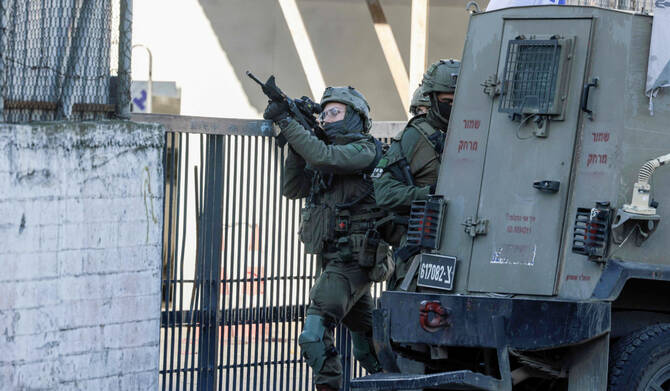
Israeli soldiers take positions during a military operation, around the old city of the Israeli-occupied northern West Bank city of Nablus on January 11, 2026. (AFP)
Short Url
Updated 11 January 2026
Follow

Palestinian shot dead in Hebron

  • Bedouin families continue flee West Bank village due to harassment by settlers living in illegal outposts

RAMALLAH: Palestinian health officials said on Sunday that Israeli forces shot dead a Palestinian man in the occupied West Bank city of Hebron, an incident the Israeli military said it was reviewing.
The Health Ministry in Ramallah said the Palestinian body that coordinates with Israeli authorities had informed it that Israeli fire had killed Shaker Falah Ahmad Al-Jaabari, 58, on Saturday evening.
The ministry said Israeli forces were still holding Al-Jaabari’s body.
Late on Saturday, the Israeli military said its troops had responded to a “threat and opened fire at the terrorist who attempted to run them over.
Hours later, however, the military said in a separate statement that investigators had found “no conclusive findings (to) indicate that the incident constituted an intentional terror attack,” adding the case remained under investigation.
Violence has surged across the West Bank since the war in Gaza broke out in October 2023 after an unprecedented attack by Hamas on Israel.
At least 1,029 Palestinians have been killed in the West Bank by Israeli forces or settlers since the war started, according to the Palestinian Health Ministry.
Some 500,000 Israelis have settled in the West Bank since Israel captured the territory, along with East Jerusalem and the Gaza Strip, in the 1967 Mideast war. 
Their presence is viewed by most of the international community as illegal and a major obstacle to peace. 
The Palestinians seek all three areas for a future state.
Over two dozen families from one of the few remaining Palestinian Bedouin villages in the central West Bank have packed up and fled their homes in recent days, saying harassment by Jewish settlers living in unauthorized outposts nearby has grown unbearable.
The village, Ras Ein El-Auja, was originally home to some 700 people from more than 100 families that have lived there for decades.
Twenty-six families already left on Thursday, scattering across the territory in search of safer ground, rights groups say. Several other families were packing up and leaving on Sunday.
“We have been suffering greatly from the settlers. Every day, they come on foot, or on tractors, or on horseback with their sheep into our homes. They enter people’s homes daily,” said Nayef Zayed, a resident, as neighbors took down sheep pens and tin structures.
Other residents pledged to stay put for the time being. That makes them some of the last Palestinians left in the area, said Sarit Michaeli, international director at B’Tselem, an Israeli rights group helping the residents.
She said that mounting settler violence has already emptied neighboring Palestinian hamlets in the dusty corridor of land stretching from Ramallah in the West to Jericho, along the Jordanian border, in the east.
The area is part of the 60 percent of the West Bank that has remained under full Israeli control under the interim peace accords signed in the 1990s. 
Since October 2023, over 2,000 Palestinians — at least 44 entire communities — have been expelled by settler violence in the area, B’Tselem says.
The turning point for the village came in December, when settlers put up an outpost about 50 meters (yards) from Palestinian homes on the northwestern flank of the village, said Michaeli and Sam Stein, an activist who has been living in the village for a month.
Settlers strolled easily through the village at night. Sheep and laundry went missing. International activists had to begin escorting children to school to keep them safe.
“The settlers attack us day and night, they have displaced us, they harass us in every way,” said Eyad Isaac, another resident. 
“They intimidate the children and women.”
Michaeli said she has witnessed settlers walk around the village at night, going into homes to film women and children and tampering with the village’s electricity.
The residents said they call the police frequently to ask for help — but it seldom arrives. 
Settlement expansion has been promoted by successive Israeli governments over nearly six decades. 
But Benjamin Netanyahu’s far-right government, which has placed settler leaders in senior positions, has made it a top priority.
That growth has been accompanied by a spike in settler violence, much of it carried out by residents of unauthorized outposts. 
These outposts often begin with small farms or shepherding that are used to seize land, say Palestinians and anti-settlement activists. 
UN officials warn the trend is changing the map of the West Bank, entrenching Israeli presence in the area.
For now, displaced families from the village have dispersed to other villages near the city of Jericho and Hebron, further south, residents said. 
Some sold their sheep and are trying to move into the cities.
Others are just dismantling their structures without knowing where to go.
“Where will we go? There’s nowhere. We’re scattered,” said Zayed, the resident, “People’s situation is bad. Very bad.”


A father awaits Rafah crossing reopening after 2-year separation from family in Gaza

Updated 4 sec ago
Follow

A father awaits Rafah crossing reopening after 2-year separation from family in Gaza

  • Belal, 51, has packed his suitcases, bought gifts for his children, and is ready to go as soon as he is allowed
  • Gaza has been closed to entry for Palestinians since Israel launched its retaliatory campaign against Hamas for its Oct. 7, 2023, attack on southern Israel

BADRASHIN, Egypt: Stranded in Egypt for the past two years, Raed Belal has had to watch helplessly as his wife and children in the Gaza Strip endured bombardment, displacement and hunger. Now he finally has hope he might return to them.
With Israel preparing to reopen the vital Rafah crossing between Egypt and Gaza, Belal, 51, has packed his suitcases, bought gifts for his children, and is ready to go as soon as he is allowed.
“It’s the moment I have been waiting for,” he said, speaking at the rented apartment where he has been living in the Egyptian village of Badrashin. “The moment when I reunite with my children, when I return to my home and homeland, even if everything is destroyed.”
Belal, who left Gaza to get treated for back pain three months before the war broke out, is one of tens of thousands of Palestinians eager to return to the territory, despite the vast destruction wreaked by Israel’s military campaign against Hamas. The Rafah border crossing is expected to reopen within days, a process jump-started by Israel’s recovery on Monday of the last hostage’s remains in Gaza, where a ceasefire with Hamas has held for four months.
Gaza has been closed to entry for Palestinians since Israel launched its retaliatory campaign against Hamas for its Oct. 7, 2023, attack on southern Israel. In the first months of the war, some 110,000 Palestinians were able to leave Gaza. The Rafah crossing was completely closed in May 2024 when Israeli troops took it over.
Since then, people like Belal have been trapped abroad – most of them in Egypt. Many feared Israel would never allow them back to Gaza.
A ‘limited opening’ of the Rafah crossing
Still, Palestinians will likely face a long wait before going home even after Rafah reopens. Israel intends to keep returns to a trickle.
The exact date of Rafah’s reopening has not been announced. Israeli Prime Minister Benjamin Netanyahu on Tuesday called it a “limited opening,” saying 50 Palestinians a day would be allowed into Gaza and that Israel will keep tight control over who enters, subject to security inspections. Before the war, several hundred people a day would enter Gaza from Egypt.
So far, some 30,000 Palestinians have registered with the Palestinian Embassy in Egypt to return to Gaza, according to an embassy official, speaking on condition of anonymity because details of the reopening remain under discussion.
Hamas in a statement Monday called on Israel to open the Rafah crossing in both directions “without restrictions.” Ali Shaath, head of the new Palestinian committee administering Gaza’s daily affairs, last week said the crossing would be opened this week to facilitate movement into and out of the territory.
Palestinians are also hoping that the crossing’s reopening will mean medical evacuations out of Gaza will increase. Some 20,000 Palestinians needing urgent treatment abroad for war wounds or chronic medical conditions have been waiting for evacuation, according to the Gaza Health Ministry.
Throughout the war, the numbers allowed out have been low. The ceasefire since October brought only a tiny uptick, with an average of only 25 medical evacuations a week, according to UN figures.
Watching his family’s trauma from afar
Belal, who owned a mobile phone store in the northern Gaza town of Beit Lahiya, left the territory in July 2023 to get treatment for his back. Weeks later, Hamas launched its attack on Israel, Israel’s massive bombardment of Gaza began, and Gaza’s borders slammed shut.
Belal was stranded, struggling to keep up with the turmoil that had enveloped his loved ones.
A few days into the war, he got a video call from his sons, who were rushing to move the merchandise out of the shop after they got a warning from the Israeli military that it was about to bomb the building, where both the shop and their family home was located.
The strike demolished the building, and Belal’s 15-year-old son Younis was wounded in the back, he said. At first, doctors said he might be paralyzed, but after months of treatment he was able to walk again.
That began a long trek for his wife and children, who were displaced 12 times over the course of the war. They first moved to a neighbor’s house, but that was bombed the next day. They sheltered for several weeks along with other displaced families in the nearby Indonesian Hospital, until Israeli forces besieged and raided the facility, forcing them to flee again in November 2023.
They eventually made it to a school-turned-shelter in the southern city of Khan Younis, but soon after Israeli forces invaded the area and they had to move again.
Sometimes, Belal spent days unable to reach his family because of communication blackouts.
One of his brothers, Mohammed, was killed along with his 2-year-old child when Israel bombed the school where they were sheltering in the Shati Refugee camp in northern Gaza in mid-2025.
At one point last year, Belal got a phone call from Gaza City’s Shifa Hospital telling him that his son Younis had been killed. They sent him a photo of the body of someone who looked like Younis. He couldn’t reach his family, and it was only after a day of torment that he was able to call them and learned it was a case of mistaken identity.
“Being far away, while your children and family were in such a situation is awful. You live in constant fear; you don’t eat because you’re thinking about your hungry children,” Belal said. “Sometimes you wake up at night, terrified. You rush to the phone and call them to make sure that they are OK.”
A family reunion that can’t come soon enough
Belal’s wife and five children now shelter in a tent in Gaza City, depending on charity kitchens for food. Belal has been sending them money when he can, but his wife, Asmahan, told the AP their savings have almost run out and they’ve had to borrow money from others to get by.
Asmahan said she has had to bear the burden of moving from place to place and keeping her children fed and safe.
“I’m mentally exhausted. The responsibility is immense,” she said. “We have been humiliated and degraded.”
“God willing, the crossing will open, my husband will return, and we will be reunited,” she said.
Belal’s brother, Jaber, left Gaza on Oct. 1, 2023, seeking a job in the West Bank. After the war began, Israel launched a crackdown in the occupied territory, carrying out destructive raids targeting armed groups and imposing tough restrictions on movement.
“Life became impossible in the West Bank,” Jabel said. So in February he joined his brother in Egypt, and he married an Egyptian woman in June. He, too, has registered to return to Gaza with his wife.
“This is our land. Our house is there, even though it’s destroyed. We will rebuild it and rebuild Gaza,” Jaber said.
Raed Belal knows it may still be a long time. After news of Rafah’s opening came, he said, his children “think it will happen tomorrow.” But it could be months, he said, before he presents the gifts he has bought for his children – shoes and clothes for his teenage sons, and makeup and perfume requested by his 8-year-old daughter.
With his bags packed, he is ready.