

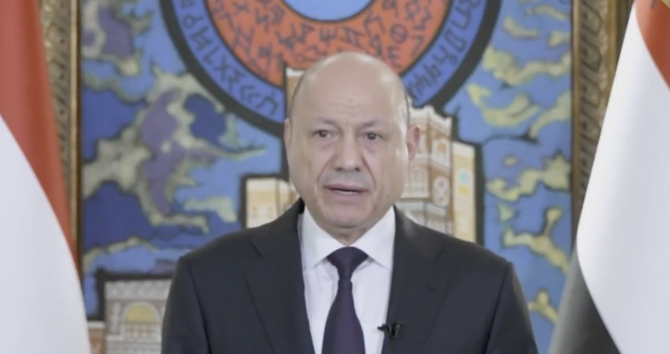
Yemen president announces formation of Supreme Military Committee, thanks Saudi Arabia for support

Short Url
Updated 11 January 2026
Follow

Yemen president announces formation of Supreme Military Committee, thanks Saudi Arabia for support

  • Committee tasked with overseeing and preparing all military forces for next phase of Yemeni conflict
  • Yemeni leader praises Saudi Arabia for ‘sincere brotherly role’ in supporting Yemen’s unity, legitimacy and stability

ADEN: Yemen’s Presidential Leadership Council announced on Saturday the formation of a Supreme Military Committee.

The committee will be tasked with overseeing and preparing all military forces for the next phase of the Yemeni conflict, as government-aligned forces secured control of key camps across the country, said council president Rashad Al-Alimi.a

In a televised address on Saturday, Al-Alimi said the committee, operating under the leadership of the Coalition to Support Legitimacy, will also be responsible for equipping, organizing and leading all military formations, and readying them in case the Houthi militias reject peaceful solutions.

The Yemeni leader praised Saudi Arabia for its “sincere brotherly role” in supporting Yemen’s unity, legitimacy and stability, describing the Kingdom’s backing as a lasting and responsible partnership for Yemen and the wider region.

Al-Alimi said government forces had successfully taken over camps in Hadramout, Al-Mahra, the temporary capital Aden and other liberated governorates, calling on Yemenis to unite behind efforts to restore state institutions and end the Houthi coup.

“The difficult decisions that were taken during the past pivotal days were not aimed at strength, but rather at protecting citizens and preserving their dignity,” he said, stressing the need for full commitment to the constitution, the law and the transitional framework.

He reiterated that the southern issue remained a top priority for the leadership, confirming his support for a comprehensive southern dialogue conference under Saudi Arabia’s sponsorship.

Al-Alimi urged those who had “gone astray” to surrender their weapons, return looted property and rejoin the ranks of the state, while directing governors to ensure continuity of vital services and improve living conditions during what he described as an exceptional phase.

He also underlined the importance of strengthening security, protecting social peace and working closely with the Coalition and the international community to combat terrorism, prevent arms smuggling, secure waterways and deter cross-border threats.

Al-Alimi accused the Houthis of refusing to engage in dialogue, saying Yemen’s prolonged suffering was the result of their coup against constitutional legitimacy. He said the council’s message remained clear: Embrace peace or face continued confrontation.


Sudan’s war robs 8 million children of 500 days’ education

Updated 8 sec ago
Follow

Sudan’s war robs 8 million children of 500 days’ education

  • British NGO Save the Children says many teachers are leaving their jobs due to unpaid salaries

PORT SUDAN: Almost three years of war in Sudan have left more than 8 million children out of education for nearly 500 days, the NGO Save the Children said on Thursday, highlighting one of the world’s longest school closures.

“More than 8 million children — nearly half of the 17 million of school age — have gone approximately 484 days without setting foot in a classroom,” the children’s rights organization said in a statement.

Sudan has been ravaged by a power struggle between the army and the Rapid Support Forces since April 2023.

This is “one of the longest school closures in the world,” the British NGO said.“Many schools are closed, others have been damaged by the conflict, or are being used as shelters” for the more than 7 million displaced people across the country, it added. North Darfur in western Sudan is the country’s hardest-hit state: Only 3 percent of its more than 1,100 schools are still functioning.

In October, the RSF seized the city of El-Fasher, the capital of North Darfur, and the last of Darfur’s five capitals to remain outside their control.

West Darfur, West Kordofan, and South Darfur follow with 27 percent, 15 percent, and 13 percent of their schools operating, respectively, according to the statement.

The NGO added that many teachers in Sudanese schools were leaving their jobs due to unpaid salaries.

“We risk condemning an entire generation to a future defined by conflict,” without urgent investment, said the NGO’s chief executive, Inger Ashing.

The conflict, which has claimed tens of thousands of lives, has triggered the “world’s worst humanitarian crisis,” according to the UN.

On Sunday, UN Human Rights commissioner Volker Turk condemned the increasing number of attacks against “essential civilian infrastructure” in Sudan, including hospitals, markets, and schools.

He also expressed alarm at “the arming of civilians and the recruitment of children.”

The UN has repeatedly expressed concern about the “lost generation” in Sudan.

Even as war rages in the southern Kordofan region, Prime Minister Kamil Idris has announced that the government will return to Khartoum after operating from the Red Sea city of Port Sudan, some 700 km away, for nearly three years.

Main roads have been cleared, and cranes now punctuate the skyline of a capital scarred by the war. Since then, officials have toured reconstruction sites daily, promising a swift return to normal life.

Government headquarters, including the general secretariat and Cabinet offices, have been refurbished. But many ministries remain abandoned, their walls pockmarked by bullets.

More than a third of Khartoum’s 9 million residents fled when the RSF seized the city in 2023. 

Over a million have returned since the army retook the city.

A jungle of weeds fills the courtyard of the Finance Ministry in central Khartoum, where the government says it plans a gradual return after nearly three years of war.

Abandoned cars, shattered glass, and broken furniture lie beneath vines climbing the red-brick facades, built in the British colonial style that shaped the city’s early 20th-century layout.

“The grounds haven’t been cleared of mines,” a guard warns at the ruined complex, located in an area still classified as “red” or highly dangerous by the UN Mine Action Service, or UNMAS.

The central bank is a blackened shell, its windows blown out. Its management announced this week that operations in Khartoum State would resume, according to the official news agency SUNA.

At a ruined crossroads nearby, a tea seller has reclaimed her usual spot beneath a large tree.

Halima Ishaq, 52, fled south when the fighting began in April 2023 and came back just two weeks ago.

“Business is not good. The neighborhood is still empty,” the mother of five said,

Near the city’s ministries, workers clear debris from a gutted bank.

“Everything must be finished in four months,” said the site manager.

Optimism is also on display at the Grand Hotel, which once hosted Queen Elizabeth II.

Management hopes to welcome guests again by mid-February.