

Ethiopia begins construction of Africa’s biggest airport

1 / 2
Ethiopia’s Prime Minister, Abiy Ahmed, addresses the commencement of construction of the Bishoftu International Airport in Abusera, Ethiopia, January 10, 2026. (REUTERS)
2 / 2
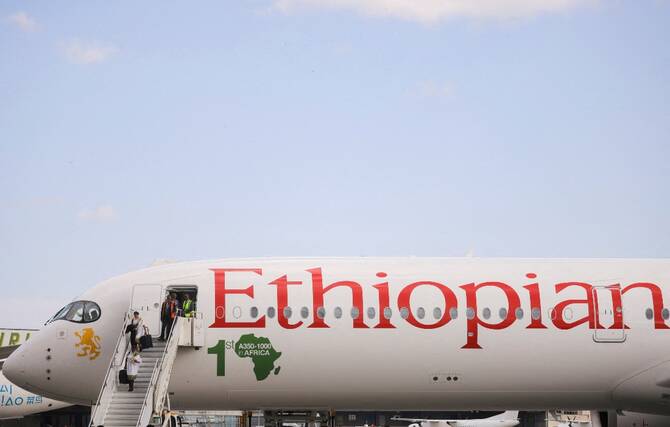
Ethiopian Airlines cabin crew disembark Ethiopia's first Airbus A350-1000 passenger plane during its reception at the Bole International Airport in Addis Ababa, Ethiopia. (Reuters)
Short Url
Updated 10 January 2026
Follow

Ethiopia begins construction of Africa’s biggest airport

  • The massive travel hub is expected to cost $12.7 billion and will handle 110 million passengers per year at full capacity

BISHOFTU: Ethiopia on Saturday began construction of what the prime minister says will be Africa’s largest airport, when completed, in the town of Bishoftu, southeast of the capital, Addis Ababa.

The massive travel hub is expected to cost approximately $12.7 billion and will eventually be able to handle approximately 110 million passengers per year at full capacity. Construction is expected to take five years.

Partly financed by national carrier Ethiopian Airlines, the Bishoftu hub is expected to replace the capital’s Bole Airport, which can handle up to 25 million passengers annually.

This multi-airport strategy aims to future-proof Ethiopia’s role as Africa’s leading air transport gateway.

Abiy Ahmed, Ethiopia’s prime minister

Prime Minister Abiy Ahmed on Saturday announced construction of “the largest aviation infrastructure project in Africa’s history” had begun.

“This multi-airport strategy aims to future-proof Ethiopia’s role as Africa’s leading air transport gateway,” he said in a post on X.

He added that the project will strengthen Ethiopian Airlines’ global competitiveness, enhance African connectivity, expand trade and tourism corridors, and position Ethiopia as a major intercontinental hub. The project includes a multi-lane motorway to link the new facility to the capital and a 38-kilometer high-speed railway, which Abiy said would reach speeds of up to 200 kph.

The African Development Bank has earmarked $500 million for the project, and Ethiopian authorities are in talks to
raise additional tranches with the Asian Development Bank, the European Investment
Bank, and the US Development Finance Corporation. Ethiopia hopes to attract foreign tourists despite the ongoing armed conflict in its two most populous regions — Amhara and Oromia — with Bishoftu located in the latter.

The future airport, which will sit on a 35-square-km site, has already displaced 2,500 farmers, who were re-housed last year at a cost of $350 million, Ethiopian Airlines CEO Mesfin Tasew Bekele said in November. Ethiopia, Africa’s second-most populous country with some 130 million inhabitants, has launched major infrastructure projects in recent years.

It officially inaugurated the continent’s largest dam last year, and extensive urban renewal projects are underway in Addis Ababa and other major cities.


Migrants languish in US detention centers amid dire conditions and prolonged waits

Updated 5 sec ago
Follow

Migrants languish in US detention centers amid dire conditions and prolonged waits

MIAMI: Felipe Hernandez Espinosa spent 45 days at ” Alligator Alcatraz,” an immigration holding center in Florida where detainees have reported worms in their food, toilets that don’t flush and overflowing sewage. Mosquitoes and other insects are everywhere.
For the past five months, the 34-year-old asylum-seeker has been at an immigration detention camp at the Fort Bliss Army base in El Paso, Texas, where two migrants died in January and which has many of the same conditions, according to human rights groups. Hernandez said he asked to be returned to Nicaragua but was told he has to see a judge. After nearly seven months in detention, his hearing was scheduled for Feb. 26.
Prolonged detention has become more common in President Donald Trump’s second term, at least partly because a new policy generally prohibits immigration judges from releasing detainees while their deportation cases wind through backlogged courts. Many, like Hernandez, are prepared to give up any efforts to stay in the United States.
“I came to this country thinking they would help me, and I’ve been detained for six months without having committed a crime,” he said in a phone interview from Fort Bliss. “It is been too long. I am desperate.”
The Supreme Court ruled in 2001 that Immigration and Customs Enforcement cannot hold immigrants indefinitely, finding that six months was a reasonable cap.
With the number of people in ICE detention topping 70,000 for the first time, 7,252 people had been in custody at least six months in mid-January, including 79 held for more than two years, according to agency data. That’s more than double the 2,849 who were in ICE custody at least six months in December 2024, the last full month of Joe Biden’s presidency.
The Trump administration is offering plane fare and $2,600 for people who leave the country voluntarily. Yet Hernandez and others are told they can’t leave detention until seeing a judge.
Legal advisers warn that these are not isolated cases
The first three detainees that attorney Ana Alicia Huerta met on her monthly trip to an ICE detention center in McFarland, California, to offer free legal advice in January said they signed a form agreeing to leave the United States but were still waiting.
“All are telling me: ‘I don’t understand why I’m here. I’m ready to be deported,’” said Huerta, a senior attorney at the California Collaborative for Immigrant Justice. “That’s an experience that I’ve never had before.”
A Chinese man has been held for more than a year without seeing an immigration judge, even though he told authorities he was ready to be deported. In the past, Huerta said, she encountered cases like this once every three or four months.
The Department of Homeland Security did not address questions from The Associated Press about why more people are being held longer than six months.
“The conditions are so poor and so bad that people say, ‘I’m going to give up’,” said Sui Cheng, executive director at Americans for Immigrant Justice.
The waiting time may depend on the country. Deportations to Mexico are routine but countries including Cuba, Nicaragua, Colombia and Venezuela have at times resisted accepting deportees.
Among those detained for months are people who have won protection under the United Nations Convention Against Torture, who cannot be deported to their home country but may be sent elsewhere.
In the past, those migrants were released and could get a work permit. Not anymore, said Sarah Houston, managing attorney at Immigrant Defenders Law Center, who has at least three clients with protection under the UN torture convention who have been in custody for more than six months. One is from El Salvador, detained for three years. He won his case in October 2025 but is still in custody in California.
“They’re just holding these people indefinitely,” said Houston, noting that every 90 days, attorneys request the release of these migrants and ICE denies those requests. “We’re seeing people who actually win their immigration cases just languishing in jail.”
The Nicaraguan who wants to be deported
Hernandez, who doesn’t have a lawyer, said he signed documents requesting to be returned to his country or Mexico at least five times. An Oct. 9 hearing was abruptly canceled without explanation. He waited months with no news, until early February, when he learned his new hearing date.
Hernandez, who has allergies and needs a gluten-free diet that he says he hasn’t been getting since November, was arrested in July on a lunch break from his job installing power generators in South Florida. His wife was detained with him but a judge allowed her to return to Nicaragua without a formal deportation order on Aug. 28.
Both crossed the Mexican border in 2022 and requested asylum. He said he received death threats after participating in marches against co-presidents and spouses Daniel Ortega and Rosario Murillo.
If he returns, they plan to go to Panama or Spain because they fear for their lives in Nicaragua, he said. His files say only that his case is pending.
The Dominican who became a father while in detention
Yashael Almonte Mejia has been detained eight months since the government sought dismissal of his asylum case in May 2025, said his aunt, Judith Mejia Lanfranco.
Since then, he has been transferred from a detention center in Florida to Texas to New Mexico.
In November, Almonte married his pregnant American girlfriend via a video call and became the father of a daughter he hasn’t seen in person. He was unable to attend the funeral of his sister who died in November.
“He has gone through depression. He has been very bad,” his aunt said. “He is desperate and he doesn’t even know what’s going to happen.”
Almonte, 29, came to the US in 2024 and told authorities he cannot return to the Dominican Republic because he fears for his life. In January, he passed his initial asylum screening interview.
A Mexican man detained for a year
Some detainees are finding relief in federal court.
A Mexican man detained in October 2024 in Florida was held for a year even though he won a protection under the UN torture convention in March 2025.
“Time was passing and I was desperate, afraid that they would send me to another country,” said the 38-year-old, who spoke on condition of anonymity for fear of being detained again.
“I didn’t know what was going to happen to me,” he said, noting that immigration officials weren’t giving him any answers.
The man said he had lived illegally in the United States from age 10 until he was deported. In Mexico, he ran his own business, but in 2023 decided to return and illegally crossed the border into the United States. He said he was looking for safety after being threatened by drug cartels who demanded monthly payments.
He was taking antidepressants when he found an attorney who filed a petition in federal court alleging he was being held illegally. He was freed in October 2025, seven months after a judge ordered his release.
But for Hernandez, the Nicaraguan asylum-seeker, desperation led him to request to be returned to the country he had fled.
“I’ve experienced a lot of trauma. It’s very difficult,” Hernandez said from Fort Bliss. “I’m always thinking about when I’m going to get out.”
