

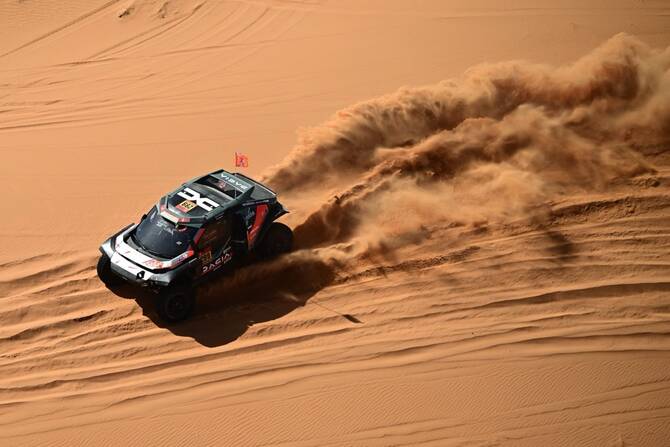
Qatar’s Al-Attiyah wins Stage 6 for Dacia, retakes Dakar lead

Dacia’s Nasser Al-Attiyah and Fabian Lurquin in action during Stage 6 of the Dakar Rally from Hail to Riyadh. (Reuters)
Short Url
Updated 10 January 2026
Follow

Qatar’s Al-Attiyah wins Stage 6 for Dacia, retakes Dakar lead

  • Al-Attiyah, 55, has now completed 19 successive Dakars with at least one stage win every time

RIYADH: Qatar’s Nasser Al-Attiyah will lead the Dakar Rally into its second  and final week after winning the sixth stage in the Saudi desert on Friday to take over at the top ​from South African rival Henk Lategan.

Al-Attiyah, a five-time Dakar winner now competing for the Dacia Sandriders, had been second overnight but turned a deficit of more than three minutes into a 6 minutes and 10 second advantage over the 326km timed stage between Hail and Riyadh.
Saturday is a rest day before the rally resumes in Riyadh on Sunday with seven more stages to the finish in Yanbu ‌on the Red ‌Sea coast on Jan. 17.
Al-Attiyah won Friday’s ‌stage ⁠by ​two ‌minutes and 58 seconds from teammate and nine-time world rally champion Sebastien Loeb, Dacia’s first Dakar one-two, with Toyota’s American Seth Quintero third.
Overall, three different manufacturers filled podium positions with Toyota’s Lategan second and Ford’s Nani Roma third — his first time on the virtual podium since 2019.
Al-Attiyah, 55, has now completed 19 successive Dakars with at ⁠least one stage win every time.
Friday was his career 49th stage win in the ‌car category — one off the record held ‍jointly by Ari Vatanen and “Mr Dakar” ‍Stephane Peterhansel.
Spaniard Carlos Sainz, father of the Formula One driver ‍and a four-time Dakar winner still racing hard at the age of 63, was in fourth place for Ford with teammate Mattias Ekstrom fifth and Loeb sixth.
American Mitch Guthrie, stage winner on Thursday for Ford, dropped ​to seventh from sixth.
In the motorcycle category there was no change at the top, although leader and defending champion Daniel Sanders was handed a 6-minute penalty for riding at 98kph in a zone limited to 50kph.
KTM rider Sanders now leads Honda’s American Ricky Brabec, the stage winner after the Australian’s penalty, by 45 seconds with Argentine rider Luciano Benavides more than 10 minutes behind in third.
“It was an emotional rollercoaster all day. Unfortunately, I got a speeding penalty, so that will set me back a bit,” said Sanders.
“I just pushed as much as I could today but it’s hard to do good in the sand, especially opening. I did the ‌best I could and I’ve got to stop making silly mistakes. I haven’t pieced this first week together so well.”


Morocco banish any doubts about ability to host World Cup 2030

Updated 4 sec ago
Follow

Morocco banish any doubts about ability to host World Cup 2030

  • Impressive stadiums, easy transportation links and a well-established tourism infrastructure ensured the 24-team tournament went off without any major hitch and will assuage any doubters about the World Cup in four years’ time

RABAT: Morocco’s successful staging of the Africa Cup of Nations means there should be no skepticism about its ability to co-host the World Cup with Portugal and Spain in 2030, even if Sunday’s final was clouded by a walk-off and defeat for the home team.

Impressive stadiums, easy transportation links and a well-established tourism infrastructure ensured the

24-team tournament went off without any major hitch and will assuage any doubters about the World Cup in four years’ time.

Morocco plans to use six venues in 2030 and five of them were used for the Cup of Nations, providing world-class playing surfaces and a spectacular backdrop.

The Grande Stade in Tangier with a 75,000 capacity is an impressive facility in the northern coastal city, less than an hour’s ferry ride from Spain.

Meanwhile, FIFA President Gianni Infantino condemned "some Senegal players" for the "unacceptable scenes" which overshadowed their victory in the final when they left the pitch in protest at a penalty awarded to Morocco.

African football's showpiece event was marred by most of the Senegal team walking off when, deep into injury time of normal play and with the match locked at 0-0, Morocco were awarded a spot-kick following a VAR check by referee Jean-Jacques Ndala for a challenge on Brahim Diaz.

security personnel at the other end of the stadium, Senegal's players eventually returned to the pitch to see Diaz shoot a soft penalty into the arms of their goalkeeper Edouard Mendy.

The match was played at the Stade Moulay Abdellah in the capital Rabat, which has a capacity of 69,500. The attendance for the final was 66,526.

Stadiums in Agadir, Fes and Marrakech were also more than adequate and will now be renovated over the next few years.

But the crowning glory is the proposed 115,000-capacity Stade Hassan II on ⁠the outskirts of Casablanca which Morocco hope will be chosen to host the final over Madrid’s Santiago Bernabeu Stadium.

In all, Morocco will spend $1.4 billion on the six stadiums. Also planned is extensive investment in airports, with some 10 Moroccan cities already running direct air links to Europe and many budget airlines offering flights to the country.

An extension of Africa’s only high-speed rail service, which already provides a comfortable three-hour ride from Tangier to Casablanca, further south to Agadir and Marrakech is also planned. Morocco hopes all of this will modernize its cities and boost the economy.

On the field, Morocco will hope to launch a credible challenge for a first African World Cup success, although on Sunday they continued their poor return in the Cup of Nations, where their only triumph came 50 years ago.

They surprised with a thrilling run to the last four at the Qatar 2022 World Cup as the first African nation to get that far and will hope for a similar impact at this year’s finals in North America. They are in Group C with Brazil, Scotland and Haiti.