

Pakistan partners with Swiss firm to provide free cancer treatment to patients

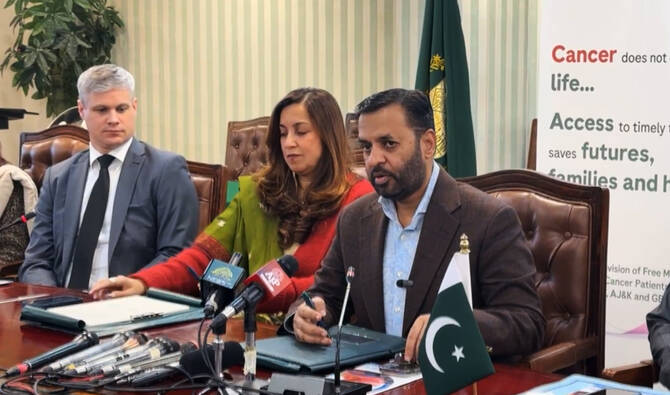
Federal Health Minister Mustafa Kamal (right) speaks after signing an agreement with leading Swiss pharmaceutical firm Roche in Islamabad, Pakistan, on January 9, 2026. (Screengrab/Health Ministry)
Short Url
Updated 09 January 2026
Follow

Pakistan partners with Swiss firm to provide free cancer treatment to patients

  • In Pakistan, more than 185,000 new cancer cases and over 125,000 deaths are reported annually
  • Under the agreement, Roche Pakistan will bear 70% cost of cancer medicines, government will pay 30%

ISLAMABAD: Pakistan has partnered with a leading Swiss pharmaceutical firm, Roche, to provide costly cancer treatment to Pakistani patients free of cost, the country’s health minister said on Friday, as the two sides signed an agreement in this regard.

Cancer is an insidious disease, alarmingly shaping the global health crisis as it claims millions of lives each year. Responsible for one in six deaths worldwide, cancer cases are projected to reach 26 million annually by 2030, with developing countries shouldering 75% of this burden.

Over 70% of cancer deaths occur in low- and middle-income countries (LMICs), where survival rates hover at just 30%. The reasons are manifold, including inadequate access to early detection and treatment services, lack of awareness, and societal taboos, to name a few.

In Pakistan alone, more than 185,000 new cases and more than 125,000 deaths are reported annually. Breast cancer is the most common, accounting for 16.5% of cases, followed by lip and oral cavity cancers (8.6%) and lung cancer (5.1%), according to Aga Khan University Hospital (AKUH).

“Roche Pakistan has proposed to the government many years ago that the cure for this cancer is only with them... and they want to do a partnership with the Government of Pakistan. They want to give 70% of the price of the medicine,”

Health Minister Mustafa Kamal said, adding the government would bear the rest of the 30% cost of treatment.

“And whoever is given this medicine should be given it free of cost.”

Kamal shared that cancer treatment in Pakistan costs around Rs9.8 million ($34,588) in five years on an average.

“[Most] people don’t have this (amount). So, this was a very important project,” he said.

Citing a World Health Organization (WHO) report, the health minister said millions of Pakistanis, who were not born poor, had fallen below the poverty line after falling sick.

“Houses were sold, plots were sold, jewelry was sold, everything was sold and illness made them poor,” he said, praising Roche Pakistan for its support.

Speaking at the agreement-signing ceremony, Roche Pakistan Managing Director Hafsa Shamsie called it “just the first step.”

“We will enhance the number of patients, we will enhance the disease areas, and God willing, we will go into other parts of the patient journey, like awareness and diagnosis,” she said.

Pakistan last year vaccinated over 10 million adolescent girls against a virus that causes cervical cancer as part of a continuing national campaign that has overcome early setbacks fueled by skeptics online.

Cervical cancer is the third most common cancer among Pakistani women after breast and ovarian cancers. Globally, it is the fourth most common. Each year, between 18,000 and 20,000 women in Pakistan die of the disease, according to health authorities.

The girls targeted in the initial campaign were in Punjab and Sindh provinces and in Azad Kashmir. The country plans to expand the coverage to additional areas by 2027, hoping to eliminate cervical cancer as a public health problem by 2030. It became the 149th country to add the HPV vaccine to its immunization schedule.


High-level Libyan delegation meets Pakistan PM, discusses areas for future cooperation

Updated 03 February 2026
Follow

High-level Libyan delegation meets Pakistan PM, discusses areas for future cooperation

  • The meeting comes over a month after Pakistan reportedly struck a $4 billion defense deal to sell military equipment to Libyan National Army
  • PM Sharif reaffirms Pakistan’s commitment to fostering friendly ties with Libya, emphasizes the importance of continued engagement and dialogue

ISLAMABAD: A high-level delegation from Libya on Tuesday called on Pakistan Prime Minister Shehbaz Sharif in Islamabad and discussed areas for future cooperation between the two sides, PM Sharif’s office said.

The delegation comprised Dr. Osama Saad Hamad, who governs eastern Libya, Libyan National Army (LNA) Commander-in-Chief Khalifa Abu-al-Qasim Haftar and his deputy, Lt. Gen. Saddam Khalifa Haftar.

During the discussions, both sides exchanged views on matters of mutual interest and underscored the importance of strengthening bilateral relations, according to PM Sharif’s office.

“The meeting reflected the shared desire to enhance cooperation in areas of common concern and to promote peace, stability, and development at regional and international levels,” Sharif’s office said in a statement.

The development comes more than a month after reports suggested Pakistan had struck a $4 billion defense deal to sell military equipment, including JF-17 fighter jets and Super Mushshak trainer aircraft, to the LNA that controls eastern Libya.

The reports followed the visit of Pakistani Defense Forces Chief Field Marshal Asim Munir to Libya in December. There has been no official confirmation of the deal so far.

Libya has been subject to a UN arms embargo since 2011, requiring approval from the UN for transfers of weapons and related material. It was not clear whether Pakistan or Libya had applied for ⁠any exemptions to the UN embargo.

PM Sharif reaffirmed Pakistan’s commitment to fostering friendly relations with Libya and emphasized the importance of continued engagement and dialogue, according to his office. The Libyan leadership appreciated Pakistan’s role and expressed interest in expanding collaboration between the two countries.

“The meeting concluded with an understanding to maintain close contact and explore avenues for future cooperation,” Sharif’s office said.

On Monday, LNA Commander-in-Chief Haftar also met Field Marshal Munir and discussed with him military cooperation and regional security, according to the Pakistani military.

“Both sides exchanged views on matters of mutual interest, with particular focus on security dynamics in respective regions and professional cooperation,” the Pakistani military said.

“The discussion underscored the importance of continued engagement and collaboration between the Armed Forces of Pakistan and Libya.”