High-level Libyan delegation meets Pakistan PM, discusses areas for future cooperation

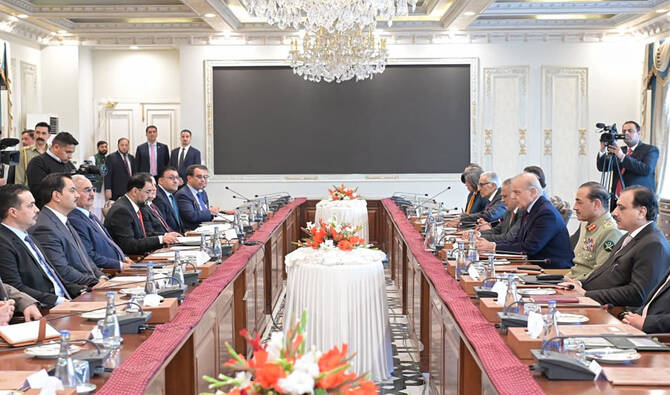
The handout photograph released on January 3, 2026, shows Prime Minister Shehbaz Sharif (third right) meeting a high-level Libyan delegation in Islamabad, Pakistan. (PMO)
Short Url
Updated 03 February 2026
Follow

High-level Libyan delegation meets Pakistan PM, discusses areas for future cooperation

  • The meeting comes over a month after Pakistan reportedly struck a $4 billion defense deal to sell military equipment to Libyan National Army
  • PM Sharif reaffirms Pakistan’s commitment to fostering friendly ties with Libya, emphasizes the importance of continued engagement and dialogue

ISLAMABAD: A high-level delegation from Libya on Tuesday called on Pakistan Prime Minister Shehbaz Sharif in Islamabad and discussed areas for future cooperation between the two sides, PM Sharif’s office said.

The development comes more than a month after reports suggested Pakistan had struck a $4 billion defense deal to sell military equipment, including JF-17 fighter jets and Super Mushshak trainer aircraft, to the LNA that controls eastern Libya.

Libya has been subject to a UN arms embargo since 2011, requiring approval from the UN for transfers of weapons and related material. It was not clear whether Pakistan or Libya had applied for ⁠any exemptions to the UN embargo.

The Libyan delegation that met PM Sharif comprised Dr. Osama Saad Hamad, who governs eastern Libya, Libyan National Army (LNA) Commander-in-Chief Khalifa Abu-al-Qasim Haftar and his deputy, Lt. Gen. Saddam Khalifa Haftar, according to Sharif’s office.

“The meeting reflected the shared desire to enhance cooperation in areas of common concern and to promote peace, stability, and development at regional and international levels,” Sharif’s office said in a statement.

PM Sharif reaffirmed Pakistan’s commitment to fostering friendly relations with Libya and emphasized the importance of continued engagement and dialogue, according to his office. 

The Libyan leadership appreciated Pakistan’s role and expressed interest in expanding collaboration between the two countries.

“The meeting concluded with an understanding to maintain close contact and explore avenues for future cooperation,” Sharif’s office said.

On Monday, LNA Commander-in-Chief Haftar also met Field Marshal Munir and discussed with him military cooperation and regional security, according to the Pakistani military.

“Both sides exchanged views on matters of mutual interest, with particular focus on security dynamics in respective regions and professional cooperation,” the Pakistani military said.

“The discussion underscored the importance of continued engagement and collaboration between the Armed Forces of Pakistan and Libya.”


Pakistan mulls 'Super App' for public services, document verification in major technology push

Updated 15 February 2026
Follow

Pakistan mulls 'Super App' for public services, document verification in major technology push

  • Pakistan has been urging technology adoption in public, private sectors as it seeks to become a key tech player globally
  • The country this month launched the Indus AI Week to harness technology for productivity, skills development and innovation

KARACHI: Pakistan is planning to launch a “Super App” to deliver public services and enable digital document verification, the country's information technology (IT) minister said on Sunday, amid a major push for technology adoption in public and private sectors.

Pakistan, a country of 240 million people, seeks to become a key participant in the global tech economy, amid growing interest from governments in the Global South to harness advanced technologies for productivity, skills development and innovation.

The country's information and communications technology (ICT) exports hit a record $437 million in Dec. last year, according to IT Minister Shaza Fatima Khawaja. This constituted a 23% increase month on month and a 26% increase year on year.

Pakistan's technology sector is also advancing in artificial intelligence (AI) and cloud computing, marked by the launch of Pakistan’s first sovereign AI cloud in November, designed to keep sensitive data domestic and support growth in the broader digital ecosystem.

“In developed countries, citizens can access all government services from a mobile phone,” Fatima said, announcing plans for the Super App at an event in Karachi where more than 7,000 students had gathered for an AI training entrance test as part of the ‘Indus AI Week.’

“We will strive to provide similar facilities in the coming years.”

Khawaja said the app will reduce the need for in-person visits to government offices such as the National Database and Registration Authority (NADRA) and the Higher Education Commission (HEC).

The Indus AI Week initiative, which ran from Feb. 9 till Feb. 15. was aimed at positioning Pakistan as a key future participant in the global AI revolution, according to the IT minister.

At the opening of the weeklong initiative, Prime Minister Shehbaz Sharif announced that Pakistan would invest $1 billion in AI by 2030 to modernize the South Asian nation’s digital economy.

“These initiatives aim to strengthen national AI infrastructure and make the best use of our human resource,” Khawaja said, urging young Pakistanis to become creators, inventors and innovators rather than just being the consumers of technology.