

AlUla announces discovery of rare 465 million-year-old crab fossils

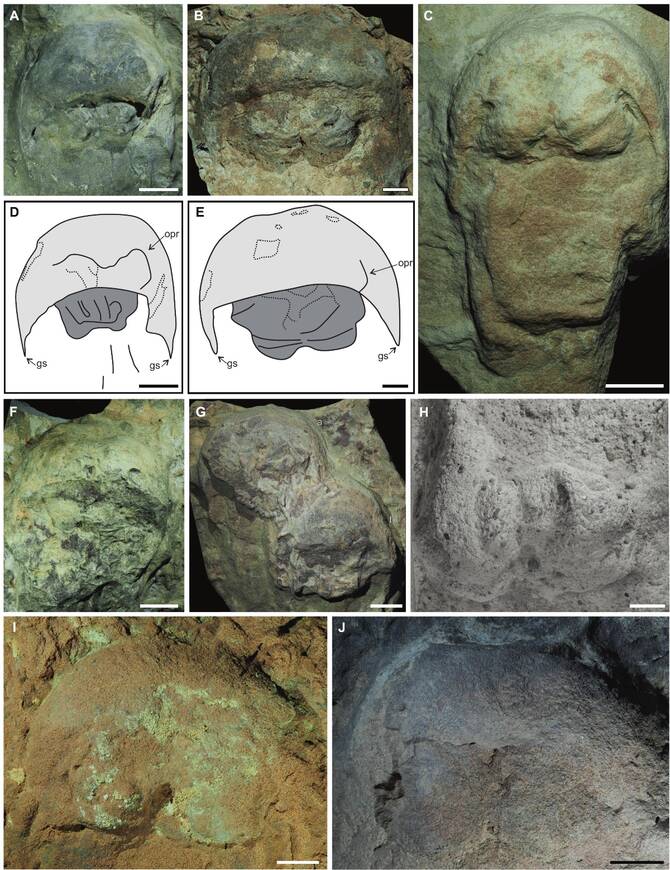
Rare horseshoe crab fossils discovered in AlUla are believed to be more than 465 million years old. (Gondwana Research)
Short Url
Updated 08 January 2026
Follow

AlUla announces discovery of rare 465 million-year-old crab fossils

  • Work being carried out to study, characterize the fossils
  • AlUla was likely closer to shore, but today 100km inland

RIYADH: The Royal Commission for AlUla announced on Thursday the discovery of rare horseshoe crab fossils estimated to be 465 million years old.

Work is being carried out to study and characterize the fossils, which have not yet been scientifically classified, the RCU said in a post on X.

All of the fossils were found in an upside-down position, an unprecedented preservation pattern for this species.

The discovery was also notable in that the fossils were larger than other known species typically found from the same period.

The RCU also said that trace fossils were found, suggesting that the specimens were moving.

The commission said on X that this was a “one-of-a-kind discovery published scientifically at an international level, enhancing AlUla’s standing as a leading global site for geological research.”

A study on the findings was published in the peer-reviewed journal Gondwana Research, in a paper titled “Ordovician horseshoe crab body and trace fossil association preserved in a unique taphonomic setting.”

It notes that the finding suggests that AlUla was historically much closer to the shore, whereas today it is more than 100 km inland.

Archaeological research in Saudi Arabia in recent years has uncovered vast troves of ancient artefacts.

In October 2025, the Heritage Commission’s Al-Yamamah Archaeological Project survey announced the discovery of 337 new archaeological sites in the Kingdom, including sites for stone tool manufacturing, water facilities and circular stone structures.

In September, the commission discovered the oldest architectural settlement in the Arabian Peninsula, dating back to the pre-pottery Neolithic period of 10,300 to 11,000 years ago, near Tabuk.


Riyadh forum to discuss AI impact on education, jobs

The conference aims to redefine work and human capacity building to meet future labor market demands. (SPA)
Updated 12 January 2026
Follow

Riyadh forum to discuss AI impact on education, jobs

  • The exhibition will give young people direct access to educational, training, career, and technological opportunities while enabling them to learn from leading local and international experiences to shape their future careers

RIYADH: Experts from more than 50 international and local organizations in education, employment, and artificial intelligence will gather in Riyadh from Jan. 28-29 for the International Conference on Data and AI Capacity Building to explore the future of education during rapid AI advances.

Discussions will examine how AI is transforming work, its implications for current and future generations, and the new opportunities it creates, the Saudi Press Agency reported on Monday.

Organized by the Saudi Data and AI Authority, the conference aims to redefine work and human capacity building to meet future labor market demands.

Participants will present practical solutions for empowering young people with AI skills, integrating AI into education, and aligning learning outcomes with the most in-demand future skills locally and globally.

By addressing AI’s evolving impact on the job market, the conference offers academics, AI and data professionals, policymakers, and students a platform to exchange insights and explore the latest innovations for societal benefit and national development.

An accompanying exhibition will highlight cutting-edge educational and digital transformation solutions from public and private sector organizations.

The exhibition will give young people direct access to educational, training, career, and technological opportunities while enabling them to learn from leading local and international experiences to shape their future careers.