

Pakistan, China agree to step up counterterrorism coordination, hold regular security talks

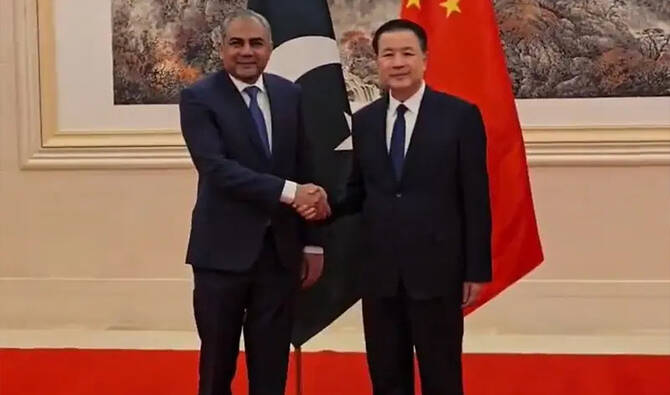
The screengrab taken from a video shows Pakistan’s Interior Minister Mohsin Naqvi and his Chinese counterpart Wang Xiaohong shaking hands at the headquarters of China’s Ministry of Public Security in Beijing on January 7, 2025. (Ministry of Interior)
Short Url
Updated 07 January 2026
Follow

Pakistan, China agree to step up counterterrorism coordination, hold regular security talks

  • The interior ministers of both countries agree on quarterly working-group meetings, annual high-level talks
  • Islamabad says Beijing expressed satisfaction over protection of Chinese citizens and projects in Pakistan

ISLAMABAD: Pakistan and China agreed on Wednesday to institutionalize closer collaboration on counterterrorism and internal security, committing to regular meetings and expanded coordination amid efforts by both countries to safeguard Chinese nationals and projects amid persistent militant threats in the region.

The agreement was reached during talks between Pakistan’s Interior Minister Mohsin Naqvi and his Chinese counterpart Wang Xiaohong at the headquarters of China’s Ministry of Public Security in Beijing, according to an official statement circulated in Islamabad.

China has raised concerns in the past over attacks targeting its citizens working on infrastructure and energy projects in Pakistan. Islamabad has stepped up security deployments and intelligence coordination in response, while Beijing has pushed for more structured and predictable security engagement.

“The two sides discussed joint counterterrorism measures, police training exchange programs and ways to expand cooperation in areas of mutual interest,” Pakistan’s interior ministry said in a statement, adding that the two officials agreed to hold working-level meetings every three months and annual talks at the interior ministers’ level.

Wang expressed satisfaction over Pakistan’s steps to protect Chinese citizens and projects, the statement added, praising Pakistan’s counterterrorism measures and internal security initiatives.

China also acknowledged Pakistan’s sacrifices in its fight against militancy, according to the statement.

Naqvi and Wang stressed the need to further improve coordination mechanisms to enhance operational cooperation between the two countries’ security agencies.

His meeting with his Chinese counterpart lasted for over three years.


Pakistan urges world to treat water insecurity as global risk, flags India treaty suspension

Updated 5 sec ago
Follow

Pakistan urges world to treat water insecurity as global risk, flags India treaty suspension

  • Pakistan says it is strengthening water management but national action alone is insufficient
  • India unilaterally suspended Indus Waters Treaty last year, leading to irregular river flows

ISLAMABAD: Pakistan on Tuesday urged the international community to recognize water insecurity as a “systemic global risk,” warning that disruptions in shared river basins threaten food security, livelihoods and regional stability, as it criticized India’s handling of transboundary water flows.

The call comes amid heightened tensions after India’s unilateral decision last year to hold the 1960 Indus Waters Treaty “in abeyance,” a move Islamabad says has undermined predictability in river flows and compounded climate-driven vulnerabilities downstream.

“Across regions, water insecurity has become a systemic risk, affecting food production, energy systems, public health, livelihoods and human security,” Pakistan’s Acting Permanent Representative to the United Nations, Ambassador Usman Jadoon, told a UN policy roundtable on global water stress.

“For Pakistan, this is a lived reality,” he said, describing the country as a climate-vulnerable, lower-riparian state facing floods, droughts, accelerated glacier melt, groundwater depletion and rapid population growth, all of which are placing strain on already stressed water systems.

Jadoon said Pakistan was strengthening water resilience through integrated planning, flood protection, irrigation rehabilitation, groundwater replenishment and ecosystem restoration, including initiatives such as Living Indus and Recharge Pakistan, but warned that domestic measures alone were insufficient.

He noted the Indus River Basin sustains one of the world’s largest contiguous irrigation systems, provides more than 80 percent of Pakistan’s agricultural water needs and supports the livelihoods of over 240 million people.

The Pakistani diplomat said the Indus Waters Treaty had for decades provided a framework for equitable water management, but India’s decision to suspend its operation, followed by unannounced flow disruptions and the withholding of hydrological data, had created an unprecedented challenge for Pakistan’s water security.

Pakistan has said the treaty remains legally binding and does not permit unilateral suspension or modification.

The issue has gained urgency as Pakistan continues to recover from last year’s monsoon floods, which killed more than 1,000 people and devastated farmland in Punjab, the country’s eastern breadbasket, in what officials described as severe riverine flooding.

Last month, Deputy Prime Minister Ishaq Dar said Pakistan had observed abrupt variations in river flows from India, creating uncertainty for farmers in Punjab during critical periods of the agricultural cycle.

“As we move toward the 2026 UN Water Conference, Pakistan believes the process must acknowledge water insecurity as a systemic global risk, place cooperation and respect for international water law at the center of shared water governance, and ensure that commitments translate into real protection for vulnerable downstream communities,” Jadoon said.