


Pakistan court sentences man to 10 years for raping daughter

An area inside the Karachi Police Office compound is seen cordoned off by a barricade tape a day after an attack by Pakistan's Taliban in Karachi on February 18, 2023. (AFP/File)
Short Url
Updated 06 January 2026
Follow

Pakistan court sentences man to 10 years for raping daughter

  • Local court finds Karachi man guilty for raping 18-year-old daughter in September 2023, fines him $358
  • Judge says victim remained “consistent and confident” in her evidence despite defense’s cross-examination

ISLAMABAD: A local court in Pakistan’s Karachi city has sentenced a man to 10 years in prison for raping his 18-year-old daughter, according to court documents seen by Arab News on Tuesday.

Additional District and Sessions Judge Naseer Noor Khan, who is also the presiding officer of a Gender Based Violence Court in Karachi, found Muhammad Irfan, 52, guilty of raping his daughter under Section 376 of the Pakistan Penal Code, which deals with the offense. 

As per a copy of the court’s judgment dated Dec. 22 seen by Arab News, the first information report states that the offense was committed in September 2023. The victim testified that after using a washroom on the ground floor of her house in Karachi’s Qur’angi area, her father pulled her into a room and raped her. He subsequently threatened to kill his daughter and divorce her mother if she disclosed the crime to anyone.

As per the court order, the victim told her maternal aunt about the incident, who in turn informed the victim’s mother who filed a police complaint against Irfan. Irfan pleaded not guilty to the charges and claimed his wife and in-laws had falsely accused him of raping his daughter to usurp his property. 

“It cannot be accepted that a mother would think to involve her real daughter for falsely implicating her husband just to usurp his property,” the court document read. “Therefore, the plea of false implication for usurping property of the accused; does not sound reasonable and believable.”

The judgment said the rape victim was examined by a woman medico-legal officer three months after the incident, adding that no evidence to corroborate the crime was found as a result. 

The judge, however, noted that DNA profiling and medical examination results are only corroborative evidence and that the crime in such cases is already established based on the victim’s testimony if it inspires confidence. 

The verdict said the rape victim was subjected to lengthy cross examination by the defense counsel but she remained “consistent and confident regarding her evidence,” noting that the defense could not put any “material dent into her confidence.”

The judgment also noted that evidence by the investigating officers, other prosecution witnesses and the mother’s statement corroborated the victim’s testimony regarding the incident. 

In addition to the 10-year jail sentence, Irfan was fined $358 by the judge. If unpaid, he will face an additional six months of imprisonment, the court order stated. The judge ordered that any fine that is paid should be given to the victim as compensation under the Anti-Rape (Investigation & Trial) Act, 2021.


T20 World Cup: ICC deputy chief in Lahore for talks after Pakistan boycotts India match

Updated 08 February 2026
Follow

T20 World Cup: ICC deputy chief in Lahore for talks after Pakistan boycotts India match

  • Islamabad’s boycott over Bangladesh’s exclusion has threatened the tournament’s most lucrative game
  • Bangladesh Cricket Board chief has also arrived in Pakistan and is expected to participate in meetings

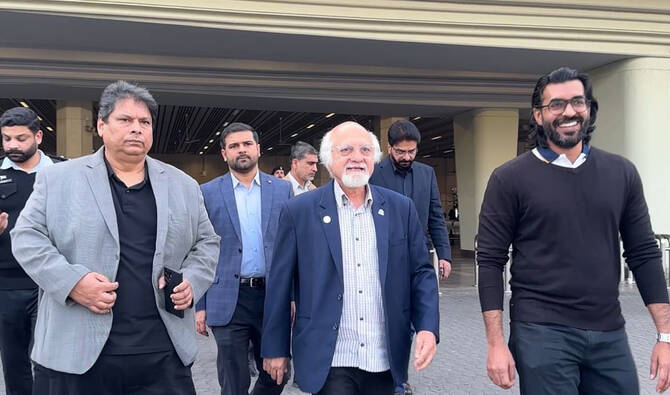
ISLAMABAD: International Cricket Council (ICC) Deputy Chairman Imran Khwaja arrived in Lahore on Sunday for talks with Pakistan Cricket Board (PCB) officials, the PCB said, as the sport’s governing body strives to save a high-stakes T20 World Cup clash between arch-rivals Pakistan and India.

The development follows Islamabad’s decision to boycott the Feb. 15 Pakistan-India match in Colombo, a move to protest the ICC’s exclusion of Bangladesh from the ongoing T20 World Cup.

The controversy over Pakistan’s participation erupted after the ICC replaced Bangladesh with Scotland, following Bangladesh’s decision to not play matches in India owing to security fears.

The ICC has since requested the Pakistan Cricket Board to reconsider the decision to boycott their match against India in Colombo or they will have to forfeit the marquee game of the tournament.

“ICC Deputy Chairman Imran Khwaja arrived in Lahore,” the PCB said on Sunday, adding that he was received at the airport by the PCB chairman’s adviser, Aamir Mir.

Prior to Khwaja’s arrival in Lahore, where the PCB is headquartered, Pakistan welcomed Bangladesh Cricket Board (BCB) President Aminul Islam, who was received by PCB CEO Salman Naseer.

The two visiting officials are scheduled to meet PCB Chairman Mohsin Naqvi.

“Bangladesh Cricket Board President Aminul Islam will also take part in other meetings,” the PCB said in a statement, hinting that he will be part of the meeting with ICC’s Khwaja.

The dispute stems from the ICC’s decision to replace Bangladesh with Scotland last month after Bangladesh refused to play tournament matches in India. Dhaka’s decision followed the removal of Mustafizur Rahman from the Indian Premier League (IPL). He was bought for $1 million by the IPL’s Kolkata Knight Riders, but on Jan. 3 the Board of Control for Cricket in India (BCCI) ordered Kolkata to release Mustafizur without a public explanation but amid regional tensions.

Pakistan have boycotted the 27th match of the tournament against India, due to take place at R. Premadasa Stadium in Colombo. An India-Pakistan fixture is the sport’s most lucrative asset, generating a massive share of global broadcasting and sponsorship revenue.

The PCB has remained defiant amid reports of potential sanctions. On Saturday, the board rejected claims by Indian media that it had initiated a dialogue with the ICC to find a way out of the standoff.

“I categorically reject the claim by Indian sports journalist Vikrant Gupta that PCB approached the ICC,” PCB’s Mir said in a statement. “As usual, sections of Indian media are busy circulating fiction. A little patience and time will clearly show who actually went knocking and who didn’t.”

The standoff highlights the growing friction within the sport’s governance.

Pakistan has accused India’s cricket board of influencing the ICC’s decisions.

Defense Minister Khawaja Asif this week called for the formation of a new cricket governing body, saying the ICC, currently chaired by Jay Shah, son of India’s Home Minister Amit Shah, was being held “hostage” to “Indian political interests.”

India generates the largest share of cricket’s commercial revenue and hence enjoys considerable influence over the sport. Critics argue that this financial contribution translates into decisive leverage within the ICC.

A large part of that revenue comes from the Indian Premier League (IPL), the sport’s most lucrative T20 cricket competition, which is run by the Board of Control for Cricket in India (BCCI). Between 2024 and 2027, the IPL is projected to earn $1.15 billion, nearly 39 percent of the ICC’s total annual revenue, according to international media reports.

While the Pakistani government cleared the team to participate in the rest of the tournament, Prime Minister Shehbaz Sharif maintained that the boycott of the India game was necessary to protest the “unjust” treatment of Bangladesh.