PARIS: Iran will offer no leniency to “rioters,” though the public has a right to demonstrate, the head of the country’s judiciary said on Monday, following more than a week of sometimes-deadly protests.
The remarks came after US President Donald Trump warned Iran would “get hit very hard by the United States” if the authorities killed more demonstrators.
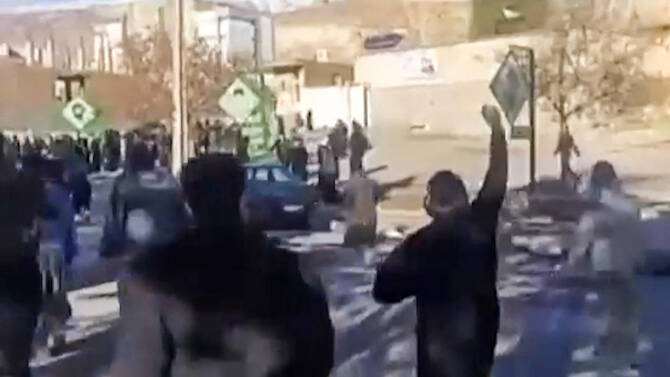
Protests erupted on December 28 when shopkeepers in capital Tehran staged a strike over high prices and economic stagnation. They have since spread to other cities and expanded to include political demands.
“I instruct the attorney general and prosecutors across the country to act in accordance with the law and with resolve against the rioters and those who support them... and to show no leniency or indulgence,” Gholamhossein Mohseni Ejei said, according to the judiciary’s Mizan news agency.
He went on to add that Iran “listens to the protesters and their criticism, and distinguishes between them and rioters.”
Demonstrations have taken place in 23 of Iran’s 31 provinces and affected, to varying degrees, at least 45 different cities, most of them small or medium-sized and concentrated in the west, according to an AFP tally based on official statements and media reports.
At least 12 people have been killed since December 30 in localized clashes, including members of the security forces, according to official announcements.
According to Mizan, police intelligence officers in the capital have identified a suspected rioter hideout and seized “weapons, ammunition, and materials for making improvised explosive devices.”
Since the protests began, officials have publicly struck a conciliatory tone when it comes to protesters’ economic demands, while vowing to take a hard line against any chaos or destabilization.
Iran’s economy has been hit hard by tough international sanctions, with the national currency, the rial, losing more than a third of its value against the US dollar over the past year and inflation in double digits.
On Sunday, the government announced a monthly allowance for every citizen to alleviate economic pressure, equivalent to around 3.5 percent of the average monthly wage.
The reformist newspaper Arman Melli said Monday that the authorities had “heard the voices of the protesters,” while the conservative papers Javan and Kayhan accused the United States and Israel of financially supporting rioters.
Watching ‘very closely’
Speaking to reporters aboard Air Force One, Trump said the US was watching the situation “very closely.”
“If they start killing people like they have in the past, I think they’re going to get hit very hard by the United States,” he said on Sunday.
Israeli Prime Minister Benjamin Netanyahu, meanwhile, said his country stood “in solidarity with the struggle of the Iranian people and with their aspirations for freedom.”
On Monday, Iranian foreign ministry spokesman Esmail Baqaei said at a press conference attended by AFP journalists that Israel was trying “to exploit the slightest opportunity to sow division and undermine our national unity.”
Iran’s prosecutor general Mohammad Movahedi-Azad last week warned against “externally designed scenarios” to harness the protests, promising a “decisive response.”
Israel fought a 12-day war with Iran in June, which the US briefly joined with limited strikes on nuclear facilities.
- ‘Movement by movement’ -
The Fars news agency said on Monday that “the trend observed on Sunday night shows a notable decrease in the number of gatherings and their geographic reach compared to previous nights.”
Local media’s accounting of the protests is not exhaustive, and state-run outlets have downplayed their coverage of the demonstrations, while videos flooding social media are often impossible to verify.
On Monday, most shops in Tehran were open and residents were going about their business after the end of the weekend on Sunday, according to AFP reporters in the capital.
However, riot police were deployed at major intersections and officers were stationed in front of some schools. Several universities have resumed classes, but only online.
Protests have also taken place among the Iranian diaspora.
At a demonstration in Paris on Sunday, 29-year-old French-Iranian translator Sahar Aghakhani told AFP: “With each new protest, Iranian men and women gain ground. Movement by movement, we’re getting closer to the end of the regime.”
Iran has experienced several outbreaks of nationwide protests in recent years, most notably in 2022 over the death in custody of Mahsa Amini over the alleged breach of Iran’s Islamic dress laws for women.
So far, the current protests have not reached the same scale.


![]()

Iran says no leniency for ‘rioters’ as protests persist
Short Url
https://arab.news/m4b53
Iran says no leniency for ‘rioters’ as protests persist
- Protests erupted on December 28 when shopkeepers in capital Tehran staged a strike over high prices and economic stagnation
- They have since spread to other cities and expanded to include political demands


Latest updates


© 2026 SAUDI RESEARCH & PUBLISHING COMPANY, All Rights Reserved And subject to Terms of Use Agreement.