

As India claims fourth-largest economy spot, what it means on the ground

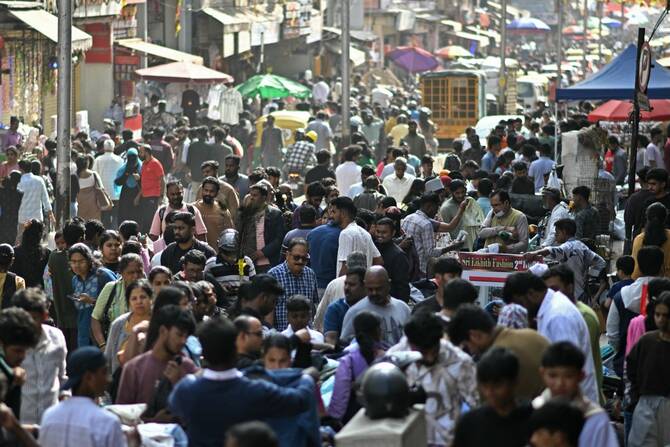
People gather to shop for clothes at a weekend market in Bengaluru, India, on Dec. 28, 2025. (AFP)
Short Url
Updated 05 January 2026
Follow

As India claims fourth-largest economy spot, what it means on the ground

  • Indian government review says economy grew to $4.19 billion, overtaking Japan
  • Claim still needs IMF review as only organized sector counted, economist says

NEW DELHI: When Ramesh Chandra Biswal left his job as a space scientist in the US, he returned to eastern India and ran an agriculture startup on a promise of his country’s rapid economic growth.

Nine years on, as India positions itself as the world’s fourth largest economy, he is still waiting for the promise to come true.

India’s economy was the sixth largest in the world, valued at about $2.6 trillion in 2017, when Biswal launched his Villamart project in his home village in Odisha.

According to calculations in the Indian government’s end-of-year economic review, it has now grown to $4.19 trillion, overtaking Japan’s economy in terms of nominal Gross Domestic Product.

The review also projects that India will overtake Germany to become the world’s third-largest economy within the next three years, trailing only the US and China in economic weight.

But on the ground, Biswal was not sure what the projections meant because they had no impact on his life or business.

“The hype around India becoming the fourth largest economy is not grounded. People cannot relate to that,” he said.

“The number of people here in India is much more than Japan ... We have to improve the per capita income instead of telling the story of being the fourth largest economy.”

Over the years that he has been running his company, Biswal has not noticed much change, but hoped that the news of the country’s growth would at least create a positive hype and motivate everyone.

“People are trying. As an entrepreneur, we are also trying, struggling every day, trying to do something new,” he said.

“I’m getting some respect in society. That way, it is giving me the driving force.”

But not everyone was immediately optimistic. For Sarvesh Sau, a fruit seller in Delhi, it has been increasingly difficult to keep his family afloat.

“Rich people are getting rich, those who have resources ... but a low-income group person like me finds it difficult to manage a decent living despite putting in more than 12 hours of work every day.

“We are a big nation, and we will look big compared to others. Are we able to match Japan?”

The world’s most populous nation, India has about 1.46 billion people and a GDP per capita estimated by the World Bank to be about $2,700. It is about 12 times lower than Japan’s.

Yogendra Kumar, a plumber in Noida, said his income has been rising, but it is consistently outpaced by the cost of living, leaving him feeling poorer over time.

“I have heard that India has become the fourth largest economy, but I don’t know how to react to that. It does not make any difference to our lives. It sounds good that India is growing, but the matter of fact is that for people like me the struggle for survival is more acute now than before,” he said.

“Today I earn more but the inflation takes away all the money, and it makes it difficult to have a comfortable life,” he told Arab News. “Mustard oil was 50 rupees 10 years ago. It is now 200 rupees. A cooking gas cylinder used to cost 500 rupees — now it costs more than double. Everything is so expensive.”

While India’s claim of being the fourth-largest economy is still awaiting review by the International Monetary Fund, Prof. Arun Kumar, a development economist, does not expect it to be confirmed.

“Our GDP data, as the IMF has said, is suspect because it doesn’t include the informal sector ... According to my estimate, we are still the seventh largest economy, just ahead of Italy,” he told Arab News, also estimating India’s actual growth to be much lower than the government’s projection.

“Even though official data shows a 7 percent to 8 percent rate of growth, people realize that it’s not growing so well,” Prof. Kumar said.

“The rate of growth is only of the organized sector, not of the unorganized sector ... The unorganized sector is declining and that is where 94 percent of the employment is.”


Only 4% women on ballot as Bangladesh prepares for post-Hasina vote

Updated 5 sec ago
Follow

Only 4% women on ballot as Bangladesh prepares for post-Hasina vote

  • Women PMs have ruled Bangladesh for over half of its independent history
  • For 2026 vote, only 20 out of 51 political parties nominated female candidates

DHAKA: As Bangladesh prepares for the first election since the ouster of its long-serving ex-prime minister Sheikh Hasina, only 4 percent of the registered candidates are women, as more than half of the political parties did not field female candidates.

The vote on Feb. 12 will bring in new leadership after an 18-month rule of the caretaker administration that took control following the student-led uprising that ended 15 years in power of Hasina’s Awami League party.

Nearly 128 million Bangladeshis will head to the polls, but while more than 62 million of them are women, the percentage of female candidates in the race is incomparably lower, despite last year’s consensus reached by political parties to have at least 5 percent women on their lists.

According to the Election Commission, among 1,981 candidates only 81 are women, in a country that in its 54 years of independence had for 32 years been led by women prime ministers — Hasina and her late rival Khaleda Zia.

According to Dr. Rasheda Rawnak Khan from the Department of Anthropology at Dhaka University, women’s political participation was neither reflected by the rule of Hasina nor Zia.

“Bangladesh has had women rulers, not women’s rule,” Khan told Arab News. “The structure of party politics in Bangladesh is deeply patriarchal.”

Only 20 out of 51 political parties nominated female candidates for the 2026 vote. Percentage-wise, the Bangladesh Socialist Party was leading with nine women, or 34 percent of its candidates.

The election’s main contender, the Bangladesh Nationalist Party, whose former leader Zia in 1991 became the second woman prime minister of a predominantly Muslim nation — after Pakistan’s Benazir Bhutto — was the party that last year put forward the 5 percent quota for women.

For the upcoming vote, however, it ended up nominating only 10 women, or 3.5 percent of its 288 candidates.

The second-largest party, Jamaat-e-Islami, has not nominated a single woman.

The 4 percent participation is lower than in the previous election in 2024, when it was slightly above 5 percent, but there was no decreasing trend. In 2019, the rate was 5.9 percent, and 4 percent in 2014.

“We have not seen any independent women’s political movement or institutional activities earlier, from where women could now participate in the election independently,” Khan said.

“Real political participation is different and difficult as well in this patriarchal society, where we need to establish internal party democracy, protection from political violence, ensure direct election, and cultural shifts around female leadership.”

While the 2024 student-led uprising featured a prominent presence of women activists, Election Commission data shows that this has not translated into their political participation, with very few women contesting the upcoming polls.

“In the student movement, women were recruited because they were useful, presentable for rallies and protests both on campus and in the field of political legitimacy. Women were kept at the forefront for exhibiting some sort of ‘inclusive’ images to the media and the people,” Khan said.

“To become a candidate in the general election, one needs to have a powerful mentor, money, muscle power, control over party people, activists, and locals. Within the male-dominated networks, it’s very difficult for women to get all these things.”