

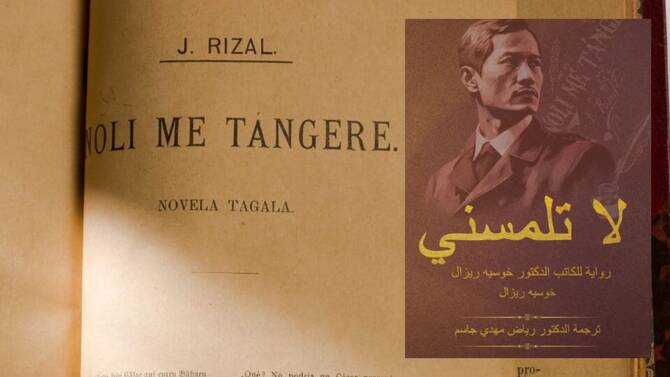

MANILA: “Noli Me Tangere,” a novel by Philippine national hero and polymath Jose Rizal, has become the first Filipino literary work translated into Arabic and is scheduled for release in 2026.
Rizal was a Filipino nationalist, writer, and reformist whose activism inspired the movement for Philippine independence from Spanish colonial rule.
His book, originally written in Spanish and privately printed in Berlin in 1887, was first published in the Philippines only in 1899 — three years after the Spanish executed him for inciting revolution against their rule.
Considered one of the most important works in Philippine history and literature, “Noli Me Tangere,” explores abuse of power, colonial oppression, and social inequality through the story of a young, educated Filipino who returns from Europe hoping to bring reform.
It was translated into dozens of languages worldwide, and the Arabic version was commissioned by the Philippine Embassy in Iraq. Its completion was announced by the Philippine government at Christmas, and the translation is expected to be published by mid-2026.
“Through Rizal, we also introduce a bit of Philippine history and culture,” Ambassador Charlie Manangan, who initiated the translation project in 2024, told Arab News.
“For Iraq specifically, this is our way of commemorating 50 years of formal diplomatic relations ... Beyond this, however, translating the ‘Noli’ — which is one of the most important literary works in the Philippines — introduces Rizal to the rest of the Arabic-speaking world.”
It also introduces Philippine literature to the Middle East.
“This is important because of the significant number of Filipinos living and working in Arabic-speaking countries,” Manangan said.
The book was translated from Rizal’s original by Dr. Reyadh Mahdi Jasim Al-Najjar, former head of the Spanish Department at the College of Languages of the University of Baghdad.
“He translated Rizal’s original 19th-century literary Spanish directly to Arabic, which is a feat by itself,” said Philippine Embassy Vice Consul Anthon Cayaco.
“It is very rare to find a person who can do that.”
The translation project was funded by the National Historical Commission of the Philippines.


