Pakistan says it awaits US response before deciding on Gaza stabilization force

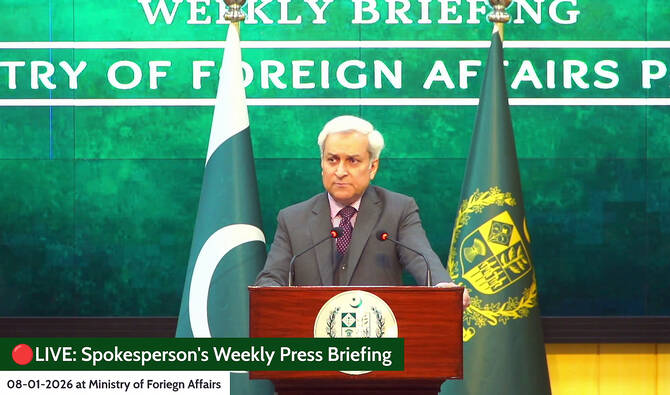
Pakistan's Foreign Office Spokesperson Tahir Andrabi is addressing the press during weekly briefing in Islamabad, Pakistan, on January 8, 2026. (MOFA)
Short Url
Updated 08 January 2026
Follow

Pakistan says it awaits US response before deciding on Gaza stabilization force

  • US said last month potential contributors to the force have sought clarity on its mandate and funding
  • Pakistan’s foreign office cites robust defense ties with Saudi Arabia, denies knowledge of JF-17 deal

ISLAMABAD: Pakistan is waiting to receive answers from the United States before making a decision on contributing troops to the International Stabilization Force (ISF) in Gaza, said Foreign Office Spokesperson Tahir Andrabi on Thursday.

Last month, Pakistan’s Deputy Prime Minister Ishaq Dar said Pakistan was willing to contribute to the international peacekeeping force in Gaza, though it would not deploy troops to disarm or de-weaponize Hamas.

According to international media outlets, Washington views Pakistan as a potentially significant contributor to the force given its battle-hardened military.

However, US Secretary of State Marco Rubio conceded last month that countries contributing troops want to know what the ISF’s specific mandate would be and how it would be funded, noting that Pakistan was among the countries who had shown interest.

“As regard to the International Stabilization Force [in Gaza], as I said, in a number of my replies, that, and in fact, what the deputy prime minister also said here, that that it depends on the mandate, and in regards to the balance of that force,” Andrabi said.

Referring to Rubio’s statement on countries asking questions on ISF, the spokesman said “we still wait for answers with respect to those questions.”

The spokesperson also highlighted Dar’s telephone conversations with Saudi Foreign Minister Faisal Bin Farhan twice this week.

“The deputy prime minister welcomed the Saudi foreign ministry’s statement regarding Yemen and appreciated the efforts of all sides to resolve the regional situation amicably,” he continued.

To a question regarding a Reuters report that claimed Pakistan and Saudi Arabia were in talks to convert about $2 billion of Saudi loans into a JF-17 fighter jet deal, Andrabi said both countries have “robust defense cooperation,” though he added he was unaware of the particular deal.

“I am not aware of any particular deal, regarding any platform or any systems and its financial adjustment. But this is a development that we would confirm upon materialization,” Andrabi said.

To another question about the possibility of Pakistan sending fresh troops to Saudi Arabia to join a Saudi military operation in Yemen, the spokesman said: “I have no information on this. We have, as I said, robust defense cooperation, many of these projects remain in the pipeline, but as regards the number of troops or an added number of troops, I do not have any information.”


Pakistan opposition to hold protest today over jailed ex-PM Khan’s deteriorating eye condition

Updated 34 min 27 sec ago
Follow

Pakistan opposition to hold protest today over jailed ex-PM Khan’s deteriorating eye condition

  • A court-appointed lawyer this week visited Imran Khan at prison and recommended independent ophthalmology review of his right eye
  • Information Minister Attaullah Tarar said Khan party’s narrative has ‘fallen flat on its face’ after ex-PM voiced ‘satisfaction’ with facilities

ISLAMABAD: Pakistan’s opposition alliance has announced a sit-in outside the Parliament House in Islamabad today, Friday, over jailed former prime minister Imran Khan’s deteriorating eye condition, following a rare prison visit by a Supreme Court-appointed lawyer this week.

Barrister Salman Safdar, who was appointed ‘amicus curiae,’ or friend of the court, visited Khan at Rawalpindi’s Adiala jail on Feb. 10 and filed a detailed report on his living conditions and health, which was made public on Thursday.

The report stated that in view of the seriousness of Khan’s ocular condition, “it is imperative that the seriousness of the condition be independently ascertained without delay.” There was no immediate response from prison authorities on the findings.

The Tehreek-e-Tahafuz-e-Ayin-e-Pakistan opposition alliance late Thursday demanded that Khan be transferred to Al-Shifa Hospital and announced a sit-in outside parliament until the former prime minister is allowed treatment in the presence of his personal physicians.

“The sit-in will be held tomorrow,” Mahmood Khan Achakzai, the head of the opposition alliance, told reporters in Islamabad, adding that they will peacefully lay down all demands at the sit-in. “If, God forbids, something happens, then the government will be responsible for that.”

Khan, 73, has been in custody since August 2023 in connection with multiple cases that he and his party describe as politically motivated. The government denies the allegation.

Concerns about Khan’s health have resurfaced in recent weeks after authorities confirmed he had been briefly taken from prison to a hospital in Islamabad for an eye procedure. The government said at the time his condition was stable, while Khan’s family and his Pakistan Tehreek-e-Insaf (PTI) political party complained they had not been informed in advance and alleged he was being denied timely and independent medical access.

The issue was then taken up by the Supreme Court earlier this week, which tasked Safdar, who has represented Khan in the past, with visiting the ex-premier and submitting a written report.

According to a medical condition report from the Pakistan Institute of Medical Sciences (PIMS), dated Feb. 6, 2026 and referenced in Safdar’s court filing, Khan was diagnosed with “right central retinal vein occlusion” after reporting reduced vision in his right eye.

The report states that he underwent anti-VEGF intravitreal injection treatment at PIMS and was discharged with follow-up advice.

However, in his interaction with Safdar, Khan said he had experienced “rapid and substantial loss of vision over the preceding three months” and claimed his complaints had not been addressed promptly while in custody. He further stated that despite treatment, he had been left with “only 15 percent vision in his right eye.”

Safdar’s report notes that the former premier appeared “visibly perturbed and deeply distressed by the loss of vision and the absence of timely and specialized medical intervention.” The amicus also recommended that the Supreme Court consider directing involvement of Khan’s personal physicians or other specialists of his choice, warning that “any further delay poses a serious risk to the Petitioner’s well-being.”

Beyond medical concerns, the report addressed Khan’s confinement conditions, noting that he expressed “satisfaction regarding his safety and security within the cell-block,” as well as contentment with basic amenities and food provisions.

Responding to the report, Information Minister Attaullah Tarar rejected claims of mistreatment, saying the “narrative being propagated to international media” by Khan’s family had “fallen flat on its face.”

He said the prison report on Khan’s daily routine and diet had removed any ambiguity and maintained that all facilities were available to the former premier, who he said enjoyed privileges “more than any other prisoner.” His X post did not address the allegations on Khan’s health issues.