

MINNEAPOLIS: The fatal shooting of a 37-year-old Minnesota mother by a US immigration agent has put the city of Minneapolis and much of the United States on edge, with the potential of becoming another flashpoint in a polarized country.
State and federal officials offered starkly different accounts of the shooting, in which an unidentified officer killed US citizen Renee Nicole Good in her car on Wednesday while immigration officers were carrying out what federal officials have called the “largest DHS operation ever” by the Department of Homeland Security.
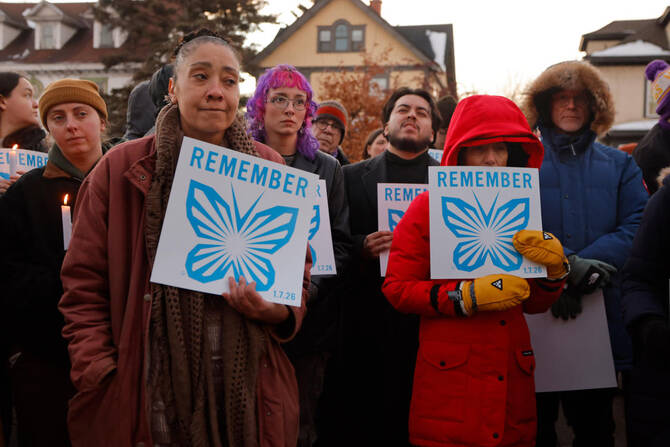
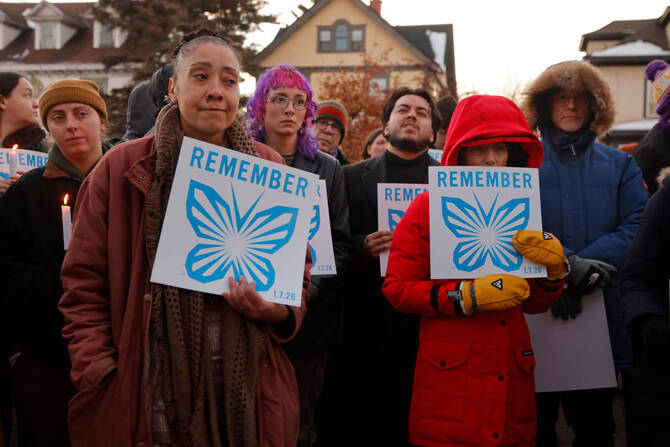
With 2,000 federal officers deployed across the Twin Cities of Minneapolis and Saint Paul, thousands of people gathered in Minneapolis to protest the shooting, while demonstrations were called in New York, Chicago, Seattle, Phoenix, Orlando, and Columbus, Ohio.
The Minnesota operation, which includes US Immigration and Customs Enforcement officers, is part of Republican President Donald Trump’s nationwide crackdown on migrants and a politically charged investigation into fraud allegations against some Minnesota nonprofit groups in the Somali community. At least 56 people have pleaded guilty since federal prosecutors under the previous Democratic administration of Joe Biden, started investigating childcare and other social service programs in the Somali community.
Trump’s DHS secretary, Kristi Noem, labeled Wednesday’s incident as an act of domestic terrorism, saying an experienced officer followed his training with an act of self-defense.
Minnesota Governor Tim Walz and Minneapolis Mayor Jacob Frey, both Democrats, immediately disputed the federal government’s account and blamed Trump for what they called an unnecessary provocation by deploying federal law enforcement.
“It was not ‘domestic terrorism.’ It was state sanctioned violence. A family will forever live with the pain caused by the admin’s reckless and deadly actions,” Democratic US Representative Ilhan Omar, a Somali-American representing Minneapolis and a frequent target of Trump’s political barbs, said on X.
COMPETING NARRATIVES
The competing narratives highlight the political polarization of the US, where Trump’s supporters enthusiastically endorse his version of events and opponents contend his assertions are often provably false.
Video showed masked officers approaching Good’s car, which was stopped at an unusual angle on a Minneapolis street. The car then backs up and pulls away, briefly driving in the direction of the officer who opened fire at close range.
The video did not appear to show contact or any sign that the officer was wounded, though Noem said he was treated at a hospital and released, while Trump said on social media the woman “ran over the ICE Officer.”
Trump administration officials called the incident part of a pattern of anti-Trump demonstrators endangering ICE officers, but critics say they saw a woman attempting to evade masked and armed men and the vehicle’s front wheels turned away from the shooter.
While Trump and Noem drew immediate conclusions that the officer was the subject of an intentional attack, border czar Tom Homan was more cautious.
“It would be unprofessional to comment on what I think happened in that situation. Let the investigation play out and hold people accountable based on the investigation,” Homan told CBS News.
The FBI and Minnesota state officials are investigating. The ICE officer would be protected from being charged by local prosecutors if he was acting within the scope of his official federal duties, and any legal case would likely come down to whether he reasonably feared for his life, said Caren Morrison, a law professor at Georgia State College of Law. She said cases involving vehicles tended to favor officers because a car could be considered a deadly weapon.
Minnesota law allows the use of deadly force by an officer only if an objectively reasonable officer would believe that doing so was necessary to protect the officer or others from immediate death or serious harm. Federal law has a similar standard.
Minnesota civil rights attorney Paul Applebaum said it was unclear who, if anyone, would prosecute the officer. “The possibility of the officer being prosecuted by Pam Bondi are slim to none,” Applebaum said of the US attorney general, a Trump loyalist. He said if state officials tried to charge the officer it would set up a constitutional conflict between state and federal government.
Federal agents are generally immune from state prosecution for actions taken as part of their official duties.
Courts have increasingly narrowed the ability to sue federal officers for damages for civil rights violations to the point it was “almost an empty exercise,” Applebaum said.
’LOVING, FORGIVING AND AFFECTIONATE’
The Minneapolis City Council identified the dead woman as Good and said she was “out caring for her neighbors this morning and her life was taken today at the hands of the federal government.”
She was the mother of a 6-year-old boy, the Minnesota Star Tribune reported, citing the boy’s grandfather.
Good’s mother told the Minnesota Star Tribune that her daughter was “extremely compassionate,” and she said Good was not the type of person to confront ICE agents. “She’s taken care of people all her life,” her mother, Donna Ganger, told the Star Tribune. “She was loving, forgiving and affectionate.”


