

Nationalist Bollywood hit ‘Dhurandhar’ ignites India-Pakistan controversy

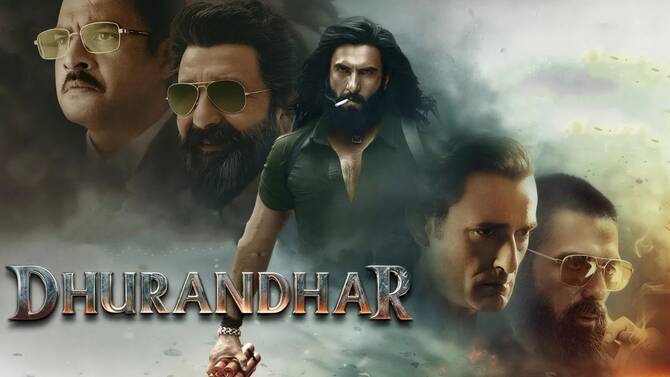
The undated picture movie posture of Bollywood movie ‘Dhurandhar.’ (YouTube)
Short Url
Updated 08 January 2026
Follow

Nationalist Bollywood hit ‘Dhurandhar’ ignites India-Pakistan controversy

  • Movie stars Ranveer Singh as an Indian intelligence agent who infiltrates alleged criminal networks in Karachi
  • Film has drawn sharp criticism from Pakistani officials while becoming one of the year’s biggest hits in India

A Bollywood spy thriller set in Pakistan has sparked heated debate across both countries over its portrayal of cross-border tensions, even as the film breaks box office records in India amid a surge in nationalist cinema.

“Dhurandhar,” starring Ranveer Singh as an Indian intelligence agent infiltrating criminal networks in Pakistan’s Karachi, has drawn sharp criticism from Pakistani officials and some international critics while becoming one of the year’s biggest commercial hits in India.

The 3.5-hour film, directed by Aditya Dhar, weaves real historical events including the 1999 plane hijacking, the 2001 Parliament attack, and the 2008 Mumbai attacks into a fictional narrative about an Indian spy’s mission to dismantle alleged links between Karachi gangs and terror networks.

Released Dec. 5 with minimal publicity, “Dhurandhar” has grossed more than 12.15 billion rupees ($134.76 million) in ticket sales, making it the highest-grossing Bollywood film last year. 

“It is a unique thing. Most films are set in India, but in this film, a RAW agent infiltrates Pakistan and is living there, hiding his identity, and the film portrays all of that through this setup, about Karachi and everything. That’s why it is such a good film. I mean, it is very important to watch this film,” said movie-goer Naresh Kumar.

The film represents a growing trend in Indian cinema toward nationalist blockbusters that align with Prime Minister Narendra Modi’s policies, following controversial hits like “The Kashmir Files” and “The Kerala Story” that sparked debates over historical accuracy while achieving commercial success.

In India, some film critics faced online harassment for negative reviews, prompting the Film Critics Guild to condemn “targeted attacks” against reviewers.

“Films that evoke patriotic fervor among audiences generally do well, but that is not to say that any film with this kind of subject would have done well,” said Bollywood film analyst Komal Nahta. “Everything seems to have gone right with the film.” 

The controversy highlights how cinema continues to reflect decades-old tensions between the nuclear-armed neighbors, who have fought four wars since partition in 1947. Fighting erupted between the countries in May following an attack on tourists in Kashmir that India blamed on Pakistan-backed militants.

In Pakistan’s Lyari neighborhood, which was depicted in the film, residents criticized the portrayal as inaccurate.

“It is a completely baseless movie because our neighboring country doesn’t know anything about our country,” said Mohammad Zohaib, a Lyari resident and burger shop owner. “They don’t know anything about Lyari, so how can they make a completely realistic film about someone?” 

The Pakistan Peoples Party filed legal action in a Karachi court last month over the film’s unauthorized use of assassinated former Prime Minister Benazir Bhutto’s image and its portrayal of party leaders as terrorist sympathizers.

“About 10 percent of what has been shown in the movie is reality, 90 percent is not real,” said Khizer Abdul Wahid, a Lyari resident and beauty salon owner.

Pakistan banned Indian films in 2019, but Bollywood remains popular there with audiences using VPNs or illegal downloads to watch new releases.

Theatre admissions in India have fallen 45 percent since their 2018 peak of 1.58 billion, according to Ernst and Young, as streaming services offer content that complements cheap mobile data available to most Indians.

Even global hits like the latest Avatar film struggled to secure screens due to “Dhurandhar’s” strong showing, analysts said.


Why this year’s Golden Globes race feels so unpredictable

Updated 16 sec ago
Follow

Why this year’s Golden Globes race feels so unpredictable

  • No dominant frontrunner and openness among voters
  • ‘Hamnet,’ ‘Sinners,’ ‘Sentimental Value’ in contention

LOS ANGELES: With the Golden Globes approaching, this awards season has taken on an unusually fluid shape. Instead of a single dominant frontrunner, the race is being defined by range, taste, and a noticeable openness among voters.

Prestige dramas are sharing space with ambitious studio films, while several contenders have built momentum quietly rather than through aggressive campaigns. The result is a season that feels unpredictable — in the best possible way.

Recently announced presenters include a wide cross section of film, television, and music figures. (Supplied)

That sense of openness is reflected not only in the awards race itself, but also in the broader tone surrounding this year’s ceremony. The 83rd Annual Golden Globes will air live on CBS on Sunday, Jan. 11, 2026, with comedian and actress Nikki Glaser returning as host.

Recently announced presenters include a wide cross section of film, television, and music figures.

Among them are Julia Roberts, George Clooney, Jennifer Garner, Kevin Hart, Miley Cyrus, Snoop Dogg, Amanda Seyfried, Ana de Armas, Ayo Edebiri, Colman Domingo, Dakota Fanning, Kathryn Hahn, Queen Latifah, Zoe Kravitz, and Pamela Anderson.

The 83rd Annual Golden Globes will air live on CBS on Sunday, Jan. 11, 2026, with comedian and actress Nikki Glaser returning as host. (Supplied)

The diversity and generational range of the presenter lineup mirrors the season itself, blending established icons with contemporary voices and signaling a ceremony that leans into variety rather than predictability.

In the drama categories, “Hamnet” has emerged as a serious presence, earning steady respect across critics’ groups and industry conversations. Its restrained approach and emotional weight have resonated with audiences and awards watchers who value craft over spectacle.

At the same time, “Sinners” and “Sentimental Value” remain firmly in contention, particularly if voters gravitate toward character-driven storytelling rather than formal experimentation.

Among them are Julia Roberts, George Clooney, Jennifer Garner, Kevin Hart, Miley Cyrus, Snoop Dogg, Amanda Seyfried, Ana de Armas, Ayo Edebiri, Colman Domingo, Dakota Fanning, Kathryn Hahn, Queen Latifah, Zoe Kravitz, and Pamela Anderson. (Supplied)

On the musical or comedy side, “One Battle After Another” appears especially well-positioned, carried by strong ensemble work and a level of sustained buzz that has followed it throughout the season.

The acting races are no less competitive. Wagner Moura has placed himself near the front of the Best Actor, Drama conversation for his performance in “The Secret Agent,” a role widely praised for its restraint and complexity.

Michael B. Jordan continues to generate strong support for “Sinners,” reinforcing his position as a consistent awards presence.

In the musical or comedy field, Timothee Chalamet has become a frequent prediction for “Marty Supreme,” a performance many see as both charismatic and strategically timed.

The actress races are equally open, with Jessie Buckley and Rose Byrne widely cited as leading figures, while the supporting categories continue to spotlight standout work from Stellan Skarsgard and Inga Ibsdotter Lilleaas.

In directing, momentum appears to favor Paul Thomas Anderson for “One Battle After Another,” reflecting both critical admiration and industry confidence.

Screenplay and score conversations have included “Sinners” and “KPop Demon Hunters,” underscoring a year that balances artistic ambition with broader appeal.

However the night ultimately unfolds, this year’s Golden Globes feels less about safe consensus choices and more about recognizing work that lingered long after the credits rolled.

From the nominees to the presenters taking the stage, the ceremony reflects a film year defined by confidence, creative risk, and a refreshing absence of certainty.