

Pakistan partners with Swiss firm to provide free cancer treatment to patients

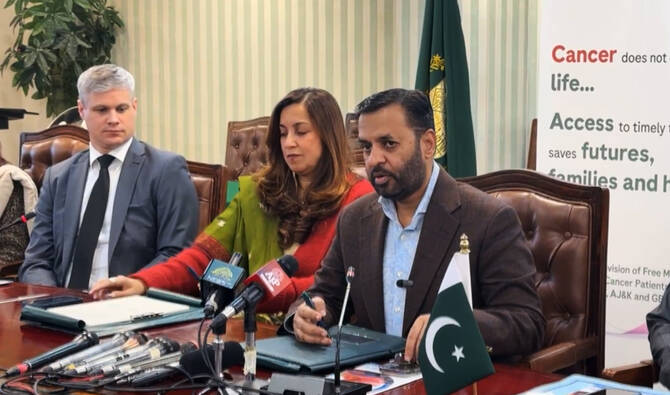
Federal Health Minister Mustafa Kamal (right) speaks after signing an agreement with leading Swiss pharmaceutical firm Roche in Islamabad, Pakistan, on January 9, 2026. (Screengrab/Health Ministry)
Short Url
Updated 09 January 2026
Follow

Pakistan partners with Swiss firm to provide free cancer treatment to patients

  • In Pakistan, more than 185,000 new cancer cases and over 125,000 deaths are reported annually
  • Under the agreement, Roche Pakistan will bear 70% cost of cancer medicines, government will pay 30%

ISLAMABAD: Pakistan has partnered with a leading Swiss pharmaceutical firm, Roche, to provide costly cancer treatment to Pakistani patients free of cost, the country’s health minister said on Friday, as the two sides signed an agreement in this regard.

Cancer is an insidious disease, alarmingly shaping the global health crisis as it claims millions of lives each year. Responsible for one in six deaths worldwide, cancer cases are projected to reach 26 million annually by 2030, with developing countries shouldering 75% of this burden.

Over 70% of cancer deaths occur in low- and middle-income countries (LMICs), where survival rates hover at just 30%. The reasons are manifold, including inadequate access to early detection and treatment services, lack of awareness, and societal taboos, to name a few.

In Pakistan alone, more than 185,000 new cases and more than 125,000 deaths are reported annually. Breast cancer is the most common, accounting for 16.5% of cases, followed by lip and oral cavity cancers (8.6%) and lung cancer (5.1%), according to Aga Khan University Hospital (AKUH).

“Roche Pakistan has proposed to the government many years ago that the cure for this cancer is only with them... and they want to do a partnership with the Government of Pakistan. They want to give 70% of the price of the medicine,”

Health Minister Mustafa Kamal said, adding the government would bear the rest of the 30% cost of treatment.

“And whoever is given this medicine should be given it free of cost.”

Kamal shared that cancer treatment in Pakistan costs around Rs9.8 million ($34,588) in five years on an average.

“[Most] people don’t have this (amount). So, this was a very important project,” he said.

Citing a World Health Organization (WHO) report, the health minister said millions of Pakistanis, who were not born poor, had fallen below the poverty line after falling sick.

“Houses were sold, plots were sold, jewelry was sold, everything was sold and illness made them poor,” he said, praising Roche Pakistan for its support.

Speaking at the agreement-signing ceremony, Roche Pakistan Managing Director Hafsa Shamsie called it “just the first step.”

“We will enhance the number of patients, we will enhance the disease areas, and God willing, we will go into other parts of the patient journey, like awareness and diagnosis,” she said.

Pakistan last year vaccinated over 10 million adolescent girls against a virus that causes cervical cancer as part of a continuing national campaign that has overcome early setbacks fueled by skeptics online.

Cervical cancer is the third most common cancer among Pakistani women after breast and ovarian cancers. Globally, it is the fourth most common. Each year, between 18,000 and 20,000 women in Pakistan die of the disease, according to health authorities.

The girls targeted in the initial campaign were in Punjab and Sindh provinces and in Azad Kashmir. The country plans to expand the coverage to additional areas by 2027, hoping to eliminate cervical cancer as a public health problem by 2030. It became the 149th country to add the HPV vaccine to its immunization schedule.


Pakistan eyes enhancing mines, minerals cooperation with Saudi Arabia at Future Minerals Forum 2026

Updated 5 sec ago
Follow

Pakistan eyes enhancing mines, minerals cooperation with Saudi Arabia at Future Minerals Forum 2026

  • Pakistan’s Petroleum Minister Ali Pervaiz Malik meets Saudi Minister of Industry and Mineral Resources Bandar Ibrahim Alkhorayef in Riyadh
  • Saudi minister offers to support Pakistan’s mining industry via Kingdom’s knowledge and expertise, says Pakistan’s petroleum ministry

ISLAMABAD: Pakistan’s Petroleum Minister Ali Pervaiz Malik met Saudi Arabia’s minister of industry and mineral resources at the Future Minerals Forum (FMF) in Riyadh on Monday, the Pakistani petroleum ministry said, during which both sides agreed to strengthen cooperation in the mines and minerals sector. 

Malik is leading the Pakistani delegation at the FMF 2026 summit in Riyadh. The Jan. 13-15 event is expected to attract around 20,000 representatives from governments, businesses, multilateral and non-governmental organizations, academic institutions and trade associations from more than 160 countries, organizers said. At least 13 public and private companies from Pakistan’s mines and mineral sector are participating in the event. 

“The minister held a meeting with Saudi Minister of Industry and Mineral Resources Bandar Ibrahim Alkhorayef, during which both sides agreed to further strengthen bilateral cooperation in the minerals and mining sector,” the Pakistani petroleum ministry said in a statement. 

The ministry said Alkhorayef pointed out “vast opportunities” for cooperation between Pakistan and Saudi Arabia in the mineral sector, adding that the Kingdom would support the development of Pakistan’s mining industry through its knowledge and technical expertise. 

Malik said fertilizer production and medical devices manufacturing sectors also present important opportunities for joint ventures between Pakistan and Saudi Arabia.

In recent years, Saudi Arabia has positioned itself as a leader in the global minerals and energy sectors and accelerated investments in green technologies, sustainable mining practices and international collaborations that are shaping the future of the mines and mineral industry.

Pakistan organized a minerals summit in April 2025 which saw participation from major international companies including the Canada-based Barrick Gold and officials from the US, Saudi Arabia, China, Türkiye, UK, Azerbaijan and other nations. 

Islamabad also plans to organize a Pakistan Mineral Investment Forum this year to attract foreign investment in its mines and minerals sector. Pakistan lies in the middle of the mineral-rich geological zone, called the ‘Tethyan Belt,’ where one of the world’s largest copper-gold mines is currently under development at Reko Diq. 

This mine is expected to start production by 2028.