US allies, foes alarmed by capture of Venezuela’s Maduro

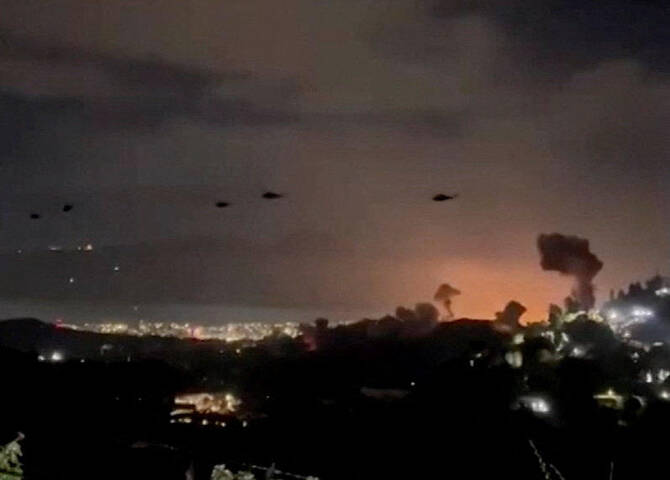
Helicopters fly past plumes of smoke rising from explosions in Caracas during the US raid to capture Maduro. (Screengrab via Reuters)
Short Url
Updated 04 January 2026
Follow

US allies, foes alarmed by capture of Venezuela’s Maduro

  • Countries such as Russia and China, which had ties with Maduro’s government, were quick to condemn the operation but alarm also shared by France and EU
  • UN Secretary-General Antonio Guterres was “deeply alarmed” by the US strikes

PARIS: The US military operation that led to the seizure of Venezuelan President Nicolas Maduro on Saturday sparked international alarm, with allies and foes of Washington and Caracas expressing disquiet.
President Donald Trump said that the United States would “run” Venezuela and tap its huge oil reserves, and posted a picture of Maduro in custody on a US naval ship wearing a blindfold and handcuffs.
Maduro and his wife were being taken to New York to face narcotics and terrorism charges.
Countries such as Russia and Iran, which had longstanding ties with Maduro’s government, were quick to condemn the operation but their alarm was also shared by Washington’s allies including France and the EU.
Here are the main reactions.

Russia

Russia demanded the US leadership “reconsider its position and release the legally elected president of the sovereign country and his wife.”

China

Beijing said “China is deeply shocked and strongly condemns the US’s blatant use of force against a sovereign state and its action against its president.”

Iran

Iran, which Trump bombed last year, said it “strongly condemns the US military attack on Venezuela and a flagrant violation of the country’s national sovereignty and territorial integrity.”

Mexico

Mexico, which Trump has also threatened with military force over drug trafficking, strongly condemned the US military action in Venezuela, saying it “seriously jeopardizes regional stability.”

Colombia

Colombian President Gustavo Petro — whose country neighbors Venezuela — called the US action an “assault on the sovereignty” of Latin America which would lead to a humanitarian crisis.

Brazil

Brazilian President Luiz Inacio Lula da Silva slammed the US attacks as a “serious affront” to Venezuela’s sovereignty.

Cuba

Cuba, a strong ally of Venezuela, denounced “state terrorism against the brave Venezuelan people.”

Spain

Prime Minister Pedro Sanchez said the intervention “violates international law and pushes the region toward a horizon of uncertainty and militarism.”

France

France said the US operation undermined international law, and no solution to Venezuela’s crisis can be imposed externally.
President Emmanuel Macron called for 2004 presidential candidate Edmundo Gonzalez Urrutia to lead a political transition.

Germany

Chancellor Friedrich Merz said that Maduro had “led his country to ruin,” but called the US action legally “complex.”

EU

The EU more generally expressed concern at the developments and urged respect for international law, even as it noted that Maduro “lacks legitimacy.”
EU candidate country North Macedonia, along with fellow Balkan nations Albania and Kosovo, backed Washington, however.
“We stand with the United States and the Venezuelan people for freedom and democracy,” North Macedonia FM Timco Mucunski said on X.

Britain

Prime Minister Keir Starmer said the UK will discuss the “evolving situation” in Venezuela with US counterparts while noting Britain will “shed no tears” about the demise of Maduro’s “regime.”

Italy

In a rare expression of support for the US operation by a major European country, far-right Italian Prime Minister Giorgia Meloni — a Trump ally — argued the US military action in Venezuela was “legitimate” and “defensive.”

Israel

Israel also hailed the operation, saying Washington acted as the “leader of the free world.”

Ukraine

Ukraine — dependent on US support in its war against invading Russia — did not address the legality of a big country like America using military force against a much smaller one like Venezuela.
Foreign minister Andriy Sybiga instead focused on Maduro’s lack of legitimacy and the Venezuelan government’s repression, while backing “democracy, human rights, and the interests of Venezuelans.”

South Africa

South Africa, which Trump accuses of alleged discrimination — and even “genocide” — of minority white Afrikaners, said: “Unlawful, unilateral force of this nature undermines the stability of the international order and the principle of equality among nations.”

UN

UN Secretary-General Antonio Guterres was “deeply alarmed” by the US strikes, with his spokesman quoting him as saying it could “constitute a dangerous precedent.”


’Content to die’: Afghanistan’s hunger crisis worsened by winter, aid cuts

Updated 5 sec ago
Follow

’Content to die’: Afghanistan’s hunger crisis worsened by winter, aid cuts

  • As winter spreads across Afghanistan’s arid landscape, work opportunities have dried up, while the wave of returning Afghans has swelled the population by a tenth, said Aylieff of WFP
  • “Last year was the biggest malnutrition surge ever recorded in Afghanistan and sadly the prediction is that it’s going to get worse“

KABUL: In the dull glow of a single bulb lighting their tent on the outskirts of Kabul, Samiullah and his wife Bibi Rehana sit down to dry bread and tea, their only meal of the day, accompanied by their five children and three-month-old grandchild.
“We have reached a point where we are content with death,” said 55-year-old Samiullah, whose family, including two older sons aged 18 and 20 and their wives, is among the millions deported by neighboring Iran and Pakistan in the past year.
“Day by day, things are getting worse,” he added, after their return to a war-torn nation where the United Nations’ World Food Programme estimates 17 million battle acute hunger after massive cuts in international aid.
“Whatever happens to us has happened, but at least our children’s lives should be better.”
He was one of the returned Afghans speaking before protests in Iran sparked a massive crackdown by the clerical establishment, killing more than 2,000 in ensuing violence.
Samiullah said his family went virtually overnight from its modest home in Iran to their makeshift tent, partially propped up by rocks and rubble, after a raid by Iranian authorities led to their arrests and then deportation.
They salvaged a few belongings but were not able to carry out all their savings, which would have carried them through the winter, Samiullah added.
Reuters was unable to reach authorities in Iran for ⁠comment.
“Migrants who are newly returning to the country receive assistance as much as possible,” said Afghan administration spokesman Zabiullah Mujahid, in areas from transport to housing, health care and food.
It was impossible to eradicate poverty quickly in a country that suffered 40 years of conflict and the loss of all its revenue and resources, he added in a statement, despite an extensive rebuilding effort.
“Economic programs take time and do not have an immediate impact on people’s lives.”
The WFP says Iran and Pakistan have expelled more than 2.5 million Afghans in massive repatriation programs.
Tehran ramped up deportations last year amid a flurry of accusations that they were spying for Israel. Authorities blamed the expulsions on concerns about security and resources.
Islamabad accelerated deportations amid accusations that the Taliban was harboring militants responsible for cross-border attacks ⁠on Pakistani soil, allegations Afghanistan has denied.

NO INCOME, NO AID
As winter spreads across Afghanistan’s arid landscape, work opportunities have dried up, while the wave of returning Afghans has swelled the population by a tenth, said John Aylieff, the WFP’s country director.
“Many of these Afghans were working in Iran and Pakistan and they were sending back remittances,” he told Reuters, adding that 3 million more people now face acute hunger. “Those remittances were a lifeline for Afghanistan.”
Cuts to global programs since US President Donald Trump returned to the White House have sapped the resources of organizations such as the WFP, while other donor countries have also scaled back, putting millions at risk worldwide.
“Last year was the biggest malnutrition surge ever recorded in Afghanistan and sadly the prediction is that it’s going to get worse,” added Aylieff, estimating that 200,000 more children would suffer acute malnourishment in 2026.
At the WFP’s aid distribution site in Bamiyan, about 180 km (111 miles) from Kabul, the capital, are stacks of rice bags and jugs of palm oil, while wheelbarrows trundle in more food, but it is still too little for the long queues of people.
“I am forced to manage the winter with these ⁠supplies; sometimes we eat, sometimes we don’t,” said Zahra Ahmadi, 50, a widowed mother of eight daughters, as she received aid for the first time.

’LIFE NEVER REMAINS THE SAME’
At the Qasaba Clinic in the capital, mothers soothed their children during the wait for medicine and supplements.
“Compared to the time when there were no migrants, the number of our patients has now doubled,” said Dr. Rabia Rahimi Yadgari.
The clinic treats about 30 cases of malnutrition each day but the supplements are not sufficient to sustain the families, who previously relied on WFP aid and hospital support, she said.
Laila, 30, said her son, Abdul Rahman, showed signs of recovery after taking the supplements.
“But after some time, he loses the weight again,” she said.
After the Taliban takeover, she said, “My husband lost his (government) job, and gradually our economic situation collapsed. Life never remains the same.”
The United States led a hasty withdrawal of international forces from Afghanistan in July 2021, after 20 years of war against the Taliban, opening the doors for the Islamists to take control of Kabul.
As dusk gathers and the temperature falls, Samiullah brings in firewood and Bibi Rehama lights a stove for warmth.
“At night, when it gets very cold, my children say, ‘Father, I’m cold, I’m freezing.’ I hold them in my arms and say, ‘It’s OK.’ What choice do we have?” Samiullah said.
“(When) I worked in Iran, at least I could provide a full meal. Here, there is neither work nor livelihood.”