


PALM BEACH, United States: President Donald Trump said Saturday that the United States will “run” Venezuela and tap its huge oil reserves after snatching leftist leader Nicolas Maduro out of the country during a bombing raid on Caracas.
Trump’s announcement came hours after a lightning attack in which special forces grabbed Maduro and his wife, while airstrikes pounded multiple sites, stunning the capital city.
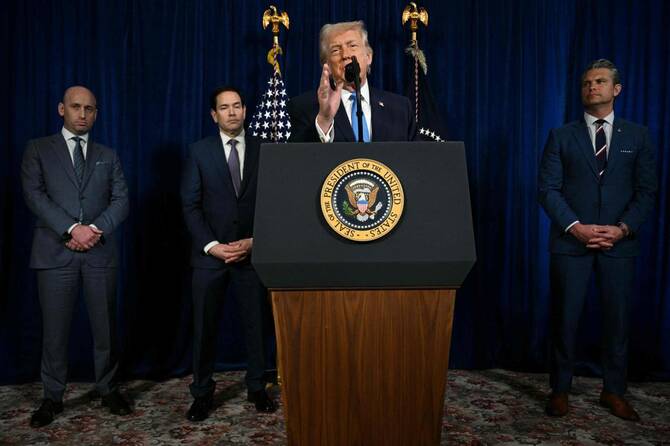
Trump did not go into detail what he meant but told a press conference in Florida: “We’re going to be running it with a group.”
“We’re designating people,” he said, mentioning that cabinet officials standing with him would be in charge.
In another surprise, Trump indicated that US troops could be deployed in Venezuela.
The US is “not afraid of boots on the ground,” he said.
Although the operation is being framed as a law-enforcement action, Trump made clear that regime change and Venezuela’s oil riches are the major goals.
“We’re going to have our very large United States oil companies, the biggest anywhere in the world, go in, spend billions of dollars, fix the badly broken infrastructure,” he said.
“We’ll be selling large amounts of oil,” he said.
The 79-year-old Republican posted a picture of Maduro in custody on a US naval ship wearing a blindfold, handcuffs and what looked like noise-canceling ear muffs. He and his wife were being taken to New York to face narcotics and terrorism charges.
Trump dismisses opposition leader
US-backed opposition leader Maria Corina Machado, who won the Nobel Peace Prize last year, posted on social media: “the hour of freedom has arrived.”
She called for the opposition’s candidate in the 2024 election, Edmundo Gonzalez Urrutia, to “immediately” assume the presidency.
But Trump scotched any expectation that Machado should emerge as Venezuela’s new leader. She doesn’t have “support or respect” there, he said.
He indicated he could instead work with Maduro’s deputy, Delcy Rodriguez, saying “she’s essentially willing to do what we think is necessary to make Venezuela great again.”
Trump also made clear that the US presence is unlikely to be short.

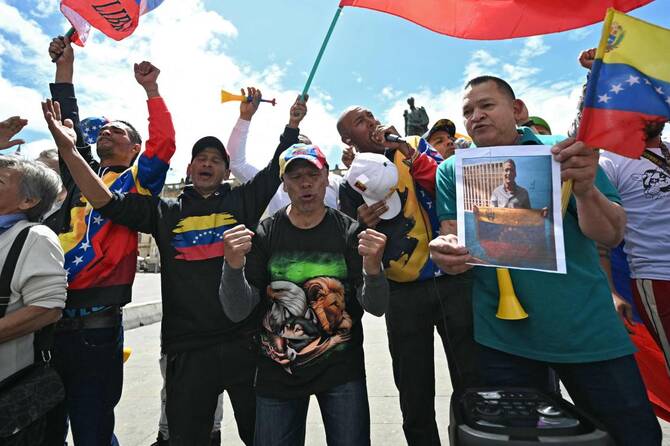
People celebrate at the Bolivar square in Caracas on Saturday, after US forces captured Venezuelan leader Nicolas Maduro. (AFP)
“We’re there now, but we’re going to stay until such time as the proper transition can take place.”
The United Nations chief said he was “deeply concerned that the rules of international law have not been respected.”
China, a backer of Maduro’s hard-left regime, said it “strongly condemns” the US attack, while France warned that a solution for troubled Venezuela cannot “be imposed from outside.”
Black-out and bombing
Venezuelans had been bracing for attacks as US forces, including the aircraft carrier USS Gerald R. Ford, spent months massing off the coast.
Caracas residents woke to explosions and the whir of military helicopters around 2:00 am (0600 GMT). Airstrikes hit a major military base and an air base, among other sites, for nearly an hour, AFP journalists said.
The bombing turned out to be only part of the more ambitious plan to topple Maduro and bring him to US soil to face narco-trafficking charges.
Trump said the assault began with a partial blackout caused by US “expertise.”
The top US military officer, General Dan Caine, said 150 aircraft took part in the operation, supporting troops helicoptering in to seize Machado with the help of months of intelligence into the leader’s daily habits — down to “what he ate” and what pets he kept.
Maduro, 63, and his wife “gave up” without a struggle and there was “no loss of US life,” he said.
Maria Eugenia Escobar, a 58-year-old resident of La Guaira, near the heavily bombed main airport, told AFP that the blasts “lifted me out of bed, and I immediately thought, ‘God, the day has come.’“
Within hours of the operation, Caracas had fallen eerily quiet, with police stationed outside public buildings and a smell of smoke drifting through the streets.
Shifting justifications
The US and numerous European governments already did not recognize Maduro’s legitimacy, saying he stole elections both in 2018 and 2024.
Maduro — in power since 2013 after taking over from leftist mentor Hugo Chavez — long accused Trump of seeking regime change in order to control Venezuela’s huge oil reserves.
Trump said the extraordinary snatching of a foreign country’s leader was justified because of his claim that Venezuela is responsible for mass death from drugs in the United States.
But Trump has given a variety of justifications for the aggressive policy toward Venezuela, at times stressing illegal migration, narcotics trafficking and the country’s oil industry.
He had previously avoided openly calling for regime change — likely mindful of his nationalist political base’s dislike for foreign entanglements.
Several members of Congress quickly questioned the legality of the operation. However, Trump’s key ally Mike Johnson, Republican speaker in the House of Representatives, said it was “decisive and justified.”


