

India displays ancient Buddhist jewels taken during British colonial rule 

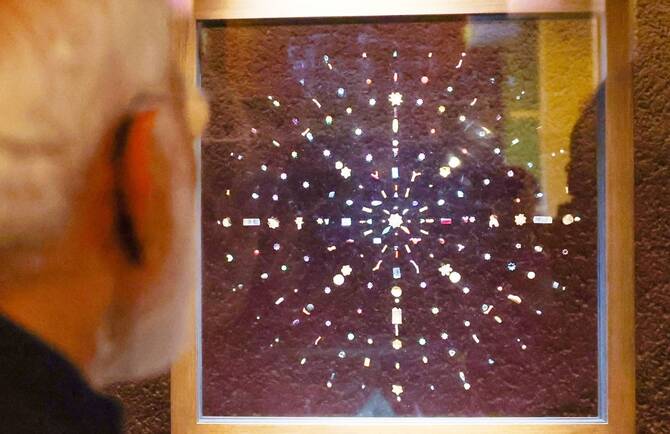
Indian Prime Minister Narendra Modi takes a look at the Piprahwa Gems displayed at an exhibit in New Delhi on Jan. 3, 2025. (PIB)
Short Url
Updated 03 January 2026
Follow

India displays ancient Buddhist jewels taken during British colonial rule 

  • Piprahwa gems are believed to have been buried with bodily relics of the Buddha  
  • Precious stones are ‘living presence’ of the Buddha himself, expert says 

NEW DELHI: Sacred ancient gems linked to the Buddha’s remains went on display at an exhibit in New Delhi on Saturday, almost 130 years since they were taken abroad during British colonial rule.  

The Piprahwa gems, named after the town in what is now the northern Indian state of Uttar Pradesh, were removed by British colonial engineer William Claxton Peppe during excavations of a nearby religious site in 1898.  

The collection of more than 300 carved gems is believed to be more than 2,000 years old and was found with the bodily relics of the Buddha in northern India, near the border with Nepal. 

“India is not only the custodian of Lord Buddha’s sacred relics but also the living carrier of his tradition,” Indian Prime Minister Narendra Modi said during the opening of the exhibit.  

“These sacred relics of Lord Buddha are India’s heritage. After a century-long wait, they have returned to the country.”  

In May, the precious stones made international headlines after Peppe’s descendants, who kept a portion of the gems, put the items up for sale and consigned them for auction by Sotheby’s in Hong Kong, with bidding starting at roughly $1.3 million.  

After the auction sparked an international outcry from Buddhist leaders, academics, and devotees, the Indian government intervened, threatening legal action and demanding the return of the jewels.  

The gems were repatriated to India in July through a public-private partnership between the Indian government and Godrej Industries Group, a Mumbai-based Indian conglomerate, which reportedly acquired the jewels. 

The New Delhi exhibit marked the first time the entire collection was displayed to the Indian public since they were excavated by the British in the late 19th century.  

“After the excavation, a portion had been kept by the excavator William Claxton Peppe, and it became his family heirloom. And, of course, it traveled out of India, and a portion remained at the Indian Museum,” Lily Pandey, a joint secretary at the Indian Ministry of Culture, told Arab News on the sidelines of the event.  

Pandey said that a series of “very fortunate events” led to the exhibition and the showing of all the gems together. 

The Piprahwa relics are considered central in the archaeological study of early Buddhism and are “among the earliest and most historically significant relic deposits directly connected” to the Buddha, the Indian government said in a release.  

Savita Kumari, an associate professor at the Indian Institute of Heritage, said the exhibit gave Indians an opportunity to connect with the Buddha.  

“Buddha is actually present in these relics,” she told Arab News.  

“It’s the living presence of Buddha himself. So, it is very important emotionally and spiritually for the people of the country to have it with us.”  


Iran war unsettles India’s packaged water makers as bottles, caps get pricey

Updated 4 sec ago
Follow

Iran war unsettles India’s packaged water makers as bottles, caps get pricey

  • Higher polymer ‌prices hurt bottled water industry
  • Industry worth $5 billion has big multinational players like Pepsi, Coca-Cola
NEW ​DELHI: The Iran war is rattling India’s $5 billion packaged water market just ahead of the sweltering summer season.
One of the world’s fastest growing bottled water markets is seeing some manufacturers hike prices for distributors, as supply disruptions linked to the war fuel higher costs in everything from plastic bottles to caps, labels and cardboard boxes.
Though retail prices are yet to feel the heat and bigger companies are absorbing the pain, about 2,000 smaller bottled water makers have increased rates for their resellers by around 1 rupee per ‌bottle, a ‌5 percent hike, which will rise by a further 10 percent in ​coming ‌days, ⁠according ​to the ⁠Federation of All India Packaged Drinking Water Manufacturers’ Association.
Consumers usually pay less than 20 rupees, or around 20 US cents, for a one-liter bottle.
“There is chaos and within the next 4-5 days, this will start impacting customer prices,” said Apurva Doshi, the federation’s secretary general.
Rising oil prices have increased the cost of polymer, which is made from crude oil and is a key material for the industry’s plastic bottles. The cost of material used in making ⁠plastic bottles has risen by 50 percent to 170 rupees per kilogram, ‌while the price of the caps has more than ‌doubled to 0.45 rupees apiece. Even corrugated boxes, labels and ​adhesive tape are costing much more, ‌industry letters showed.
Clean water is a privilege in the country of 1.4 billion people where ‌researchers say 70 percent of the groundwater is contaminated, leaving people reliant on bottled water. Companies including Bisleri, Coca-Cola’s Kinley, Pepsi’s Aquafina, billionaire Mukesh Ambani’s Reliance and Tata all compete for a share of the $5 billion market. The companies did not respond to Reuters request for comment.
PREMIUM WATER FACES HEAT ‌TOO
Within the broad bottled water market, natural mineral water is a $400 million business in India and a new, fast-growing wellness product for ⁠India’s wealthy.
The premium ⁠water segment accounted for 8 percent of the bottled water market last year in India, compared to just 1 percent in 2021, Euromonitor says.
Aava, which sells mineral water sourced from the foothills of the Aravalli mountains, has increased prices of its water bottles by 18 percent for resellers, Shiroy Mehta, CEO of the company, told Reuters.
“Most manufacturers are absorbing 40-50 percent of the cost to ensure that they don’t lose clients. It’s a poor situation for the beverage industry ahead of the summer season,” he said.
The mass market, however, is dominated by companies that produce “drinking water” to be sold in 1-liter bottles to customers. Clear Premium Water, a brand of India’s Energy Beverages, said in a notice to its distributors there ​had been an “unprecedented and continuous surge” in ​prices of key raw materials used in packaging and production.
“It is no longer possible for us to absorb the escalating costs while maintaining existing product prices,” the notice said.