

Report: Low light pollution in Northern Borders is ideal for astronomers

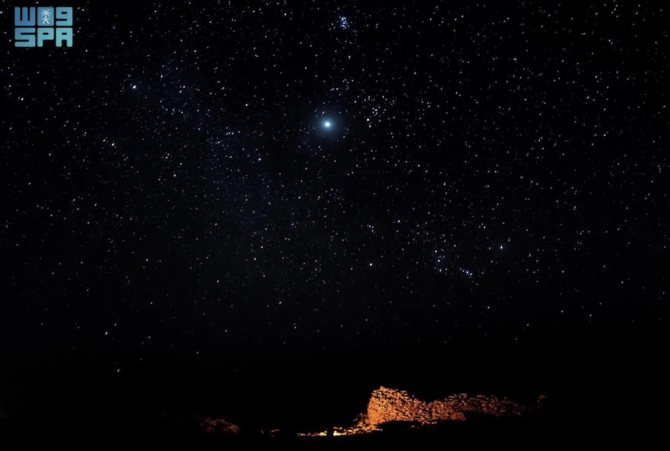
Northern Borders Region - a prime destination for astronomical observation. (SPA)
Short Url
Updated 02 January 2026
Follow

Report: Low light pollution in Northern Borders is ideal for astronomers

  • Region has a vast desert horizon and few tall buildings
  • Rare meteorological event recently in Northern Borders

RIYADH: The Kingdom’s Northern Borders, characterized by significantly lower levels of light pollution, is a prime destination for astronomical observation, the Saudi Press Agency reported on Friday.

The SPA quoted from a recent report from the Visible Infrared Imaging Radiometer Suite which is circling in space.

The VIIRS is a whiskbroom scanner radiometer that collects imagery and radiometric measurements of land, atmosphere, cryosphere, and oceans in the visible and infrared bands of the electromagnetic spectrum.

This lower level of light pollution, according to the VIIRS, is found in the open areas surrounding Turaif, east of Rafha, and west of the city of Arar.

The Bortle Scale, which measures night-sky brightness, shows readings allowing the Milky Way to be seen with the naked eye on clear nights.

“The vast desert horizon and the scarcity of tall buildings contribute to improved astronomical observation conditions by minimizing ambient light and enhancing viewing quality,” the SPA reported.

“This allows celestial phenomena, such as meteor showers and planetary conjunctions, to be observed with greater precision.”

The report added: “Due to these factors, the region is an ideal destination for amateur astrophotographers and astrophysicists seeking a dark, expansive sky that enables them to observe celestial objects with greater clarity.”

Recently a striking astronomical and optical phenomenon was observed in the Northern Borders, as light pillars appeared in the sky, drawing the attention of locals and enthusiasts of natural phenomena.

A light pillar is an optical phenomenon that occurs in the atmosphere as a vertical column extending above or below its source. This effect is caused by the reflection of light on tiny ice crystals suspended in clouds or the air.

Abouazza El-Mhamdi, an associate professor in the physics and astronomy department at King Saud University, told Arab News at that it was a “rare meteorological event — the vibrant light pillars that illuminated the night sky, was crucial for astronomy and astro tourism in the region.”

“Although these pillars are common in Arctic climates like Canada or Russia, their appearance in the Northern Border region is a remarkable anomaly, highlighting the unique and intense winter conditions affecting the Kingdom’s northern reaches,” said El-Mhamdi.


Jeddah students get closer look at electric motorsport

Updated 24 January 2026
Follow

Jeddah students get closer look at electric motorsport

  • A PIF-linked initiative highlights technical and engineering careers behind electric racing events

JEDDAH: Students from local and international schools in Jeddah were introduced to STEM-related career pathways in electric motorsport this week, as part of an education program linked to the UIM E1 World Championship held on the Red Sea.

The sessions formed part of Driving Force Presented by the Public Investment Fund, an initiative run by Formula E and its electric racing series partners, to familiarize students aged eight to 18 with science, technology, engineering and mathematics through electric racing and sustainability-focused industries.

The sessions for students formed part of Driving Force Presented by the Public Investment Fund, an initiative run by Formula E and its electric racing series partners. (Supplied)

The programme took place alongside the 2026 E1 Jeddah GP and included workshops, school visits and trackside access designed to show how engineering, data, broadcast technology and event operations function within professional motorsport.

According to organisers, the initiative reached more than 60,000 students globally in 2025, with further expansion planned this year. 

HIGHLIGHTS

• The program took place alongside the 2026 E1 Jeddah GP and included workshops, school visits and trackside access.

• Students learned about E1 races and their technical and environmental dimensions and discussed the engineering and marine aspects of electric boats.

• According to organisers, the initiative reached more than 60,000 students globally in 2025, with further expansion planned this year. 

John Williams, managing director at E1, told Arab News: “The PIF is absolutely vital to everything we do here at the E1. They were crucial initial investment partner since the start of the championship and they continue to support us in a number of ways and more specifically around the Driving Force program.”

The sessions for students formed part of Driving Force Presented by the Public Investment Fund, an initiative run by Formula E and its electric racing series partners. (Supplied)

Elaborating more on the program, he said: “What we are doing is presenting and showing these students the available careers of science, technology, engineering and mathematics, as well as careers in sports, not only pilots but also engineers and mechanics.”

Williams added that the main key to the program was bringing a new generation to the mechanism of sport.

“We are introducing to these exciting new technologies around the race but it could be our technology on the boat or our broadcast products, as well as how to manage the event its self. There are a range of opportunities to show it to the children in addition to enjoying the excitement of the race and meeting the pilots.”

The program’s Jeddah activities began at King Abdulaziz University’s faculty of maritime studies, where students took part in a hands-on workshop focused on STEM careers in the motorsport and sustainability areas conducted by technology experts and famous water pilots such as Dani Clos, Emma Kimilainen and Patricia Pita.

Students learned about E1 races and their technical and environmental dimensions and discussed the engineering and marine aspects of electric boats.

They also enjoyed exclusive behind-the-scenes access at the E1 Jeddah GP, pilot meet-and-greets, and front-row seats to watch the RaceBird boats in action.