


Light pollution threatens to darken the night sky in 20 years, scientists warn

Aside from astronomical and cultural repercussions, the excessive or inappropriate use of outdoor artificial light is affecting human health and wildlife behavior. (AFP/File)
Short Url
Updated 29 May 2023
Follow

Light pollution threatens to darken the night sky in 20 years, scientists warn

  • Disappearance of stars is having consequences on humans, animals
  • Singapore, Qatar and Kuwait top list of most light-polluted countries in the world

LONDON: Light pollution could darken the night sky in just two decades, making stars invisible to the human eye, scientists warned.

Martin Rees, the British astronomer royal, said in an interview with The Guardian that light pollution has worsened rapidly in recent years and could soon wipe out our ability to see the night sky.

“The night sky is part of our environment, and it would be a major deprivation if the next generation never got to see it, just as it would be if they never saw a bird’s nest,” Rees said.

“You don’t need to be an astronomer to care about this. I am not an ornithologist but if there were no songbirds in my garden, I’d feel impoverished.”

Rees noted that in 2016, astronomers reported that the Milky Way was no longer visible to a third of humanity. He attributed this to the increasing use of light-emitting diodes and other forms of lighting, which are now brightening the night sky at a dramatic rate.

The World Atlas of Night Sky Brightness, a computer-generated map that provides data on how and where our globe is lit up at night, shows that vast areas of North America, Europe, the Middle East, and Asia are glowing with light, while only the most remote regions on Earth (Siberia, the Sahara, and the Amazon) remain in total darkness.

The map, based on thousands of satellite photos, reveals that Singapore, Qatar, and Kuwait are among the most light-polluted countries in the world, highlighting how densely populated areas are most affected by the issue.

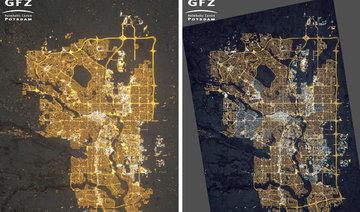
According to research by physicist Christopher Kyba, of the German Centre for Geosciences, light pollution is now obscuring the stars at a rate of about 10 percent per year.

Kyba explained that a child born where 250 stars are visible at night today would only be able to see about 100 by the time they reach 18.

“A couple of generations ago, people would have been confronted regularly with this glittering vision of the cosmos, but what was formerly universal is now extremely rare. Only the world’s richest people, and some of the poorest, experience that anymore. For everybody else, it’s more or less gone,” Kyba said.

Aside from astronomical and cultural repercussions, the excessive or inappropriate use of outdoor artificial light is affecting human health and wildlife behavior.

Scientists warned that the increased use of lights wreaks havoc on natural body rhythms in humans and animals, destabilizing many wild species that rely on the night sky for their migration movements.

In 2019, scientists found that the issue is contributing to an “insect apocalypse,” after discovering that light has a significant impact on how bug species move, search for food, reproduce, grow and hide from predators.

Nevertheless, introducing only a modest number of changes to lighting could considerably improve the situation and have “an enormous impact,” Kyba argued.

These moves would include ensuring outdoor lights are carefully shielded, point downwards, have limits placed on their brightness, and are not predominantly blue-white but have red and orange components.

Essex man takes on charity endurance challenge for children in Gaza

Updated 04 January 2026
Follow

Essex man takes on charity endurance challenge for children in Gaza

  • Mark Watson, 63, is undertaking a “virtual Sumud” journey from his Essex home town in Harlow to Gaza, covering 2,287 miles

LONDON: A man in England has launched a demanding charity challenge to raise funds for children affected by the war in Gaza.

Mark Watson, 63, is undertaking a “virtual sumud” journey from his Essex home town in Harlow to Gaza, covering 3,680 km running, walking, swimming, cycling and rowing.

He is raising money for Medical Aid for Palestinians, a UK-based humanitarian organization that provides healthcare to Palestinians in Gaza and the occupied territories.

“I have felt helpless day after day seeing images of countless children in Gaza with broken bodies and missing limbs and witnessing their unbearable suffering,” Watson said on his JustGiving page.

“I have been inspired by the courage of those who took part in the global sumud flotilla and all of the activists who have put their lives and freedom at risk supporting the Palestinian people and so I am raising funds for Medical Aid for Palestinians.

“My challenge is to complete a virtual sumud from Harlow, where I live, to Gaza. Running, walking, swimming, cycling and rowing I will cover the 2,287 miles as quickly as I can.

“I am an unfit, overweight 63-year-old, so I’m not going to break any records, but the Arabic word Sumud means steadfastness and perseverance, and I will give it my all.

Watson added: “I hope to be joined by people I love and admire along the way, so please support my fundraiser. Every donation, however small, will help save the lives of Palestinians.”

As of Jan. 3, his fundraising effort had reached 12 per cent of its £5,000 ($6,733) target.

The war in Gaza began after the Oct. 7, 2023, attack by Hamas on southern Israel, in which about 1,200 people were killed and more than 200 taken hostage, according to Israeli authorities.

Israel responded with a large-scale military campaign in Gaza, which local health authorities say has resulted in the deaths of more than 71,000 Palestinians, widespread destruction of civilian infrastructure and a severe humanitarian crisis.

International aid agencies have repeatedly said that children are among the most affected, facing injury, displacement, malnutrition and limited access to medical care.

Watson said he was inspired by activists and humanitarian efforts supporting Palestinians and hopes his challenge can make a small contribution to saving lives.