

Islamophobic attacks on public transport growing in UK

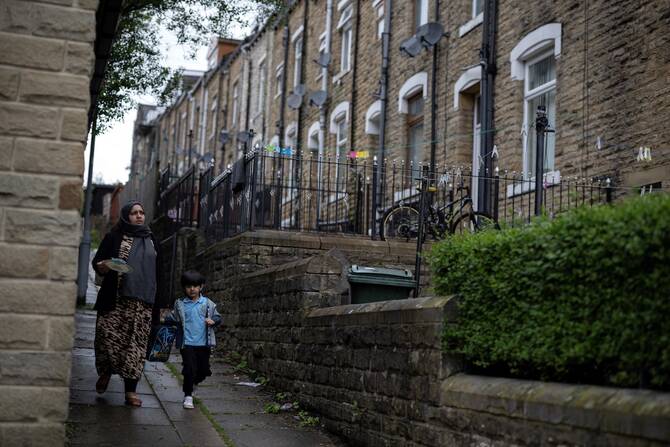
A woman and child walk along an alley past a terrace of houses in a residential area close to the town centre of Keighley, northwest England, on June 14, 2024. (FILE/AFP)
Short Url
Updated 02 January 2026
Follow

Islamophobic attacks on public transport growing in UK

  • Muslim travelers restricting journeys over fear of abuse and assault, community groups warn
  • Authorities must ‘take urgent and meaningful action,’ says British Muslim Trust CEO

LONDON: Islamophobic attacks are on the rise on public transport across Britain, according to new information revealed by The Guardian, as community organizations warn that Muslims are restricting their journeys over fear of abuse and assault.

A freedom of information request showed that racial hate crimes recorded by British Transport Police across England, Wales and Scotland grew from 2,827 cases in 2019-2020 to 3,258 in 2024-25.

The environment of public transport “creates a particular dynamic where aggressors are often emboldened by alcohol, can isolate their targets and then exit at the next stop,” The Guardian reported.

Hate crimes of a religious nature climbed from 343 cases in 2019-20 to 419 in 2023-24.

Akeela Ahmed, CEO of the British Muslim Trust, said the data reflects the stories her organization has collected from Muslims across the country.

She urged local authorities, transport operators and community safety groups to “take urgent and meaningful action” to address the issue.

“For visible Muslims in particular, the top deck of a bus or a half-empty train carriage can mean threatening behaviour, verbal abuse or even violent attack simply because of their faith,” Ahmed said, adding that Islamophobic attacks on public transport reported to the BMT are “some of the most complex and distressing cases we have handled to date.

“Many Muslims now feel compelled to micro-analyse every movement, expression or gesture out of fear that it may be misinterpreted, recorded and weaponised against them.”

A significant number of physical and verbal attacks against Muslims target children traveling to and from school, Ahmed said, describing this trend as the “most alarming” of all.

“The lack of CCTV coverage on buses and at many stops means perpetrators routinely evade accountability,” she added.

Carol Young, deputy director of the Coalition for Racial Equality, said the recorded figures cited by The Guardian “are probably the tip of the iceberg,” adding: “Anecdotally, we know that using public transport may not feel safe for everyone and some people may avoid using it or restrict their use to certain times of day.”

In response to a request by The Guardian for comment, a spokesperson for British Transport Police said: “Abuse, intimidation and violence — especially that which is motivated by hate — will never be tolerated, and we have acted swiftly and decisively when we receive reports of hate crimes on the rail network.

“If you are a victim of hate crime, or if you witness an incident that makes you feel uncomfortable, please do not suffer in silence.”


India, Arab League target $500bn in trade by 2030

Updated 01 February 2026
Follow

India, Arab League target $500bn in trade by 2030

  • It was the first such gathering of India–Arab FMs since the forum’s inauguration in 2016
  • India and Arab states agree to link their startup ecosystems, cooperate in the space sector

NEW DELHI: India and the Arab League have committed to doubling bilateral trade to $500 billion by 2030, as their top diplomats met in New Delhi for the India–Arab Foreign Ministers’ Meeting. 

The foreign ministers’ forum is the highest mechanism guiding India’s partnership with the Arab world. It was established in March 2002, with an agreement to institutionalize dialogue between India and the League of Arab States, a regional bloc of 22 Arab countries from the Middle East and North Africa.

The New Delhi meeting on Saturday was the first gathering in a decade, following the inaugural forum in Bahrain in 2016.

India’s Foreign Minister S. Jaishankar said in his opening remarks that the forum was taking place amid a transformation in the global order.

“Nowhere is this more apparent than in West Asia or the Middle East, where the landscape itself has undergone a dramatic change in the last year,” he said. “This obviously impacts all of us, and India as a proximate region. To a considerable degree, its implications are relevant for India’s relationship with Arab nations as well.”

Jaishankar and his UAE counterpart co-chaired the talks, which aimed at producing a cooperation agenda for 2026-28.

“It currently covers energy, environment, agriculture, tourism, human resource development, culture and education, amongst others,” Jaishankar said.

“India looks forward to more contemporary dimensions of cooperation being included, such as digital, space, start-ups, innovation, etc.”

According to the “executive program” released by India’s Ministry of External Affairs, the roadmap agreed by India and the League outlined their planned collaboration, which included the target “to double trade between India and LAS to US$500 billion by 2030, from the current trade of US$240 billion.”

Under the roadmap, they also agreed to link their startup ecosystems by facilitating market access, joint projects, and investment opportunities — especially health tech, fintech, agritech, and green technologies — and strengthen cooperation in space with the establishment of an India–Arab Space Cooperation Working Group, of which the first meeting is scheduled for next year.

Over the past few years, there has been a growing momentum in Indo-Arab relations focused on economic, business, trade and investment ties between the regions that have some of the world’s youngest demographics, resulting in a “commonality of circumstances, visions and goals,” according to Muddassir Quamar, associate professor at the School of International Studies, Jawaharlal Nehru University.

“The focus of the summit meeting was on capitalizing on the economic opportunities … including in the field of energy security, sustainability, renewables, food and water security, environmental security, trade, investments, entrepreneurship, start-ups, technological innovations, educational cooperation, cultural cooperation, youth engagement, etc.,” Quamar told Arab News.

“A number of critical decisions have been taken for furthering future cooperation in this regard. In terms of opportunities, there is immense potential.”