

Pakistan joins OIC, Islamic nations to reject Israel’s recognition of Somaliland

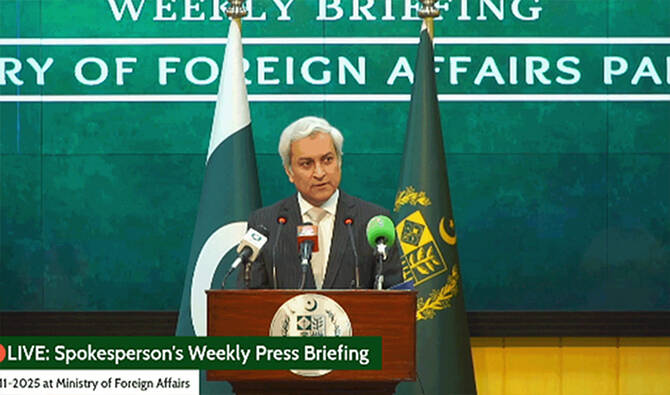
A screengrab taken from the weekly press briefing showing spokesperson of Pakistan's Ministry of Foreign Affairs,Tahir Andrabi, in Islamabad, Pakistan, on November 7, 2025. (@ForeignOfficePk/X)
Short Url
Updated 28 December 2025
Follow

Pakistan joins OIC, Islamic nations to reject Israel’s recognition of Somaliland

  • Foreign ministers of 21 Islamic nations, OIC issue joint statement to condemn Israel’s move to recognize breakaway African region
  • Joint statement describes Israel’s move as a “grave violation of the principles of international law and the United Nations Charter“

ISLAMABAD: Pakistan on Sunday joined the Organization of Islamic Cooperation (OIC) and other Arab and Islamic nations in condemning Israel’s recognition of Somaliland, a breakaway African region, calling it a violation of international law and reaffirming its support for the sovereignty and territorial integrity of Somalia. 

Israel this week announced it had recognized Somaliland — a self-declared region that broke away from Somalia in 1991 but has not previously been recognized by any United Nations member state — triggering condemnation from Somalia and criticism from regional bodies.

The joint statement shared by Pakistan’s foreign ministry on Sunday was endorsed by the foreign ministers of 20 other Muslim countries including Jordan, Egypt, Saudi Arabia, Palestine, Qatar, Libya, Iran, Iraq, Türkiye, Yemen and others as well as the OIC. 

“Their unequivocal rejection of Israel’s recognition of the ‘Somaliland’ region of the Federal Republic of Somalia on 26 December 2025, given the serious repercussions of such unprecedented measure on peace and security in the Horn of Africa, the Red Sea, and its serious effects on international peace and security as a whole, which also reflects Israel’s full and blatant disregard to international law,” the joint statement said. 

The statement said Israel’s recognition constitutes a “grave violation of the principles of international law and the United Nations Charter,” pointing out that it reflects Tel Aviv’s expansionist agenda.

The Muslim states said they reject any measures that undermine Somalia’s unity, territorial integrity or sovereignty over its entire territory.

“The full rejection of any potential link between such a measure and any attempts to forcibly expel the Palestinian people out of their land, which is unequivocally rejected in any form as a matter of principle,” the statement said.

The statement was referencing international media reports earlier this year that said Israel and the US had reached out to East African states, including Somaliland, to take in Palestinians from Gaza.

Pakistan’s foreign office on Saturday issued a separate statement condemning Israel’s recognition of Somaliland. 

“Pakistan strongly condemns any attempts to undermine the sovereignty, unity, and territorial integrity of Somalia, and rejects, in this regard, the announcement made by Israel recognizing the independence of the so-called Somaliland region of the Federal Republic of Somalia,” the foreign office had said. 

Somalia’s government has said Israel’s recognition of Somaliland violates its sovereignty, while the African Union has opposed unilateral recognition of breakaway regions on the continent.

Israeli Prime Minister Benjamin Netanyahu said on Friday his country had recognized Somaliland “in the spirit of the Abraham Accords,” referring to US-brokered deals that helped establish ties between Israel and Arab states.


Pakistan’s president defends ongoing strikes in Afghanistan, urges Kabul to dismantle militants

Updated 02 March 2026
Follow

Pakistan’s president defends ongoing strikes in Afghanistan, urges Kabul to dismantle militants

  • Afghanistan on Thursday launched attacks in retaliation for Pakistani airstrikes the previous Sunday
  • Pakistan’s military says it is only targeting Afghan military installations to avoid civilian casualties

ISLAMABAD: Pakistan’s president on Monday defended his country’s ongoing military strikes in neighboring Afghanistan, saying Islamabad tried all forms of diplomacy before targeting militants operating from Afghan territory, and called on the Taliban government in Kabul to disarm groups responsible for attacks in Pakistan.

Pakistan earlier said it is in “open war” with Afghanistan, alarming the international community. The border area remains a stronghold for militant organizations including Al-Qaeda and the Daesh (Islamic State) group.

“(The Afghan Taliban) must choose to dismantle the terror groups that survive on conflict and its war economy,” Asif Ali Zardari said during a speech to lawmakers, adding that “no state accepts serial attacks on its soil.”

Afghanistan on Thursday launched attacks in retaliation for Pakistani airstrikes the previous Sunday. Since then, Pakistan has carried out operations along the border, with Information Minister Attaullah Tarar claiming the killing of 435 Afghan forces and the capture of 31 Afghan positions.

Kabul has denied such claims.

In Afghanistan, the deputy government spokesman Hamdullah Fitrat said Pakistan’s military fired mortar shells at a refugee camp in eastern Kunar province, killing three children and injuring three others.

Afghanistan’s defense ministry said Afghan forces carried out strikes targeting a Pakistani military facility near Paktia province, causing “substantial losses and heavy casualties.”

Pakistan’s military did not respond to questions. It has said Pakistan is only targeting Afghan military installations to avoid civilian casualties.

Pakistan has witnessed a surge of violence in recent months and blames it on the outlawed Pakistani Taliban, known as Tehreek-e-Taliban Pakistan or TTP. It operates both inside Pakistan and from Afghan territory.
Islamabad accuses Afghanistan’s Taliban government of providing safe havens for the TTP, which Kabul denies.

The latest cross-border fighting ended a ceasefire brokered by Qatar and Turkiye in October. The two sides failed to reach a permanent agreement during talks in Istanbul.

Zardari reiterated Pakistan’s call for talks, saying, “We have never walked away from dialogue.”

The Pakistani leader again accused Afghanistan of acting as a proxy for India by sheltering militant groups.

“Stop being used by another country as a battlefield for their ambitions,” he said.

Zardari cited a recent report from the United Nations Security Council’s monitoring team that described the presence of militant groups in Afghanistan as an extra-regional threat.