Police in Finland arrest 2 in connection with damage to undersea telecom cable

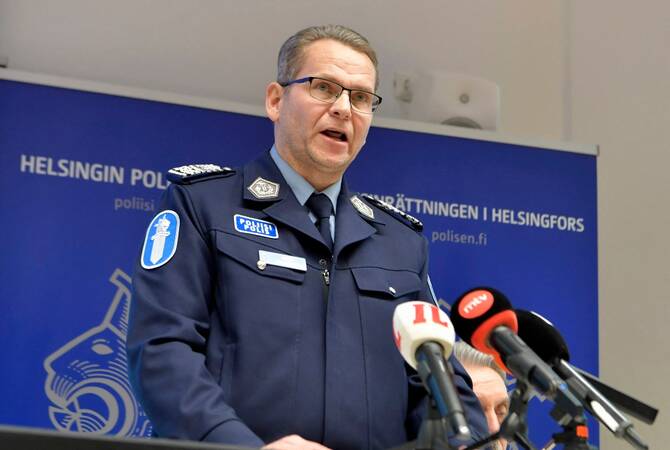
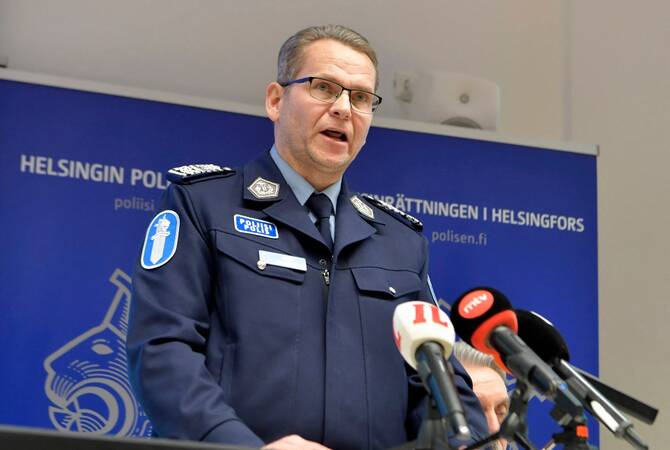
Finland's National Police Comissioner Ilkka Koskimäki speaks during a press conference in Helsinki, Finland. (AFP)
Short Url
Updated 02 January 2026
Follow

Police in Finland arrest 2 in connection with damage to undersea telecom cable

  • Officials placed two other people under travel bans as a result of the ongoing investigation, Helsinki police said in a statement

HELSINKI: Finnish authorities have arrested two people in connection with damage to an undersea telecommunications cable in the Gulf of Finland that occurred earlier this week between the capitals of Finland and Estonia, police said Thursday.
The damage was discovered early Wednesday in Estonia’s exclusive economic zone. The cable belongs to Finnish telecommunications service provider Elisa and is considered to be critical underwater infrastructure.
Helsinki police have opened an investigation into aggravated criminal damage, attempted aggravated criminal damage and aggravated interference with telecommunications.
Officials placed two other people under travel bans as a result of the ongoing investigation, Helsinki police said in a statement Thursday.
The individuals’ connections to the ship was not immediately clear and police would not release their nationalities or other details.
The ship, named the Fitburg, was flagged in St. Vincent and the Grenadines. It had been traveling from Russia to Israel. The 14 crew members hail from Russia, Georgia, Azerbaijan and Kazakhstan and were detained by Finnish authorities.
Finnish National Police Commissioner Ilkka Koskimäki said earlier this week that the ship was dragging its anchor for hours when it was discovered in Finland’s exclusive economic zone. He noted investigators are not speculating on whether a state-level actor was behind the damage.
Finnish Customs discovered structural steel in the cargo that originated in Russia and falls under sanctions imposed by the European Union, the agency said in a statement.
“Import of such sanctioned goods into the EU is prohibited under EU sanctions regulations,” the statement said. “Finnish Customs continues to investigate the sequence of events and the applicability of EU sanctions legislation to this case.”
The undersea cables and pipelines that crisscross one of the busiest shipping lanes in Europe link Nordic, Baltic and central European countries. They promote trade and energy security and, in some cases, reduce dependence on Russian energy resources.
Finnish authorities last year charged the captain and two senior officers of a Russia-linked vessel, the Eagle S, that damaged undersea cables between Finland and Estonia on Christmas Day in 2024.
The Finnish deputy prosecutor general said in an August statement that charges of aggravated criminal mischief and aggravated interference with communications were filed against the captain and first and second officers of the oil tanker. The officers, whose names were not made public, denied the allegations, the statement said.
The Kremlin previously denied involvement in damaging the infrastructure, which provides power and communication for thousands of Europeans.
The Eagle S was flagged in the Cook Islands but had been described by Finnish customs officials and the European Union’s executive commission as part of Russia’s shadow fleet of fuel tankers. Those are aging vessels with obscure ownership, acquired to evade Western sanctions during the war in Ukraine and operating without Western-regulated insurance.
For the West, such incidents are believed to be part of widespread sabotage attacks in Europe allegedly linked to Moscow following its full-scale invasion of Ukraine in 2022.


US allies, foes alarmed by capture of Venezuela’s Maduro

Updated 4 sec ago
Follow

US allies, foes alarmed by capture of Venezuela’s Maduro

  • Countries such as Russia and China, which had ties with Maduro’s government, were quick to condemn the operation but alarm also shared by France and EU
Paris — FRA
Paris, France, Jan 3, 2026 : The US military operation that led to the seizure of Venezuelan President Nicolas Maduro on Saturday sparked alarm across the international community, with allies and foes of Washington and Caracas expressing disquiet.
US President Donald Trump said Maduro and his wife would be taken to New York to face federal charges after military strikes and an operation which he described as looking like a “television show.”
The Venezuelan government decried what it termed a “extremely serious military aggression” by Washington and declared a state of emergency.
Countries such as Russia and Iran, which had longstanding ties with Maduro’s government, were quick to condemn the operation but their alarm was also shared by Washington’s allies including France and the EU.
Here is a rundown of the main reaction.

- Russia -

Russia demanded the US leadership “reconsider its position and release the legally elected president of the sovereign country and his wife.”

- China -

Beijing said “China is deeply shocked and strongly condemns the US’s blatant use of force against a sovereign state and its action against its president.”

- Iran -

Iran, which Trump bombed last year, said it “strongly condemns the US military attack on Venezuela and a flagrant violation of the country’s national sovereignty and territorial integrity.”

- Mexico -

Mexico, which Trump has also threatened with military force over drug trafficking, strongly condemned the US military action in Venezuela, saying it “seriously jeopardizes regional stability.”

- Colombia -

Colombian President Gustavo Petro — whose country neighbors Venezuela — called the US action an “assault on the sovereignty” of Latin America which would lead to a humanitarian crisis.

- Brazil -

Brazilian President Luiz Inacio Lula da Silva slammed the US attacks as a “serious affront” to Venezuela’s sovereignty.

- Cuba -

Cuba, a strong ally of Venezuela, denounced “state terrorism against the brave Venezuelan people.”

- Spain -

Spain offered to mediate in the crisis to find a way to a peaceful solution, while calling for “de-escalation and restraint.”
- France -

France condemned the US operation, saying it undermined international law and no solution to Venezuela’s crisis can be imposed from the outside.

- EU -

The EU more generally expressed concern at the developments and urged respect for international law, even as it noted that Maduro “lacks legitimacy.”
EU candidate country North Macedonia, along with fellow Balkan nations Albania and Kosovo, backed Washington, however.
“We stand with the United States and the Venezuelan people for freedom and democracy,” North Macedonia FM Timco Mucunski said on X.

- Britain -

British Prime Minister Keir Starmer said all countries should “uphold international law” and added that “the UK was not involved in any way in this operation” as he urged patience in order to “establish the facts.”

- Italy -

In a rare expression of support for the US operation by a major European country, far-right Italian Prime Minister Giorgia Meloni — a Trump ally — argued the US military action in Venezuela was “legitimate” and “defensive.”

- Israel -

Israel also hailed the operation, saying Washington acted as the “leader of the free world.”

- Ukraine -

Ukraine — dependent on US support in its war against invading Russia — did not address the legality of a big country like America using military force against a much smaller one like Venezuela.
Foreign minister Andriy Sybiga instead focused on Maduro’s lack of legitimacy and the Venezuelan government’s repression, while backing “democracy, human rights, and the interests of Venezuelans.”

- South Africa -

South Africa, which Trump accuses of alleged discrimination — and even “genocide” — of minority white Afrikaners, said: “Unlawful, unilateral force of this nature undermines the stability of the international order and the principle of equality among nations.”

- UN -

UN Secretary-General Antonio Guterres was “deeply alarmed” by the US strikes, with his spokesman quoting him as saying it could “constitute a dangerous precedent.”