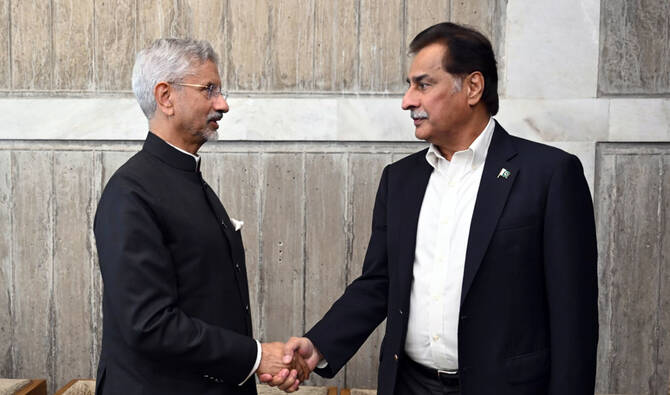
Pakistan assembly speaker, Indian FM shake hands in first high-level contact since May

Pakistan’s National Assembly Speaker Sardar Ayaz Sadiq shakes hands with India’s External Affairs Minister Subrahmanyam Jaishankar (left) in Dhaka, Bangladesh, on December 31, 2025. (X/@ChiefAdviserGoB)
Short Url
Updated 01 January 2026
Follow

Pakistan assembly speaker, Indian FM shake hands in first high-level contact since May

  • Tensions persist between India and Pakistan after they engaged in brief military conflict in May this year
  • Pakistan assembly speaker, Indian FM both attend former Bangladesh PM Khaleda Zia’s funeral in Dhaka

ISLAMABAD: Pakistan’s National Assembly Speaker Sardar Ayaz Sadiq and India’s External Affairs Minister Subrahmanyam Jaishankar shook hands in Dhaka on Wednesday, establishing the first high-level contact between officials of both countries since their brief military conflict in May. 

Sadiq and Jaishankar arrived in Dhaka to attend the funeral of Bangladesh’s first female prime minister Khaleda Zia, who passed away earlier this week at the age of 80 after prolonged illness. Diplomats from several countries attended Zia’s funeral on Wednesday, which drew large crowds to the Bangladeshi capital. 

Tensions persist between nuclear-armed neighbors India and Pakistan, who engaged in a four-day military conflict in May this year. The conflict was triggered when India blamed Pakistan for supporting a militant attack in Indian-administered Kashmir in April that killed over 20 tourists. Pakistan denied involvement and called for a transparent probe into the incident. 

“Sardar Ayaz Sadiq, Speaker of the National Assembly of Pakistan, exchanges greetings with Indian External Affairs Minister S. Jaishankar in Dhaka on Wednesday ahead of the funeral program of former Bangladesh Prime Minister Khaleda Zia,” the official X account of Bangladesh’s Chief Adviser Muhammad Younus wrote. 

Sadiq also met Zia’s son Tarique Rahman, the acting chairperson of the Bangladesh Nationalist Party (BNP), to convey condolences over his mother’s demise from the people and government of Pakistan, the Pakistan High Commission in Bangladesh said.

“During the meeting, he recalled Begum Zia’s remarkable political leadership and noted her pivotal role in promoting historical affinities, mutual respect and cooperation between our two nations,” the high commission wrote on social media platform X.

Senior officials from both India and Pakistan have refrained from shaking hands or exchanging pleasantries since the May conflict, as tensions persist between the two sides. 

The May conflict saw both countries exchange artillery fire, pound each other with fighter jets and trade missiles and drone strikes before Washington brokered a ceasefire on May 10. 

Sadiq is expected to meet senior officials of Bangladesh’s interim government during his trip, according to an earlier statement issued by his office.

Prime Minister Shehbaz Sharif had described Zia as a “committed friend of Pakistan” on Tuesday, praising her role in Bangladesh’s political life and expressing solidarity with the Bangladeshi people during what he called a difficult moment.

Zia, who served three terms as prime minister, led the BNP and remained a central figure in Bangladeshi politics despite years of ill health and imprisonment under the government of her longtime rival, Sheikh Hasina. She was released last year following Hasina’s ouster after a violent uprising.

Pakistan and Bangladesh were part of the same country until Bangladesh’s secession following a bloody civil war in 1971, an event that has long cast a shadow over bilateral ties. Relations remained largely strained for decades, shaped by historical grievances and political mistrust.

However, Islamabad enjoyed comparatively warmer ties with Dhaka during Zia’s tenure than under Hasina.

Engagement between Islamabad and Dhaka has increased since Hasina’s removal and the formation of an interim administration, with both sides signaling interest in improving political, diplomatic, economic and security ties.


Pakistan, China call for more ‘visible, verifiable’ actions to dismantle ‘terrorist’ groups in Afghanistan 

Updated 5 sec ago
Follow

Pakistan, China call for more ‘visible, verifiable’ actions to dismantle ‘terrorist’ groups in Afghanistan 

  • Foreign ministers of China, Pakistan co-chair seventh round of strategic dialogue in Beijing to review bilateral cooperation, regional situation
  • Pakistan accuses Kabul of facilitating attacks launched by militant outfits from Afghanistan’s soil, a charge Kabul has repeatedly denied

ISLAMABAD: Pakistan and China on Monday urged Afghanistan to take more visible actions to dismantle “terrorist organizations” based in its country, vowing to work with world powers to encourage Kabul to adopt moderate policies and integrate into the international community. 

Ties between Pakistan and Afghanistan remain strained as Islamabad alleges militant outfits, mainly the Tehreek-e-Taliban Pakistan (TTP) group, uses Afghan soil to launch attacks against Pakistan. Islamabad accuses the Afghan Taliban government of facilitating these attacks against Pakistan, charges Kabul have repeatedly denied. 

The joint statement by China and Pakistan was released after a meeting of both countries’ foreign ministers, Ishaq Dar and Wang Yi, in Beijing. Dar and his Chinese counterpart co-chaired the Seventh Round of China-Pakistan Foreign Ministers’ Strategic Dialogue in Beijing on Jan. 4 where they reviewed cooperation in trade, investment, economic sectors, counterterrorism, defense and regional matters. 

“The two sides called for more visible and verifiable actions to dismantle and eliminate all terrorist organizations based in Afghanistan which continue to pose serious threats to regional and global security, and prevent terrorist organizations from using the Afghan territory for terrorism against any other country and to endanger any other country,” the statement read. 

The joint statement said the two countries will work with world powers to encourage Kabul to adopt an inclusive political framework, moderate policies, and pursue good neighborliness. 

On bilateral cooperation, China and Pakistan said they had agreed to focus on industry, agriculture and mining, and also promote the building and operation of the Gwadar Port in southwestern Pakistan. 

“The two sides will deepen cooperation in areas such as trade and investment, information technology, science and technology, cybersecurity, technical and vocational training and education, and people-to-people and cultural exchanges,” the statement said. 

“The two sides agreed to further strengthen cooperation in the financial and banking sectors, including extending mutual support at regional and international multilateral financial forums. Pakistan appreciated China for providing support for its fiscal and financial sectors.”

The joint statement said China commended Pakistan’s “comprehensive measures” to combat “terrorism” and protect Chinese personnel, projects and institutions in the country.

“The two sides reiterated their commitment to combating terrorism in all its forms and manifestations with zero tolerance, and agreed to further deepen all-round cooperation on counter-terrorism and security, and make concerted efforts to ensure that the China-Pakistan Belt and Road cooperation advance in a secure and smooth manner,” the statement said. 

Pakistan and China expressed their willingness to conduct a transboundary water resources cooperation, stressing the importance of fulfilling international legal obligations. The statement comes as Pakistan frequently accuses India of violating a water-sharing agreement between the two neighbors, claiming New Delhi purposefully diverts the flow of water away from its territory. 

Islamabad has warned that any move by New Delhi to stop or divert the flow of Indus rivers to Pakistan will be considered an “act of war.”

Pakistan and China also demanded an unconditional, comprehensive and permanent ceasefire in Gaza in their joint statement, reaffirming their support for the Palestinian people’s right to self-determination and for the implementation of a two-state solution in the Middle East. 

“The two sides also expressed their concern at the situation in the occupied West Bank, and urged the need for urgently addressing it,” the statement said.