

Pakistan expresses solidarity with Canada as school shooting claims 9 lives

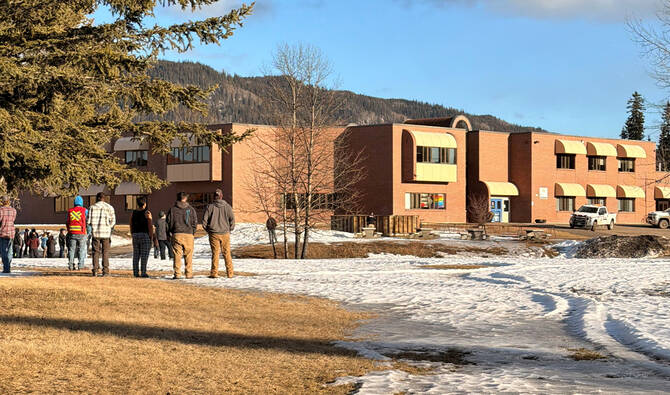
People gather outside the school building after an assailant opened fire at a high school in the town of Tumbler Ridge, British Columbia, Canada, on February 10, 2026. (REUTERS)
Short Url
Updated 12 February 2026
Follow

Pakistan expresses solidarity with Canada as school shooting claims 9 lives

  • At least 9 dead, 27 wounded in shooting incident at secondary school, residence in British Columbia on Tuesday
  • Officials say the shooter was found dead with an apparent self-inflicted gunshot wound after the incident

ISLAMABAD: Pakistan’s Prime Minister Shehbaz Sharif on Wednesday expressed solidarity with Canada as a high school shooting incident in a British Columbia town left at least nine dead, more than 20 others injured. 

Six people were found at the Tumbler Ridge Secondary School while a seventh died on the way to the hospital, the Royal Canadian Mounted Police (RCMP) said in a statement on Tuesday. Two other people were found dead at a home that police believe is connected to the shooting at the school. A total of 27 people were wounded in the attack. 

In an initial emergency alert, police described the suspect as a “female in a dress with brown hair,” with officials saying she was found dead with an apparent self-inflicted gunshot wound.

“Saddened by the tragic shooting in Tumbler Ridge, British Columbia,” Sharif wrote on social media platform X.

He conveyed his condolences to the families of the victims, wishing a swift recovery to those injured in the attack. 

“Pakistan stands in solidarity with the people and Government of Canada in this difficult time,” he added. 


Canadian police have not yet released any information about the age of the shooter or the victims.

Canadian Prime Minister Mark Carney said he was “devastated” by the violence, announcing he had suspended plans to travel to the Munich Security Conference on Wednesday.

While mass shootings are rare in Canada, last April, a vehicle attack that targeted a Filipino cultural festival in Vancouver killed 11 people.

British Columbia Premier David Eby called the latest violence “unimaginable.”

Nina Krieger, British Columbia’s minister of public safety, described it as one of the “worst mass shootings” in Canada’s history. 

Pakistan reports current account surplus in Jan. owing to improved trade, remittances

Updated 17 February 2026
Follow

Pakistan reports current account surplus in Jan. owing to improved trade, remittances

  • Pakistan’s exports crossed the $3 billion mark in Jan. as the country received $3.5 billion in remittances
  • Last month, IMF urged Pakistan to accelerate pace of structural reforms to strengthen economic growth

ISLAMABAD: Pakistan recorded a current account surplus of more than $120 million in January, the country’s finance adviser said on Tuesday, attributing it to improved trade balance and remittance inflows.

Pakistan’s exports rebounded in January 2026 after five months of weak performance, rising 3.73 percent year on year and surging 34.96 percent month on month, according to data released by the country’s statistics bureau.

Exports crossed the $3 billion mark for the first time in January to reach $3.061 billion, compared to $2.27 billion in Dec. 2025. The country received $3.5 billion in foreign remittances in Jan. 2026.

Khurram Schehzad, an adviser to the finance minister, said Pakistan reported a current account surplus of $121 million in Jan., compared to a current account deficit of $393 million in the same month last year.

“Improved trade balance in January 2026, strong remittance inflows, and sustained momentum in services exports (IT/Tech) continue to reinforce the country’s external account position,” he said on X.

Pakistan has undergone a difficult period of stabilization, marked by inflation, currency depreciation and financing gaps, and international rating agencies have acknowledged improvements after Islamabad began implementing reforms such as privatizing loss-making, state-owned enterprises (SOEs) and ending subsidies as part of a $7 billion International Monetary Fund (IMF) loan program.

Late last month, the IMF urged Pakistan to accelerate the pace of these structural reforms to strengthen economic growth.

Responding to questions from Arab News at a virtual media roundtable on emerging markets’ resilience, IMF’s director of the Middle East and Central Asia Jihad Azour said Islamabad’s implementation of the IMF requirements had been “strong” despite devastating floods that killed more than 1,000 people and devastated farmland, forcing the government to revise its 4.2 percent growth target to 3.9 percent.

“What is important going forward in order to strengthen growth and to maintain the level of macroeconomic stability is to accelerate the structural reforms,” he said at the meeting.

Azour underlined Pakistan’s plans to privatize some of the SOEs and improve financial management of important public entities, particularly power companies, as an important way for the country to boost its capacity to cater to the economy for additional exports.

“This comes in addition to the effort that the authorities have made in order to reform their tariffs, which will allow the private sector of Pakistan to become more competitive,” the IMF official said.