

Iraqis cover soil with clay to curb sandstorms

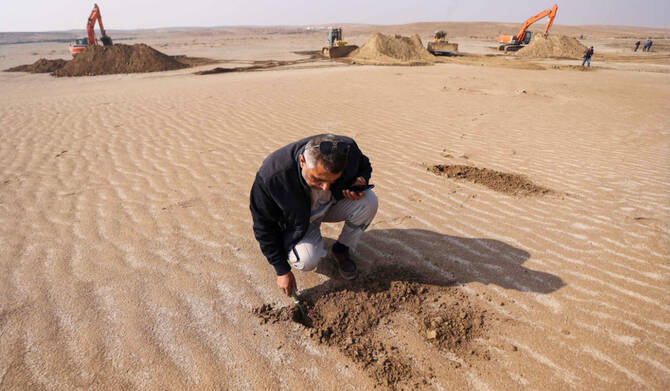
An Iraqi engineer examines the soil as excavators clear sand dunes and extract clay in the desert south of Samawah on December 21, 2025. (AFP)
Short Url
Updated 28 December 2025
Follow

Iraqis cover soil with clay to curb sandstorms

  • Dust storms have cloaked cities and villages in an endless ochre haze

BAGHDAD: Deep in Iraq’s southern desert, bulldozers and earthmovers spread layers of moist clay over sand dunes as part of a broader effort to fight increasingly frequent sandstorms.

Iraq has long suffered from sand and dust storms, but in recent years they have become more frequent and intense as the country falls prey to the effects of climate change.
Sand and dust storms — driven by severe drought, rising temperatures and deforestation — have cloaked cities and villages in an endless ochre haze, grounded flights and filled hospitals with patients suffering from breathing difficulties.

FASTFACT

Iraqi authorities have warned that the suffocating storms will intensify further, adding urgency to address the root of the problem.

Iraqi authorities have warned that these suffocating storms will intensify further, adding urgency to address the root of the problem.
In a relatively small area between the cities of Nasiriyah and Samawah, not far from ancient Sumerian ruins, laborers are working hard to stabilize the soil by applying a layer of moist clay 20-25 centimeters thick.
The project also includes planting heat-tolerant seedlings like Prosopis and Conocarpus to further stabilize the soil.
“The main goal is to reduce the impact of transboundary dust storms,” said Udai Taha Lafta from UN-Habitat, which is leading the project to combat sandstorms with Iraqi expertise.
“It is a vital area despite its small size, and will hopefully help reduce dust storms next summer,” Lafta said.
A short-term objective is to shield a southern highway where many traffic accidents have occurred due to poor visibility during dust storms.
The Ministry of Environment estimates that Iraq now faces about 243 storms per year, and the frequency is expected to increase to 300 “dust days” by 2050 unless drastic mitigation measures are adopted.
In 2023, Iraqi authorities teamed up with the UN-Habitat and the Kuwait Fund for Arab Economic Development in areas that have been identified as major sources of sandstorms.
The project has been implementing several methods in three southern areas, including digging water canals and supplying electricity to pump water from the Euphrates river, preparing barren lands for vegetation.
One of the project’s ultimate goals is to increase green spaces and for farmers to eventually sustain the lands after droughts and chronic water shortages have drastically reduced agricultural areas.
Qahtan Al-Mhana, from the Agriculture Ministry, said that stabilising the soil gives agricultural efforts in sandy areas a chance to endure.
He added that Iraq has extensive “successful” experience in combating desertification and dust storms by stabilising sand dunes.
Since the 1970s, the country has implemented such projects, but after decades of turmoil, environmental challenges have largely fallen by the wayside.
With the severe recent impact of climate change, “work has resumed,” said Najm Abed Taresh from Dhi Qar University. “We are making slow but steady progress.”


Syria’s Kurdish fighters agree to leave Aleppo after deadly clashes

Updated 3 sec ago
Follow

Syria’s Kurdish fighters agree to leave Aleppo after deadly clashes

  • Syria’s official SANA news agency reported that “buses carrying the last batch of members of the SDF organization have left the Sheikh Maqsud neighborhood in Aleppo, heading toward northeastern Syria”

ALEPPO: Syria’s Kurdish fighters said Sunday that they agreed under a ceasefire to withdraw from Aleppo after days of fighting government forces in the city.
Hours earlier, Syria’s military said it had finished operations in the Kurdish-held Sheikh Maqsud neighborhood with state television reporting that Kurdish fighters who surrendered were being bused to the north.
The military had already announced its seizure of Aleppo’s other Kurdish-held neighborhood, Ashrafiyeh.
Kurdish forces had controlled pockets of Syria’s second city Aleppo and operate a de facto autonomous administration across swathes of the north and northeast, much of it captured during the 14-year civil war.
The latest clashes erupted after negotiations to integrate the Kurds into the country’s new government stalled.
“We reached an understanding that led to a ceasefire and secured the evacuation of the martyrs, the wounded, the trapped civilians and the fighters from Ashrafiyeh and Sheikh Maqsud neighborhoods to northern and eastern Syria,” the Kurdish-led Syrian Democratic Forces (SDF) wrote in a statement.
Syria’s official SANA news agency reported that “buses carrying the last batch of members of the SDF organization have left the Sheikh Maqsud neighborhood in Aleppo, heading toward northeastern Syria.”
The SDF initially denied its fighters were leaving, describing the bus transfers as forced displacement of civilians.
An AFP correspondent saw at least five buses on Saturday carrying men out of Sheikh Maqsud, but could not independently verify their identities.
According to the SDF statement, the ceasefire was reached “through the mediation of international parties to stop the attacks and violations against our people in Aleppo.”
The United States and European Union both called for the Syrian government and Kurdish authorities to return to political dialogue.
The fighting, some of the most intense since the ousting of long-time ruler Bashar Assad in December 2024, has killed at least 21 civilians, according to figures from both sides, while Aleppo’s governor said 155,000 people fled their homes.
Both sides blamed the other for starting the clashes on Tuesday.

Children ‘still inside’

On the outskirts of Sheikh Maqsud, families who had been trapped by the fighting were leaving, accompanied by Syrian security forces.
An AFP correspondent saw men carrying children on their backs board buses headed to shelters.
Dozens of young men in civilian clothing were separated from the crowd, with security forces making them sit on the ground before transporting them to an unknown destination, according to the correspondent.
A Syrian security official told AFP on condition of anonymity that the young men were “fighters” being “transferred to Syrian detention centers.”
At the entrance to the district, 60-year-old Imad Al-Ahmad was heading in the opposite direction, trying to seek permission to return home.
“I left four days ago...I took refuge at my sister’s house,” he told AFP. “I don’t know if we’ll be able to return today.”
Nahed Mohammad Qassab, a 40-year-old widow also waiting to return, said she left before the fighting to attend a funeral.
“My three children are still inside, at my neighbor’s house. I want to get them out,” she said.
A flight suspension at Aleppo airport was extended until further notice.

‘Return to dialogue’

US envoy Tom Barrack met Syrian President Ahmed Al-Sharaa on Saturday, and afterwards called for a “return to dialogue” with the Kurds in accordance with the integration framework agreed in March.
The deal was meant to be implemented last year, but differences, including Kurdish demands for decentralized rule, stymied progress as Damascus repeatedly rejected the idea.
The fighting in Aleppo raised fears of a regional escalation, with neighboring Turkiye, a close ally of Syria’s new Islamist authorities, saying it was ready to intervene. Israel has sided with the Kurdish forces.
The clashes have also tested the Syrian authorities’ ability to reunify the country after the brutal civil war and commitment to protecting minorities, after sectarian bloodshed rocked the country’s Alawite and Druze communities last year.