

Pakistan saw 73% increase in combat-related deaths in 2025— think tank

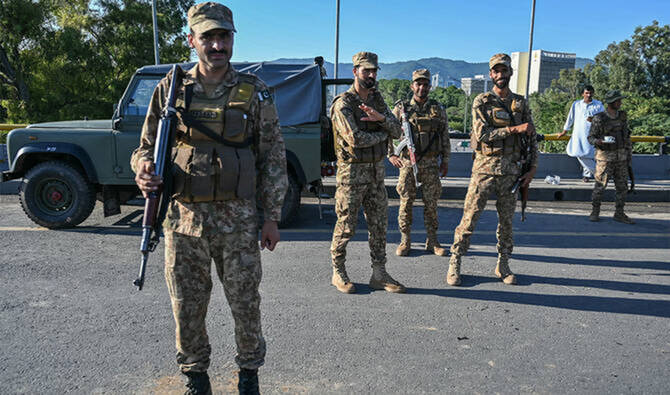
Pakistan Army soldiers stand guard in anticipation of a protest in Islamabad, Pakistan on October 6, 2024. (AFP/File)
Short Url
Updated 28 December 2025
Follow

Pakistan saw 73% increase in combat-related deaths in 2025— think tank

  • Pakistan reported 3,387 deaths thus year, among them 2,115 militants and 664 security forces personnel, says think tank
  • Civilian deaths increased by 24% to 580 in 2025, compared to 468 in 2024, as Pakistan saw 1,063 militant attacks in 2025

ISLAMABAD: Combat-related deaths in Pakistan this year increased by 73%, with both security forces and militants suffering casualties in large numbers, a report published by an Islamabad-based think tank said on Sunday.

As per statistics released by the Pakistan Institute for Conflict and Security Studies (PICSS), combat-related deaths in 2025 rose 73% to 3,387, compared with 1,950 in 2024. These deaths included 2,115 militants, 664 security forces personnel, 580 civilians and 28 members of pro-government peace committees (combatants), the think tank said in a press release. 

“Militants accounted for about 62% of total combat-related deaths, and their 2,115 fatalities represented the highest annual militant death toll since 2015, when 2,322 militants were killed,” PICSS said. 

Compared to last year, militant deaths recorded a steep increase by 122% as the PICSS reported that 951 militants had been killed in 2024.

The think tank, however, said this year was also particularly bloody for Pakistani security forces. PICSS recorded 664 security personnel deaths in 2025, a 26% rise from 528 in 2024, and the highest annual figure since 2011, when 677 security forces personnel lost their lives. 

Civilian deaths also increased by 24% to 580 in 2025, compared with 468 in 2024, marking the highest annual civilian toll since 2015, when 642 civilians were killed. 

As per the PICSS report, at least 1,063 militant attacks took place in 2025, a 17% increase compared with 908 in 2024 and the highest annual total since 2014, when 1,609 militant attacks were recorded. 

The report also noted a 53 percent increase in suicide attacks this year, with 26 such incidents reported in 2025 compared with 17 in 2024. 

“PICSS noted an expanding trend in the use of small drones, including quadcopters, with 33 such incidents recorded during 2025, alongside increased use of unmanned aerial vehicles by security forces,” the report said. 

The report noted an 83% rise in arrests of suspected militants, with 497 arrested in 2025 compared to 272 in 2024. 

This 2025 figure is the highest annual total of suspected militants arrested since 2017, when 1,781 militants were either arrested or laid down their weapons.

“PICSS noted that most violence remained concentrated in Pashtun-majority districts of Khyber Pakhtunkhwa, including the tribal districts (erstwhile FATA), and in Balochistan,” it said. 

Pakistan has been grappling with a surge in militant attacks in its western provinces of Khyber Pakhtunkhwa and Balochistan, both bordering Afghanistan, this year. 

Islamabad blames Afghanistan for providing sanctuaries to militants it alleges use Afghan soil to carry out attacks against Pakistan. Kabul denies the charges. 


Pakistan says repaid over $13.06 billion domestic debt early in last 14 months

Updated 29 January 2026
Follow

Pakistan says repaid over $13.06 billion domestic debt early in last 14 months

  • Finance adviser says repayment shows “decisive shift” toward fiscal discipline, responsible economic management
  • Says Pakistan’s total public debt has declined from over $286.6 billion in June 2025 to $284.7 billion in November 2025

KARACHI: Pakistan has repaid Rs3,650 billion [$13.06 billion] in domestic debt before time during the last 14 months, Adviser to the Finance Minister Khurram Schehzad said on Thursday, adding that the achievement reflected a shift in the country’s approach toward fiscal discipline. 

Schehzad said Pakistan has been repaying its debt before maturity, owed to the market as well as the State Bank of Pakistan (SBP), since December 2024. He said the government had repaid the central bank Rs300 billion [$1.08 billion] in its latest repayment on Thursday. 

“This landmark achievement reflects a decisive shift toward fiscal discipline, credibility, and responsible economic management,” Schehzad wrote on social media platform X. 

Giving a breakdown of what he said was Pakistan’s “early debt retirement journey,” the finance official said Pakistan retired Rs1,000 billion [$3.576 billion] in December 2024, Rs500 billion [$1.78 billion] in June 2025, Rs1,160 billion [$4.150 billion] in August 2025, Rs200 billion [$715 million] in October 2025, Rs494 billion [$1.76 billion] in December 2025 and $1.08 billion in January 2026. 

He said with the latest debt repaid today, the July to January period of fiscal year 2026 alone recorded Rs2,150 billion [$7.69 billion] in early retirement, which was 44 percent higher than the debt retired in FY25.

He said of the total early repayments, the government has repaid 65 percent of the central bank’s debt, 30 percent of the treasury bills debt and five percent of the Pakistan Investment Bonds (PIBs) debt. 

The official said Pakistan’s total public debt has declined from over Rs 80.5 trillion [$286.6 billion] in June 2025 to Rs80 trillion [$284.7 billion] in November 2025. 

“Crucially, Pakistan’s debt-to-GDP ratio, around 74 percent in FY22, has declined to around 70 percent, reflecting a broader strengthening of fiscal fundamentals alongside disciplined debt management,” Schehzad wrote. 

Pakistan’s government has said the country’s fragile economy is on an upward trajectory. The South Asian country has been trying to navigate a tricky path to economic recovery under a $7 billion loan from the International Monetary Fund.