

C. Africa’s displaced youth bet on vote for brighter future

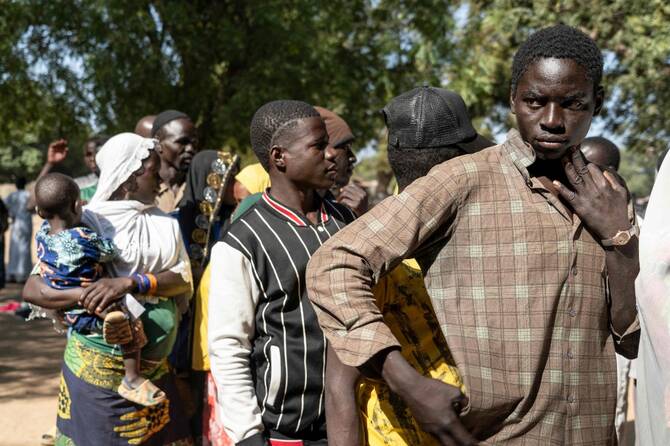
Central Africans from Birao, as well as displaced people from other regions of Vakaga, line up to collect their voter cards in Birao, CAR. (AFP)
Short Url
Updated 27 December 2025
Follow

C. Africa’s displaced youth bet on vote for brighter future

  • Across CAR, there were 416,000 internally displaced persons as of November, the vast majority of whom are under 25 and will be voting for the first time

BIRAO: Amani Abdramane bustled around her donkey in the makeshift camp where she lives in the Central African Republic.
In this northern part of the country, on the edge of the Sahel, the sun is scorching and sand is swallowing the last traces of vegetation.
The 18-year-old adjusted a pink scarf covering her head and shoulders and pondered what she wanted from Sunday’s general election that will choose local and regional officials, members of parliament and a new president.
“I hope the person I vote for brings peace,” she said of the seven candidates vying to become head of state.
They include President Faustin-Archange Touadera, who is seeking a third consecutive term.
Displaced by decades of conflict, young people like Abdramane who live in camps around the town of Birao in the far northeast, see the elections as a chance for a better future.
Abdramane fled ethnic violence in El-Sisi, her home village seven kilometers (four miles) from Birao, in 2015 with her mother and eight siblings.
Her father had been killed a few months earlier.
“I just want my brothers, sisters and me to be able to go to school,” she said.

- First-time voters -

Abdramane had just completed her second year of school, aged eight, when her family had to flee.
She has not returned to lessons since.
Now the teenager and other young people are counting on the elections to bring them peace, education and opportunities beyond life as displaced persons.
The last polls were in 2020 but lack of security meant even those old enough to vote at the time were unable to do so.
There is a crowd outside the community radio station in the Korsi neighborhood of Birao, which serves as a distribution center for voter registration cards.
Marina Hajjram, also 18, will be voting for the first time.
“I’m so happy,” she told AFP, clutching her voter card.
Behind her in the queue, 25-year-old Issa Abdoul agreed the elections were essential “to continue the reconstruction of our country.”
Korsi is home to thousands of internally displaced persons, as well as many refugees from neighboring Sudan.
Across CAR, there were 416,000 internally displaced persons as of November, the vast majority of whom are under 25 and will be voting for the first time this weekend.

- A brighter future -

For them, the mere act of obtaining a voter registration card is a challenge.
First they must produce an identity document. But many lost everything when they fled, including ID papers for those who had them.
Three quarters of people in the CAR are under 35, according to a 2018 report by the United Nations Population Fund.
And peace is one of the things these young people most want.
Although the situation has improved in much of the country, particularly in cities, violence persists in the northeast on the border between the two Sudans.
This is mainly due to incursions by Sudanese armed forces, who are waging war in a region already plagued by abuses blamed on rebel groups.
Issene Abdoulkasim, 23, only made it to the third year of primary school.
Now he wants to become a tailor so he can afford to study again.
“I dream of studying so I can become a member of parliament. Because as an MP I’ll be able to bring peace and development,” he said.
“I want to put an end to conflicts, tensions and everything that is destroying our country.”


EU leaders to reassess US ties despite Trump U-turn on Greenland

Updated 55 min 3 sec ago
Follow

EU leaders to reassess US ties despite Trump U-turn on Greenland

  • Diplomats stressed that, although Thursday’s emergency EU talks in Brussels would now lose some of their urgency, the longer-term issue of how to handle the relationship with the US remained

BRUSSELS: EU leaders will rethink their ties with the US at an emergency summit on Thursday after Donald Trump’s threat of tariffs and even military action to ​acquire Greenland badly shook confidence in the transatlantic relationship, diplomats said.
Trump abruptly stepped back on Wednesday from his threat of tariffs on eight European nations, ruled out using force to take Greenland, a semi-autonomous territory of NATO ally Denmark, and suggested a deal was in sight to end the dispute.
German Chancellor Friedrich Merz, welcoming Trump’s U-turn on Greenland, urged Europeans not to be too quick to write off the transatlantic partnership.
But EU governments remain wary of another change of mind by a mercurial president who is increasingly seen as a bully that Europe will have to stand up to, and they are focused on coming up with a longer-term plan on how to deal with the ‌United States under this ‌administration and possibly its successors too.
“Trump crossed the Rubicon. He might do ‌it ⁠again. ​There is no ‌going back to what it was. And leaders will discuss it,” one EU diplomat said, adding that the bloc needed to move away from its heavy reliance on the US in many areas.
“We need to try to keep him (Trump) close while working on becoming more independent from the US It is a process, probably a long one,” the diplomat said.
EU RELIANCE ON US
After decades of relying on the United States for defense within the NATO alliance, the EU lacks the needed intelligence, transport, missile defense and production capabilities to defend itself against a possible Russian attack. This gives the US substantial leverage.
The US ⁠is also Europe’s biggest trading partner, making the EU vulnerable to Trump’s policies of imposing tariffs to reduce Washington’s trade deficit in goods, and, as in ‌the case of Greenland, to achieve other goals.
“We need to discuss where ‍the red lines are, how we deal with this bully ‍across the Atlantic, where our strengths are,” a second EU diplomat said.
“Trump says no tariffs today, but does ‍that mean also no tariffs tomorrow, or will he again quickly change his mind? We need to discuss what to do then,” the second diplomat said.
The EU had been considering a package of retaliatory tariffs on 93 billion euros ($108.74 billion) on US imports or anti-coercive measures if Trump had gone ahead with his own tariffs, while knowing such a step would harm Europe’s economy as well ​as the United States.
WHAT’S THE GREENLAND DEAL?
Several diplomats noted there were still few details of the new plan for Greenland, agreed between Trump and NATO Secretary General Mark Rutte late on ⁠Wednesday on the sidelines of the World Economic Forum in Davos, Switzerland.
“Nothing much changed. We still need to see details of the Greenland deal. We are a bit fed up with all the bullying. And we need to act on a few things: more resiliency, unity, get our things together on internal market, competitiveness. And no more accepting tariff bullying,” a third diplomat said.
Rutte told Reuters in an interview in Davos on Thursday that under the framework deal he reached with Trump the Western allies would have to step up their presence in the Arctic.
He also said talks would continue between Denmark, Greenland and the US on specific issues.
Diplomats stressed that, although Thursday’s emergency EU talks in Brussels would now lose some of their urgency, the longer-term issue of how to handle the relationship with the US remained.
“The approach of a united front in solidarity with Denmark and Greenland while focusing on de-escalation and finding an off-ramp has worked,” a fourth EU diplomat said.
“At the ‌same time it would be good to reflect on the state of the relationship and how we want to shape this going forward, given the experiences of the past week (and year),” he said.