UAE president wraps first official Pakistan visit with talks on trade and regional issues

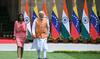
President of the United Arab Emirates, Sheikh Mohamed bin Zayed Al Nahyan, meets Prime Minister Shehbaz Sharif (right) in Islmabad, Pakistan, on December 26, 2025. (PID)
Short Url
Updated 26 December 2025
Follow

UAE president wraps first official Pakistan visit with talks on trade and regional issues

  • Pakistan’s JF-17 fighter jets escort Sheikh Mohamed bin Zayed’s aircraft as it enters the country’s airspace
  • The two countries discuss cooperation in energy, investment, technology and people-to-people exchanges

ISLAMABAD: Sheikh Mohamed bin Zayed Al Nahyan, President of the United Arab Emirates, on Friday paid his first official visit to Pakistan since assuming office, holding talks with Prime Minister Shehbaz Sharif that focused on deepening economic cooperation and regional coordination, the Prime Minister’s Office said.

The visit, undertaken at Sharif’s invitation, comes as Pakistan seeks to strengthen ties with Gulf partners and attract foreign investment to support its economy.

The visiting leader arrived at Nur Khan Airbase in Rawalpindi, where he was received by Sharif, Deputy Prime Minister Ishaq Dar, Chief of Army Staff Field Marshal Asim Munir and senior members of the federal cabinet. His aircraft was escorted by a formation of JF-17 fighter jets as it entered Pakistani airspace, and he was accorded a 21-gun salute.

“Sheikh Mohamed bin Zayed held substantive talks with the Prime Minister,” the official statement circulated at the end of his visit said. “Both sides underscored the importance of expanding collaboration in economic cooperation, investment, energy, infrastructure development, IT, technology and people-to-people exchanges.”

“They also agreed on the need to enhance bilateral trade, which had great potential for mutually beneficial growth,” it added.

The statement said the two leaders also exchanged views on important regional and international developments and reaffirmed their shared commitment to continue close coordination on matters of mutual interest.

Islamabad was decorated with Pakistani and Emirati flags and large billboards ahead of the visit, while the capital observed a public holiday as authorities rolled out traffic restrictions.

State-run broadcasters and private television channels aired footage of the UAE president’s arrival and ceremonial reception.

Pakistan considers the UAE one of its closest regional and economic partners. The Gulf state is Islamabad’s third-largest trading partner after China and the United States and a major source of foreign investment, with Emirati investment in Pakistan exceeding $10 billion over the past two decades, according to the UAE’s foreign ministry.

Pakistani policymakers also view the UAE as an important export destination due to its geographical proximity, which reduces transportation and freight costs.


Security forces kill four militants in Pakistan’s volatile southwest, military says

Updated 13 January 2026
Follow

Security forces kill four militants in Pakistan’s volatile southwest, military says

  • Balochistan, Pakistan’s largest province by land area bordering Iran and Afghanistan, has long been the site of a low-level insurgency
  • The Balochistan government has recently established a threat assessment center to strengthen early warning, prevent ‘terrorism’ incidents

ISLAMABAD: Pakistani security forces gunned down four militants in an intelligence-based operation in the southwestern Balochistan province, the military said on Tuesday.

The operation was conducted in Balochistan’s Kalat district on reports about the presence of militants, according to the Inter-Services Public Relations (ISPR), the Pakistani military’s media wing.

The “Indian-sponsored militants” were killed in an exchange of fire during the operation, while weapons and ammunition were also recovered from the deceased, who remained actively involved in numerous militant activities.

“Sanitization operations are being conducted to eliminate any other Indian-sponsored terrorist found in the area,” the ISPR said in a statement.

There was no immediate response from New Delhi to the statement.

Balochistan, Pakistan’s largest province by land area bordering Iran and Afghanistan, has long been the site of a low-level insurgency involving Baloch separatist groups, including the Balochistan Liberation Army (BLA) and the Balochistan Liberation Front (BLF).

Pakistan accuses India of supporting these separatist militant groups and describes them as “Fitna Al-Hindustan.” New Delhi denies the allegation.

The government in Balochistan has also established a state-of-the-art threat assessment center to strengthen early warning and prevention against “terrorism” incidents, a senior official said this week.

“Information that was once scattered is now shared and acted upon in time, allowing the state to move from reacting after incidents to preventing them before they occur,” Balochistan Additional Chief Secretary Hamza Shafqaat wrote on X.

The development follows a steep rise in militancy-related deaths in Pakistan in 2025. According to statistics released by the Pakistan Institute for Conflict and Security Studies (PICSS) last month, combat-related deaths in 2025 rose 73 percent to 3,387.

These included 2,115 militants, 664 security forces personnel, 580 civilians and 28 members of pro-government peace committees, the think tank said.