

Why Christmas joy flickers in Lebanon — even in the shadow of war

1 / 8
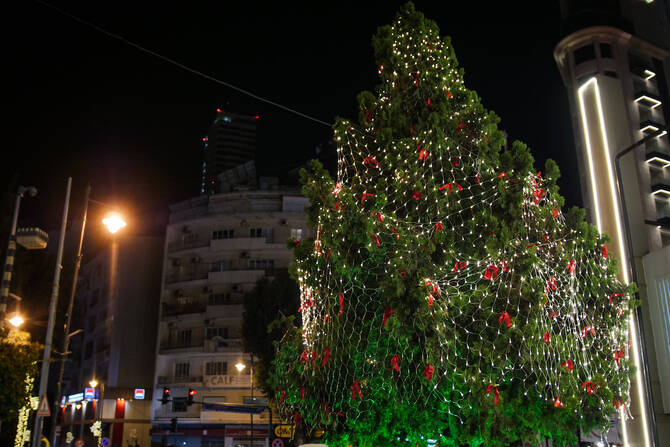
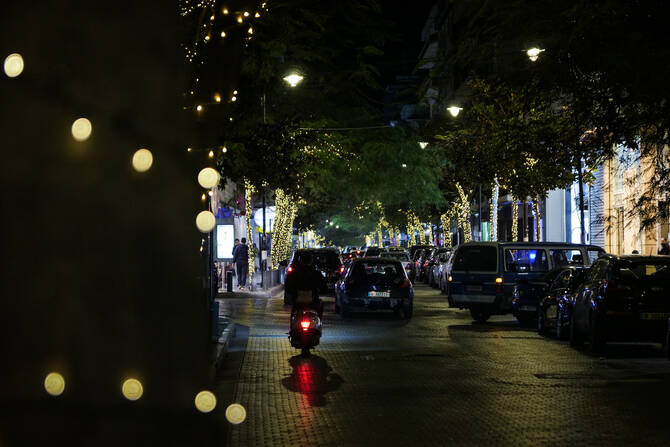
Even under the weight of political and economic turmoil, the Christmas season continues to bring moments of light, joy, and resilience to Lebanon. (AN photo by Firas Haidar)
2 / 8
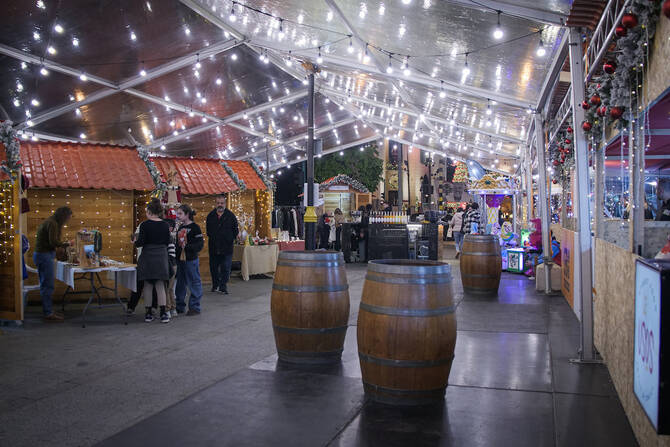
Even under the weight of political and economic turmoil, the Christmas season continues to bring moments of light, joy, and resilience to Lebanon. (AN photo by Firas Haidar)
3 / 8
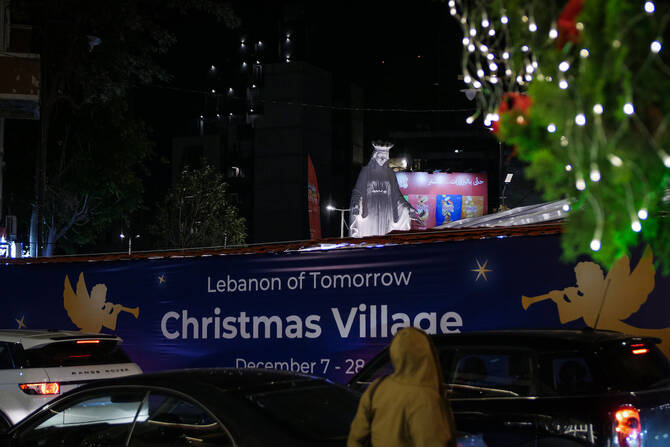
Even under the weight of political and economic turmoil, the Christmas season continues to bring moments of light, joy, and resilience to Lebanon. (AN photo by Firas Haidar)
4 / 8
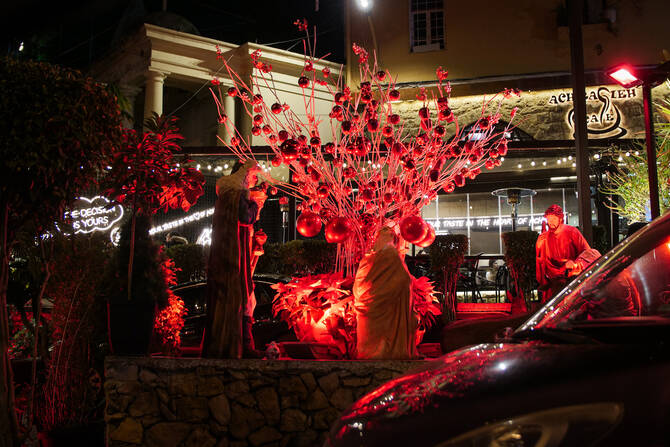
Even under the weight of political and economic turmoil, the Christmas season continues to bring moments of light, joy, and resilience to Lebanon. (AN photo by Firas Haidar)
5 / 8
Even under the weight of political and economic turmoil, the Christmas season continues to bring moments of light, joy, and resilience to Lebanon. (AN photo by Firas Haidar)
6 / 8
Even under the weight of political and economic turmoil, the Christmas season continues to bring moments of light, joy, and resilience to Lebanon. (AN photo by Firas Haidar)
7 / 8
Even under the weight of political and economic turmoil, the Christmas season continues to bring moments of light, joy, and resilience to Lebanon. (AN photo by Firas Haidar)
8 / 8
Even under the weight of political and economic turmoil, the Christmas season continues to bring moments of light, joy, and resilience to Lebanon. (AN photo by Firas Haidar)
Short Url
Updated 24 December 2025
Follow

Why Christmas joy flickers in Lebanon — even in the shadow of war

  • Celebrations cut across sectarian lines, reviving shared traditions despite war, economic collapse and lingering national trauma
  • Returning expatriates boost seasonal activity, though war-related tensions and limited tourism continue to strain hospitality and retail sectors

BEIRUT: Even under the weight of political and economic turmoil, the Christmas season continues to bring moments of light, joy, and resilience to Lebanon.

Amid rising tensions with Israel and ongoing instability, this year’s holiday season offers many Lebanese a rare reprieve, cutting through daily hardships with scenes of celebration, renewal and hope.

In Beirut, the festive spirit stretches across neighborhoods regardless of religious confession, with both Christian and Muslim-majority areas lit up and imbued with cheer.

In the city’s Achrafieh and downtown, trees dusted with artificial snow and adorned with ornaments, bells, stars, and ribbons, stand proudly in storefronts, on balconies, and outside restaurants and hotels.

From the capital’s high-end boutiques to its corner cafes, the sound of Christmas music fills the air, offering a glimmer of hope and rekindling a long-lost sense of warmth and unity.

The holiday celebrations extended to the Presidential Palace, which has joined the mood with lights and decorations lining its corridors.

In preparation for the holiday season, the management of Beirut Souks announced it had cleared key passageways in the downtown area, removing barriers that had obstructed vehicle and pedestrian movement.

The move came under the directives of Prime Minister Nawaf Salam.

“The plan is to turn downtown into an open space with interconnected streets, allowing for smooth movement at the heart of the capital and toward neighboring areas,” the management said in a statement.

“The goal is to ease mobility for citizens, especially during the holiday season.”

Downtown Beirut has endured years of upheaval since 2019, when street protests were sparked by the collapse of the Lebanese pound.

During the unrest, demonstrators smashed the facades of shops, restaurants, and hotels, contributing to the area’s prolonged decline.

The following year, the devastating Beirut port explosion inflicted further damage, leaving much of the area in ruins. Recovery has been slow and uneven.

Despite these hardships, the holiday season has revived the spirit of the city. Religious celebrations, carol singing, and local festivals are once again drawing people from across faiths, reflecting Lebanon’s rich cultural and religious diversity.

Since mid-December, crowds have been gathering every night at churches, theaters, and public squares to share in moments of joy and unity.

Jean Beiruti, secretary-general of the Tourism Syndicates Union, noted a resurgence of activity in the streets and bustling markets, where shoppers are making the most of the holiday sales.

“Some are buying luxury gifts, while others opt for simple ones, both reflecting the spirit of giving despite the tough economic conditions,” he told Arab News.

Across Lebanon, communities have embraced a friendly competition to showcase the most beautiful Christmas tree and festive decorations.

Local authorities in Beirut, Jbeil, Batroun, Zgharta in the north, Faraya in the mountains, Maghdouche in the south, and Zahle in the Bekaa, have spared no effort to transform public spaces with dazzling displays that reflect local pride.

“Jbeil is a city of coexistence and unity — a model of the peace envisioned by the Pope,” Ziad Hawat, a local lawmaker, told Arab News, citing the recent visit to Lebanon by Pope Leo XIV.

“It is a peace built on dialogue, understanding, and love; a peace that brings stability, prosperity, and hope. A peace of the heart — one that paves the way for the birth of a nation worthy of our hopes, aspirations and the potential of our youth.”

Meanwhile, the aroma of traditional sweets drifts from pastry shops, where holiday-themed cakes sit in chilled displays, awaiting final touches.

Restaurant reservations are rising, home banquet preparations are in full swing, and New Year’s Eve booking announcements continue to circulate on social media and television.

Pierre Achkar, president of the Syndicate of Hotel Owners, warned that ongoing Israeli strikes are dampening holiday tourism, even if the attacks remain limited to southern Lebanon. At the same time, he noted that flights into the country are fully booked for the season.

While many Lebanese expatriates are returning to spend the holidays at home, Achkar said this does not necessarily translate into high hotel occupancy, as most stay with family or in their own residences. He also noted that Gulf visitor numbers remain limited.

“Christmas is typically celebrated in homes with family,” he said. “Our hopes are pinned on New Year’s Eve, which usually brings a stronger tourism boost. However, the delayed start of the ski season has further hindered activity in mountain resorts.”

Achkar said the sector is looking forward to February, when Saudi Arabia marks a second official holiday. “We hope that will encourage more Saudi tourists to visit Lebanon,” he said.

Despite ongoing security concerns, Lebanon continues to defy expectations, thanks to both its residents and returning expatriates. The atmosphere of reassurance created by Pope Leo’s visit in late November may have helped project a brighter image of the country.

His repeated messages calling for tolerance, coexistence, and peace may have also encouraged collective holiday festivities.

For observers, however, this year’s celebrations feel unusually extravagant in Lebanon. While the holidays are typically a time for rest and renewal, they now seem to serve as compensation for the psychological, political, and social strain weighing on the country.

Hoda Rizk, a researcher in social sciences and political sociology, said Pope Leo’s visit delivered “a living message of coexistence, religious diversity, and interfaith dialogue,” calling for stronger social cohesion.

His meetings with religious and civil society leaders “offered a beacon of hope and recognition of shared resilience,” she said, reinforcing coexistence and national unity while giving Lebanese Christians renewed confidence in their role within Lebanon’s diverse fabric.

“This helps discourage migration by reaffirming the importance of their presence alongside other sects in preserving the country’s identity and social cohesion,” Rizk said.

While the pope’s visit contributed to the atmosphere of celebration, “decorating public spaces during the holidays is a deeply rooted Lebanese tradition,” she said.

Still, the exuberant displays seen this year in every neighborhood and street “are an attempt to escape the dark shadow of war and a way for communities to resist the sadness and fear that has gripped the country,” she added.

While some regions, particularly those affected by recent bombardments, may experience more subdued festivities than in previous years, Rizk said a “festive touch” remains. “It carries the spirit of the holiday even amid grief and sorrow.”

She believes Beirut’s multi-sectarian celebrations reflect the capital’s enduring drive to bring people together despite Lebanon’s overlapping crises.

“This resilience is rooted in the Lebanese people’s will to live,” Rizk said. “This is what the Lebanese people have demonstrated throughout the long years of war. Solidarity emerges in times of hardship, and joy is reborn with the holiday.”

Lebanon’s Interior Minister Ahmad Al-Hajjar announced heightened security measures for the holiday season, calling for maximum readiness across all security, military, and civil defense bodies, along with tighter coordination and rapid emergency response mechanisms.

The measures include streamlined procedures at Beirut’s Rafic Hariri International Airport to ease holiday arrivals, increased security deployment around churches, places of worship, and nightlife venues, as well as stricter enforcement of public order and enhanced traffic controls to facilitate movement across major roads.

Al-Hajjar also confirmed the intensification of intelligence operations to preempt any threats to public safety, with a particular focus on preventing celebratory gunfire. Offenders, he said, would be tracked down and referred to judicial authorities.


Retouched images of Israel’s first lady, distributed by the state, ignite a fiery ethics debate

Updated 58 min 18 sec ago
Follow

Retouched images of Israel’s first lady, distributed by the state, ignite a fiery ethics debate

  • Since the manipulation of images was revealed, the government has taken the unprecedented step of crediting Sara Netanyahu in its releases that include manipulated images

JERUSALEM: The photos seemed destined for posterity in Israel’s state archives.
In the snapshots, Prime Minister Benjamin Netanyahu is joined by his wife, Sara, as well as US Ambassador Mike Huckabee and a group of Israeli soldiers, as they light Hannukah candles at Western Wall, the holiest site where Jews pray. The leaders exchange triumphant looks.
But something is off.
Sara Netanyahu’s skin is poreless, her eyes overly defined and her hair perfectly coiffed — a look officials acknowledge is the result of heavy retouching.
Critics say the issue isn’t the use of photo-editing software, which is common on the social media accounts of celebrities and public figures. They say it’s the circulation of the images in official government announcements, which distorts reality, violates ethical codes and risks compromising official archiving and record-keeping efforts.
“All the pictures to this day in the archives in Israel are authentic pictures of reality as it was captured by the lenses of photographers’ cameras since the establishment of the state,” said Shabi Gatenio, the veteran political journalist who broke the story in The Seventh Eye, an Israeli site that covers local media. “These images, if entered into the database, will forever infect it with a virtual reality that never existed.”
Since the manipulation of images was revealed, the government has taken the unprecedented step of crediting Sara Netanyahu in its releases that include manipulated images. And it’s not clear if official archive will include images of her taken during the second half of last year, when Gatenio said the editing appears to have begun.
The first lady’s personal spokesperson did not respond to a request for comment.
Nitzan Chen, director of the Government Press Office, told The Associated Press that images of the prime minister are never manipulated and that his office would not upload any retouched photos to the official archive.
Personal Photoshop habit enters political realm
Sara Netanyahu, 67, has long used photo-editing software on her images. Her social media account is filled with images in which her face appears heavily retouched.
But the topic raised eyebrows since her Photoshop habit entered the public record.
Gatenio said he first noticed this last July, when the couple visited President Donald Trump in Washington, D.C., and again in September, as Sara Netanyahu joined her husband on the tarmac ahead of a trip to New York for the UN General Assembly.
At the time, the prime minister’s office released a video of the send-off along with a photo, credited to Avi Ohayon, an official government photographer.
Comparing the photo to the raw video, Hany Farid, a digital forensics expert at the University of California, Berkeley, said the image had been post-processed, bearing local manipulations to smooth the first lady’s skin and remove wrinkles.
Since then, photos showing the first lady meeting with Vice President JD Vance and his wife, Usha, in Washington also appear to have been retouched, Farid said.
“There’s been some Photoshop editing to — let’s call it — ‘beautify,’ lighten, smooth the face,” Farid said.
“Is it nefarious? No. Is it a problem? Yes. This is about something bigger than, ‘she Photoshopped her face to make herself look younger.’ This is about trust. Why should I trust any official photo coming out of that administration?”
Chen, the head of the Government Press Office, said office lawyers are trying to determine how to handle and properly identify photos “processed by people other than GPO photographers.”
He said the Justice Ministry is also examining the “criteria, limitations and possibilities” of the edited images, though he stressed there is nothing illegal about touching up photos. The issue, he said, is being transparent when such changes are made.
For now, his office has decided to add Sara Netanyahu’s name to press releases that include retouched images. Since November, press releases showing photos of her smiling next to Trump and the family of the last hostage in Gaza in Washington, visiting a Miami synagogue and attending a funeral for an Israeli mayor have included this label.
At least one outlet, the Times of Israel, has said it will no longer carry official state photos that appear to have been manipulated. The Associated Press does not publish images that appear to have been retouched or digitally manipulated.
A broader phenomenon
Chen said the prime minister is never edited: “No Photoshop, no corrections, no color. Nothing.”
While his face may not be retouched, the prime minister’s official Instagram account tells another story.
The page has posted a bevy of content that appears to be AI-edited or generated, including a picture of the couple with Trump and first lady Melania Trump celebrating the new year in Washington.
The photo raised suspicions in Israel because it shows Sara Netanyahu wearing a black dress absent from other photos of the event, where she wore a dark red frock. Appearing in the sky above the couples are brightly colored fireworks and American and Israeli flags that Farid said were “almost certainly” generated by AI.
It is now marked with a tag on Instagram indicating that it may have been altered or generated using AI. It is not clear when the tag was added nor by whom.
Netanyahu is not alone. Many world figures, including Trump, use AI-generated image manipulation frequently in their public output.
Tehilla Shwartz Altshuler, who runs the “Democracy in the Digital Age Program,” at the Israel Democracy Institute, a Jerusalem think tank, called it “part of the populist playbook” and said there was “no question” that Netanyahu was emulating how Trump uses the technology.
Netanyahu’s official Instagram has posted video of Trump and Netanyahu in a B-2 bomber that appears entirely AI-generated. It is captioned “on our victory lap,” referencing the joint Israel-US attacks on Iran last year.
“This is exactly what Netanyahu and his surrounding circle have tried to do for many years,” she said. “Presenting himself as a superhero, his wife as a supermodel, their family as a super loyal family. Even when it wasn’t the case, even at the expense of actual political work, administrative work and social work.”
She said Israel has reached a critical point in official government record-keeping and communications.
“The question of archiving the truth, archiving history, will be one of the questions of our time.”