

India marks ‘significant stride’ in space sector with launch of its heaviest satellite

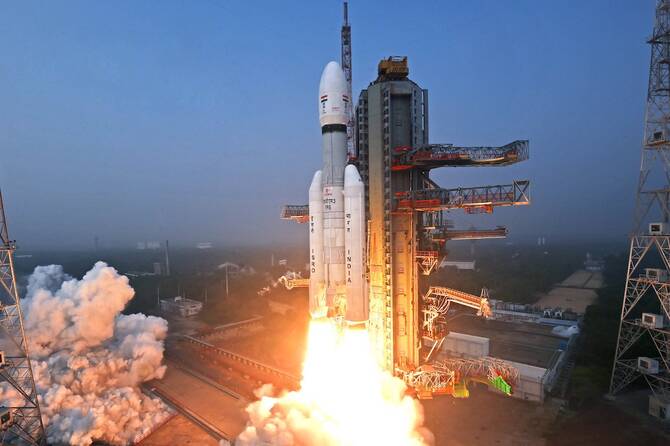
LVM3-M6 rocket successfully carried its heaviest ever payload to low earth orbit on Dec. 24, 2025. (ISRO)
Short Url
Updated 24 December 2025
Follow

India marks ‘significant stride’ in space sector with launch of its heaviest satellite

  • Wednesday’s mission also marks India’s 100th orbital launch
  • India plans to launch its first human space mission in 2027

NEW DELHI: India launched its heaviest communication satellite on Wednesday, marking the latest feat in the country’s efforts to establish itself in the global space industry.

The Indian Space Research Organization launched a LVM-3 rocket carrying the BlueBird Block-2 satellite, which weighs over 6 tonnes, from the Satish Dhawan Space Center in Sriharikota island off the Bay of Bengal at 8:55 a.m. local time.

Codenamed LVM3-M6, the mission was the ISRO’s 100th orbital launch and involved deploying the US-built satellite in low Earth orbit.

“A significant stride in India’s space sector,” Indian Prime Minister Narendra Modi said on X soon after the mission was declared successful by the ISRO.

“It strengthens India’s heavy-lift launch capability and reinforces our growing role in the global commercial launch market.”

The BlueBird Block-2 satellite was the “heaviest payload ever launched” from Indian soil, breaking a record set by the ISRO only last month, when it launched the CMS-03 communication satellite, which weighs about 4.4 tonnes.

“The successful LVM3-M6 launch of ISRO’s heaviest commercial payload to date marks a quantum leap in India’s launch capabilities, pushing the boundaries of LVM3’s performance in low Earth orbit,” Lt. Gen. (Retd) A. K. Bhatt, director-general of the Indian Space Association, said in a statement.

The mission exemplified the Indian space agency’s capability to handle “heavier payloads that cater to the global demand for advanced satellite constellations,” he added.

Under Modi, India has been making breakthroughs in the space industry.

For the past few years, the government has been creating the environment and long-term investment for the industry to flourish and involve the private sector. The ISRO has achieved significant milestones to add to India’s status as an emerging space superpower.

The achievements include a successful space docking mission in January. And the ISRO’s Chandrayaan-3 moon rover making history in 2023 by landing on the lunar surface. This made India the first country to land near the lunar south pole and the fourth to land on the moon — after the US, Soviet Union and China.

The ISRO is planning to use a modified version of the LVM-3 rocket for its future space missions, including India’s first human spaceflight program, the Gaganyaan mission, in 2027.

Its long-term space ambitions include building a modular space facility, the Bharatiya Antariksh Station, by 2035, and sending the first Indian to the moon by 2040.


Trump says ‘my own morality’ is only restraint on global power

Updated 13 sec ago
Follow

Trump says ‘my own morality’ is only restraint on global power

  • On Thursday the Senate advanced a measure to rein in presidential military action in Venezuela

WASHINGTON, United States: US President Donald Trump said in an interview published Thursday that his “own morality” was the only constraint on his power to order military actions around the world.
Trump’s comments to The New York Times came days after he launched a lightning operation to topple Venezuelan leader Nicolas Maduro, and threatened a host of other countries plus the autonomous territory Greenland.
“Yeah, there is one thing. My own morality. My own mind. It’s the only thing that can stop me,” Trump told the newspaper when asked if there were any limits on his global powers.
“I don’t need international law,” he added. “I’m not looking to hurt people.”
The Republican president then added that “I do” need to abide by international law, but said “it depends what your definition of international law is.”
The United States is not a member of the International Criminal Court (ICC), which tries war criminals, and it has repeatedly rejected decisions by the International Court of Justice (ICJ), the UN’s top court.
Trump himself has had his own run-ins with domestic law, having been impeached twice, faced a slew of federal charges including conspiring to overturn the 2020 election — which were eventually dropped after his re-election — and convicted for covering up a hush money payment to a porn star.
While proclaiming himself as “peace president” and seeking the Nobel Prize, Trump has launched a series of military operations in his second presidential term.
Trump ordered attacks on Iran’s nuclear program in June and in the past year has also overseen strikes on Iraq, Nigeria, Somalia, Syria, Yemen — and most recently on Venezuela.
Since Maduro’s capture, an emboldened Trump has threatened a string of other countries including Colombia, as well as Greenland, which is administered by fellow NATO member Denmark.
Asked whether his priority was preserving the NATO military alliance or acquiring Greenland, Trump told the Times: “it may be a choice.”
Some members of Congress, including a handful of Republicans, are trying to check Trump’s power.
On Thursday the Senate advanced a measure to rein in presidential military action in Venezuela. But even if it reaches his desk, Trump would likely veto it.
Billionaire Trump, who made his fortune as a property developer, added that US ownership of Greenland is “what I feel is psychologically needed for success.”
Trump said separately that he had no problem with his family conducting foreign business deals since his return to office.
“I prohibited them from doing business in my first term, and I got absolutely no credit for it,” Trump told the daily. “I found out that nobody cared, and I’m allowed to.”
