

Israel accuses Hamas of violating Gaza truce

1 / 2
Palestinians walk in a street next to the rubble of destroyed buildings in Jabalia refugee camp, in northern Gaza on Wednesday. (AFP)
2 / 2
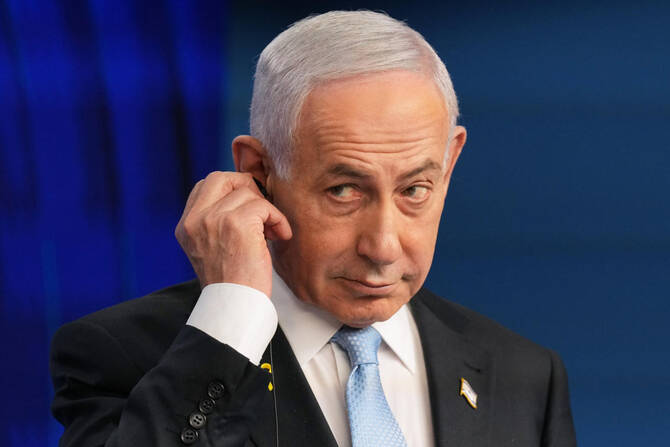
Israeli Prime Minister Benjamin Netanyahu adjusts the headphones during a joint press conference with German Chancellor Friedrich Merz in Jerusalem earlier this month. (AP)
Short Url
Updated 24 December 2025
Follow

Israel accuses Hamas of violating Gaza truce

  • Prime Minister Benjamin Netanyahu made the claim after a military ​officer was wounded by an explosive device in Rafah
  • Israeli delegation meets officials from Gaza truce mediating countries in ⁠Cairo

Prime Minister Benjamin Netanyahu said on Wednesday that Israel would retaliate after a military officer was wounded by a blast ​in Gaza, while Hamas denied responsibility, suggesting the explosive device had been left over from the conflict.
In a speech at a graduation ceremony for Air Force pilots, Netanyahu mentioned the incident in Rafah, part of Gaza where Israeli forces still operate, and said Hamas had made clear it had no plan to disarm as foreseen under the October truce deal.
“Israel will respond accordingly,” he said.
The Israeli military earlier said that an explosive device had detonated against a military vehicle in the Rafah area and that one officer had been lightly injured.
Hamas said the incident had taken place in an ‌area where the Israeli ‌military was in full control and that it had warned ‌that explosives ⁠remained ​in the ‌area and elsewhere since the war, reiterating its commitment to the October 10 ceasefire.
Hamas official Mahmoud Merdawi said in an earlier post on X that mediators had been informed about the issue.

Meeting in Cairo

A 20-point plan issued by US President Donald Trump in September calls for an initial truce followed by steps toward a wider peace. So far, only the first phase has taken effect, including a ceasefire, release of hostages and prisoners, and a partial Israeli withdrawal.
An Israeli delegation met officials from mediating countries in ⁠Cairo on Wednesday to discuss efforts to return the remains of the last Israeli hostage, police officer Ran Gvili, from Gaza, Netanyahu’s ‌office said later on Wednesday.
The delegation included officials from the ‍Israeli military, the Shin Bet domestic intelligence service ‍and the Mossad intelligence service.
Trump’s plan ultimately calls for Hamas to disarm and have no governing role ‍in Gaza, and for Israel to pull out. Hamas has said it will hand over arms only once a Palestinian state is established, which Israel says it will never allow.
Violence has subsided but not stopped since the Gaza truce took effect, with the sides regularly accusing each other of violations. Gaza’s health ministry says Israel ​has killed more than 400 people in the territory while Israel says three soldiers have been killed in militant attacks.
Hamas “openly declares it has no intention of disarming, in complete ⁠contradiction to President Trump’s 20-point plan,” Netanyahu said.

Hezbollah warning 

Netanyahu said Hezbollah in Lebanon, which Israel severely weakened in strikes last year that also ended in a US-brokered truce, also had no intention to disarm “and we are addressing that as well.”
Israel still needs to settle accounts with Iran-backed Houthis in Yemen as well as Iran itself, he added.
“As these old threats change form, new threats arise morning and evening. We do not seek confrontations, but our eyes are open to every possible danger,” Netanyahu said.
Netanyahu is set to meet with Trump next week, mainly to discuss the next phase of the US president’s Gaza plan.
Hamas said in a statement later on Wednesday that a delegation led by its chief negotiator Khalil Al-Hayya had discussed Gaza with Turkiye’s foreign minister in Ankara.
Al-Hayya warned against what he described as the continuation ‌of Israeli violations of the ceasefire, saying they were aimed at hindering the move to the next phase of the ceasefire deal.


UK condemns drone strikes across Sudan and blocking of aid as famine continues to rage

Updated 10 sec ago
Follow

UK condemns drone strikes across Sudan and blocking of aid as famine continues to rage

  • Drone attacks by Rapid Support Forces include strike on humanitarian convoy that killed aid worker, and another in North Kordofan that killed 24 people, including 8 children
  • Famine conditions reported in Darfur towns of Um Baru and Kernoi; British ambassador calls this a ‘devastating indictment’ of how warring factions ‘continue to block life-saving aid’

NEW YORK CITY: The UK on Friday condemned drone strikes by the Rapid Support Forces, one of the warring military factions in Sudan, and accused the group and its rival, the Sudanese Armed Forces, of blocking life-saving aid while parts of Sudan’s Darfur region descend into famine.

Speaking ahead of a UN Security Council meeting to discuss the situation in Sudan, requested by Britain, Bahrain and Denmark, the UK’s deputy ambassador, James Kariuki, told reporters that the latest alert from the Integrated Food Security Phase Classification warned of famine conditions in the Darfur towns of Um Baru and Kernoi.

“This is a devastating indictment of how the SAF and RSF continue to block life-saving aid,” he added.

The ways in which they are doing this include blocking trade routes, disrupting supply chains and restricting humanitarian access, Kariuki said. Such actions are deliberately exacerbating the crisis, he warned, and constitute violations of international humanitarian law under UN Security Council Resolution 2417.

“Starvation must never be used as a weapon of war,” he added.

More than 33 million people across the country are now in urgent need of humanitarian assistance, Kariuki said, making the humanitarian crisis in Sudan the worst in the world.

The UK also condemned recent RSF drone strikes across the country, including a reported attack on a World Food Programme convoy on Friday that killed an aid worker. Another RSF drone strike in North Kordofan had killed 24 people, including eight children, Kariuki said.

“Humanitarian workers must be able to deliver the response on the ground without obstruction and without retaliation,” he told the Security Council.

The civil war in Sudan began in April 2023 when fighting erupted between the SAF, led by army chief Abdel Fattah Al-Burhan, and the paramilitary RSF, commanded by Mohammed Hamdan Dagalo, also known as Hemedti.

Kariuki said authorities in the UK had imposed fresh sanctions last Thursday targeting six individuals suspected of committing atrocities or fueling the conflict in Sudan by supplying mercenaries and military equipment.

“These sanctions send a clear message that all those who perpetrate or profit from the brutal violence in Sudan will be held accountable, no matter how long it takes,” he added.