

Demolition ‘is a tragedy for all Palestinians’

1 / 2
Israeli security forces gather as excavators demolish a building constructed without a permit in the Wadi Qaddum area near the Silwan neighbourhood of east Jerusalem on December 22, 2025. (AFP)
2 / 2
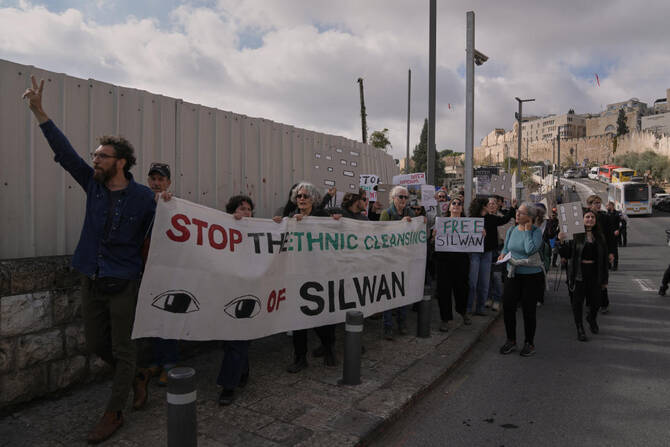
Israeli activists from Free Jerusalem movement take part in a protest against the evictions of Palestinian residents from the Silwan neigbouhood located in the east Jerusalem, near the Old City, Friday, Dec. 19, 2025. (AP Photo/Mahmoud Illean)
Short Url
Updated 22 December 2025
Follow

Demolition ‘is a tragedy for all Palestinians’

  • Israeli bulldozers tear through four-story building in East Jerusalem

JERUSALEM: Israeli bulldozers tore through a four-story building in East Jerusalem on Monday, leaving scores of Palestinian residents unsure where to go after their doors were broken down in the middle of the night by authorities enforcing hasty evictions.

The building was the latest in a series of residential structures to be razed as Israeli officials target what they describe as unauthorized construction in the city’s annexed east — a campaign that local Palestinian officials characterised as a “systematic policy” to displace residents.
“The demolition is a tragedy for all residents,” said Eid Shawar, who lives in the building.
Located in the Silwan neighborhood near the Old City, the building comprised a dozen apartments housing around 100 people, many of them women, children, and elderly residents.
“They broke down the door while we were asleep and told us we could only change our clothes and take essential papers and documents,” said Shawar, a father of five.
With nowhere else to go, Shawar, 38, said his seven-member family would have to sleep in his car.
“They are destroying my bedroom,” lamented one woman, as she watched the heavy machines rip through the building.
Three bulldozers began tearing down the structure early on Monday as residents looked on, their clothes and belongings scattered across nearby streets, an AFP journalist saw.
Israeli police cordoned off surrounding roads, with security forces deployed across the area and positioned on the rooftops of neighboring houses.
By midday, a large part of the building had already been razed to the ground.
Built on privately owned Palestinian land, the structure had been slated for demolition for lacking a permit, activists said.
Two Israeli NGOs, Ir Amin and Bimkon, said the demolition was the largest carried out in 2025, adding in a statement that “around 100 East Jerusalem families have lost their homes.”
Palestinians face severe obstacles in obtaining building permits due to Israel’s restrictive planning policies, according to activists, an issue that has fueled tensions in East Jerusalem and across the occupied West Bank for years.
The building’s destruction “is part of a systematic policy aimed at forcibly displacing Palestinian residents and emptying the city of its original inhabitants,” the Jerusalem governorate, affiliated with the Ramallah-based Palestinian Authority, said in a statement.
“Any demolition that expels residents from their homes constitutes a clear occupation plan to replace the land’s owners with settlers.”
On Sunday, Israel approved the establishment of 19 new settlements in the occupied West Bank, part of a rapid expansion, but considered illegal under international law.
Jerusalem municipality, which administers both West and East Jerusalem, has previously said demolitions are carried out to address illegal construction and to enable the development of infrastructure or green spaces in the area.
In a statement on Monday, the municipality said the demolition of the building in Silwan was based on a 2014 court order, and “the land on which the structure stood is zoned for leisure and sports uses and construction, and not for residential purposes.”
“For a long period, the residents were granted extensions for the execution of the order and were offered various options in order to find a solution, but they declined to do so.”
Activists, however, accuse Israeli authorities of frequently designating areas in East Jerusalem as national parks or open spaces to advance Israeli settlement interests.
Silwan begins at the foot of the Old City, where hundreds of Israeli settlers live among nearly 50,000 Palestinians.
The demolition there was “carried out without prior notice, despite the fact that a meeting was scheduled” on Monday to discuss steps to legalize the structure, Ir Amin and Bimkom said in their statement.
“This is part of an ongoing policy,” they said.
Meanwhile, residents and their relatives are worried.
“You had children and even sick people like my brother, who is a cancer patient, living in the building,” Ashraf Sqafi said as he watched the demolition.
“All this is very painful.”
The status of Jerusalem remains one of the most contentious issues in the Israeli-Palestinian conflict.
Tensions are constant in East Jerusalem and its Old City, which Israel has occupied since the 1967 Arab-Israeli war. It swiftly annexed the area following the conflict.
Those tensions have only intensified since the Oct. 7, 2023, attack that triggered the devastating war in Gaza.
Israel regards East Jerusalem as an integral part of its capital, while the Palestinians want to make the city the capital of their future state.
The UN deems Israel’s annexation of East Jerusalem illegal, and does not recognize Jerusalem as Israel’s capital.


Sudan’s prime minister takes his peace plan to the UN, but US urges humanitarian truce now

Updated 23 December 2025
Follow

Sudan’s prime minister takes his peace plan to the UN, but US urges humanitarian truce now

  • Sudan’s prime minister is proposing a wide-ranging peace initiative to end a nearly 1,000-day war with a rival paramilitary force
  • It seems unlikely the RSF would support the proposal, which would essentially give government forces a victory and take away their military power

UNITED NATIONS: Sudan’s prime minister on Monday proposed a wide-ranging peace initiative to end a nearly 1,000-day war with a rival paramilitary force, but the United States urged both sides to accept the Trump administration’s call for an immediate humanitarian truce.
Kamil Idris, who heads Sudan’s transitional civilian government, told the Security Council his plan calls for a ceasefire monitored by the United Nations, African Union and Arab League, and the withdrawal of paramilitary forces from all areas they occupy, their placement in supervised camps and their disarmament.
Sudan plunged into chaos in April 2023 when a power struggle between the military and the powerful paramilitary Rapid Support Forces exploded into open fighting, with widespread mass killings and rapes, and ethnically motivated violence. This has amounted to war crimes and crimes against humanity, according to the UN and international rights groups.
It seemed highly unlikely the RSF would support the prime minister’s proposal, which would essentially give government forces a victory and take away their military power.
In an indirect reference to the truce supported by the US and key mediators Saudi Arabia, Egypt and the United Arab Emirates, known as the Quad, Idris stressed to the UN Security Council that the government’s proposal is “homemade — not imposed on us.”
In early November, the Rapid Support Forces agreed to a humanitarian truce. At that time, a Sudanese military official told The Associated Press the army welcomed the Quad’s proposal but would only agree to a truce when the RSF completely withdraws from civilian areas and gives up their weapons — key provisions in the plan Idris put forward on Monday.
Idris said unless the paramilitary forces were confined to camps, a truce had “no chance for success.” He challenged the 15 members of the Security Council to back his proposal.
“This initiative can mark the moment when Sudan steps back from the edge and the international community — You! You! — stood on the right side of history,” the Sudanese prime minister said. He said the council should “be remembered not as a witness to collapse, but as a partner in recovery.”
US deputy ambassador Jeffrey Bartos, who spoke to the council before Idris, said the Trump administration has offered a humanitarian truce as a way forward and “We urge both belligerents to accept this plan without preconditions immediately.”
Bartos said the Trump administration strongly condemns the horrific violence across Darfur and the Kordofan region — and the atrocities committed by both the Sudanese Armed Forces and the Rapid Support Forces, who must be held accountable.
UAE Ambassador Mohamed Abushahab, a member of the Quad, said there is an immediate opportunity to implement the humanitarian truce and get aid to Sudanese civilians in desperate need.
“Lessons of history and present realities make it clear that unilateral efforts by either of the warring parties are not sustainable and will only prolong the war,” he warned.
Abushahab said a humanitarian truce must be followed by a permanent ceasefire “and a pathway toward civilian rule independent of the warring parties.”
UN Assistant Secretary-General for political affairs Khaled Khiari reflected escalating council concerns about the Sudan war, which has been fueled by the continuing supply of increasingly sophisticated weapons.
He criticized unnamed countries that refuse to stop supplying weapons, and both government and paramilitary forces for remaining unwilling to compromise or de-escalate.
“While they were able to stop fighting to preserve oil revenues, they have so far failed to do the same to protect their population,” Khiari said. “The backers of both sides must use their influence to help stop the slaughter, not to cause further devastation.”
The devastating war in Sudan has killed more than 40,000 people according to UN figures, but aid groups say the true number could be many times higher. The conflict has created the world’s largest humanitarian crisis, with over 14 million people displaced, disease outbreaks and famine spreading in parts of the country.