PHOENIX: Vice President JD Vance said Sunday the conservative movement should be open to everyone as long as they “love America,” declining to condemn a streak of antisemitism that has divided the Republican Party and roiled the opening days of Turning Point USA’s annual convention.
After a long weekend of debates about whether the movement should exclude figures such as bigoted podcaster Nick Fuentes, Vance came down firmly against “purity tests.”
“I didn’t bring a list of conservatives to denounce or to de-platform,” Vance said during the convention’s closing speech.
Turning Point leader Erika Kirk, who took the helm after the assassination of her husband, Charlie Kirk, has endorsed Vance as a potential successor to President Donald Trump, a helpful nod from an influential group with an army of volunteers.
But the tension on display at the four-day gathering foreshadowed the treacherous political waters that Vance, or anyone else who seeks the next Republican presidential nomination, will need to navigate in the coming years. Top voices in the “Make America Great Again” movement are jockeying for influence as Republicans begin considering a future without Trump, and there is no clear path to holding his coalition together.
Defining a post-Trump GOP
The Republican Party’s identity has been intertwined with Trump for a decade, but he’s constitutionally ineligible to run for reelection despite his musings about serving a third term. Tucker Carlson said people are wondering, “who gets the machinery when the president exits the scene?”
So far, it looks like settling that question will come with a lot of fighting among conservatives. The Turning Point conference featured arguments about antisemitism, Israel and environmental regulations, not to mention rivalries between leading commentators.
Ben Shapiro, co-founder of the conservative media outlet Daily Wire, used his speech on the conference’s opening night to denounce “charlatans who claim to speak in the name of principle but actually traffic in conspiracism and dishonesty.”
“These people are frauds and they are grifters and they do not deserve your time,” Shapiro said. He specifically called out Carlson for hosting Fuentes for a friendly interview on his podcast.
Carlson brushed off the criticism when he took the stage barely an hour later, and he said the idea of a Republican “civil war” was “totally fake.”
“There are people who are mad at JD Vance, and they’re stirring up a lot of this in order to make sure he doesn’t get the nomination,” he said. Carlson described Vance as “the one person” who subscribes to the “core idea of the Trump coalition,” which Carlson said was “America first.”
Turning Point spokesperson Andrew Kolvet framed the discord as a healthy debate about the future of the movement, an uncomfortable but necessary process of finding consensus.
“We’re not hive-minded commies,” he wrote on social media. “Let it play out.”
If you love America, you’re welcome in the movement, Vance says
Vance acknowledged the controversies that dominated the Turning Point conference, but he did not define any boundaries for the conservative movement besides patriotism.
“We don’t care if you’re white or black, rich or poor, young or old, rural or urban, controversial or a little bit boring, or somewhere in between,” he said.
Vance didn’t name anyone, but his comments came in the midst of an increasingly contentious debate over whether the right should give a platform to commentators espousing antisemitic views, particularly Fuentes, whose followers see themselves as working to preserve America’s white, Christian identity. Fuentes has a growing audience, as does top-rated podcaster Candace Owens, who routinely shares antisemitic conspiracy theories.
“We have far more important work to do than canceling each other,” he said.
Vance ticked off what he said were the accomplishments of the administration as it approaches the one-year mark, noting its efforts at the border and on the economy. He emphasized efforts to end diversity, equity and inclusion policies, drawing applause by saying they had been relegated to the “dustbin of history.”
“In the United States of America, you don’t have to apologize for being white anymore,” he said.
Vance also said the US “always will be a Christian nation,” adding that “Christianity is America’s creed, the shared moral language from the Revolution to the Civil War and beyond.”
Those comments resonated with Isaiah White-Diller, an 18 year-old from Yuma, Arizona, who said he would support Vance if he runs for president.
“I have my right to be Christian here, I have my right to say whatever I want,” White-Diller said.
Turning Point backs Vance
Vance hasn’t disclosed his future plans, but Erika Kirk said Thursday that Turning Point wanted Vance “elected for 48 in the most resounding way possible.” The next president will be the 48th in US history.
Turning Point is a major force on the right, with a nationwide volunteer network that can be especially helpful in early primary states, when candidates rely on grassroots energy to build momentum. In a surprise appearance, rapper Nicki Minaj spoke effusively about Trump and Vance.
Vance was close with Charlie Kirk, and they supported each other over the years. After Kirk’s assassination on a college campus in Utah, the vice president flew out on Air Force Two to collect Kirk’s remains and bring them home to Arizona. The vice president helped uniformed service members carry the casket to the plane.
Emily Meck, 18, from Pine City, New York, said she appreciated Vance making space for a wide variety of views.
“We are free-thinkers, we’re going to have these disagreements, we’re going to have our own thoughts,” Meck said.
Trump has spoken highly of both Vance and Secretary of State Marco Rubio as potential successors, even suggesting they could form a future Republican ticket. Rubio has said he would support Vance.
Asked in August whether Vance was the “heir apparent,” Trump said “most likely.”
“It’s too early, obviously, to talk about it, but certainly he’s doing a great job, and he would be probably favorite at this point,” he said.


![]()


Vance refuses to set red lines over bigotry as conservatives feud at Turning Point

Vance refuses to set red lines over bigotry as conservatives feud at Turning Point
- This statement came during Turning Point USA’s annual convention, where debates raged about excluding figures like Nick Fuentes
- Vance says he opposes “purity tests” and emphasized patriotism as the only boundary
US military boards sanctioned oil tanker in Indian Ocean
- Tanker tracking website says Aquila II departed the Venezuelan coast after US forces captured then-President Nicolás Maduro
- Pentagon says it 'hunted' the vessel all the way from the Caribbean to the Indian Ocean
WASHINGTON: US military forces boarded a sanctioned oil tanker in the Indian Ocean after tracking the ship from the Caribbean Sea, the Pentagon said Monday.
The Pentagon’s statement on social media did not say whether the ship was connected to Venezuela, which faces US sanctions on its oil and relies on a shadow fleet of falsely flagged tankers to smuggle crude into global supply chains.
However, the Aquila II was one of at least 16 tankers that departed the Venezuelan coast last month after US forces captured then-President Nicolás Maduro, said Samir Madani, co-founder of TankerTrackers.com. He said his organization used satellite imagery and surface-level photos to document the ship’s movements.
According to data transmitted from the ship on Monday, it is not currently laden with a cargo of crude oil.
The Aquila II is a Panamanian-flagged tanker under US sanctions related to the shipment of illicit Russian oil. Owned by a company with a listed address in Hong Kong, ship tracking data shows it has spent much of the last year with its radio transponder turned off, a practice known as “running dark” commonly employed by smugglers to hide their location.
US Southern Command, which oversees Latin America, said in an email that it had nothing to add to the Pentagon’s post on X. The post said the military “conducted a right-of-visit, maritime interdiction” on the ship.
“The Aquila II was operating in defiance of President Trump’s established quarantine of sanctioned vessels in the Caribbean,” the Pentagon said. “It ran, and we followed.”
The US did not say it had seized the ship, which the US has done previously with at least seven other sanctioned oil tankers linked to Venezuela.
A Navy official, who spoke on condition of anonymity to discuss military operations, would not say what forces were used in the operation but confirmed the destroyers USS Pinckney and USS John Finn as well as the mobile base ship USS Miguel Keith were operating in the Indian Ocean.
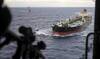
In videos the Pentagon posted to social media, uniformed forces can be seen boarding a Navy helicopter that takes off from a ship that matches the profile of the Miguel Keith. Video and photos of the tanker shot from inside a helicopter also show a Navy destroyer sailing alongside the ship.
Since the US ouster of Maduro in a surprise nighttime raid on Jan. 3, the Trump administration has set out to control the production, refining and global distribution of Venezuela’s petroleum products. Officials in President Donald Trump’s Republican administration have made it clear they see seizing the tankers as a way to generate cash as they seek to rebuild Venezuela’s battered oil industry and restore its economy.
Trump also has been trying to restrict the flow of oil to Cuba, which faces strict economic sanctions by the US and relies heavily on oil shipments from allies like Mexico, Russia and Venezuela.
Since the Venezuela operation, Trump has said no more Venezuelan oil will go to Cuba and that the Cuban government is ready to fall. Trump also recently signed an executive order that would impose a tariff on any goods from countries that sell or provide oil to Cuba, primarily pressuring Mexico because it has acted as an oil lifeline for Cuba.
The Pentagon’s statement on social media did not say whether the ship was connected to Venezuela, which faces US sanctions on its oil and relies on a shadow fleet of falsely flagged tankers to smuggle crude into global supply chains.
However, the Aquila II was one of at least 16 tankers that departed the Venezuelan coast last month after US forces captured then-President Nicolás Maduro, said Samir Madani, co-founder of TankerTrackers.com. He said his organization used satellite imagery and surface-level photos to document the ship’s movements.
According to data transmitted from the ship on Monday, it is not currently laden with a cargo of crude oil.
The Aquila II is a Panamanian-flagged tanker under US sanctions related to the shipment of illicit Russian oil. Owned by a company with a listed address in Hong Kong, ship tracking data shows it has spent much of the last year with its radio transponder turned off, a practice known as “running dark” commonly employed by smugglers to hide their location.
US Southern Command, which oversees Latin America, said in an email that it had nothing to add to the Pentagon’s post on X. The post said the military “conducted a right-of-visit, maritime interdiction” on the ship.
“The Aquila II was operating in defiance of President Trump’s established quarantine of sanctioned vessels in the Caribbean,” the Pentagon said. “It ran, and we followed.”
The US did not say it had seized the ship, which the US has done previously with at least seven other sanctioned oil tankers linked to Venezuela.
A Navy official, who spoke on condition of anonymity to discuss military operations, would not say what forces were used in the operation but confirmed the destroyers USS Pinckney and USS John Finn as well as the mobile base ship USS Miguel Keith were operating in the Indian Ocean.
In videos the Pentagon posted to social media, uniformed forces can be seen boarding a Navy helicopter that takes off from a ship that matches the profile of the Miguel Keith. Video and photos of the tanker shot from inside a helicopter also show a Navy destroyer sailing alongside the ship.
Since the US ouster of Maduro in a surprise nighttime raid on Jan. 3, the Trump administration has set out to control the production, refining and global distribution of Venezuela’s petroleum products. Officials in President Donald Trump’s Republican administration have made it clear they see seizing the tankers as a way to generate cash as they seek to rebuild Venezuela’s battered oil industry and restore its economy.
Trump also has been trying to restrict the flow of oil to Cuba, which faces strict economic sanctions by the US and relies heavily on oil shipments from allies like Mexico, Russia and Venezuela.
Since the Venezuela operation, Trump has said no more Venezuelan oil will go to Cuba and that the Cuban government is ready to fall. Trump also recently signed an executive order that would impose a tariff on any goods from countries that sell or provide oil to Cuba, primarily pressuring Mexico because it has acted as an oil lifeline for Cuba.
Latest updates


Recommended


© 2026 SAUDI RESEARCH & PUBLISHING COMPANY, All Rights Reserved And subject to Terms of Use Agreement.