

Pakistan, Iran resolve to strengthen trade cooperation, work for regional peace

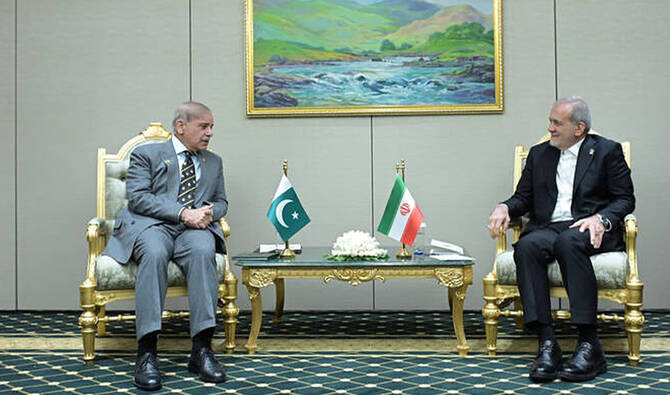
Prime Minister Shehbaz Sharif (left) meets Iranian President Masoud Pezeshkian in Tehran, Iran, on December 12, 2025. (Government of Pakistan)
Short Url
Updated 21 December 2025
Follow

Pakistan, Iran resolve to strengthen trade cooperation, work for regional peace

  • Pakistan Foreign Minister Ishaq Dar speaks to Iranian counterpart Seyyed Abbas Araghchi
  • Pakistan, Iran have attempted to enhance bilateral trade to $10 billion in recent years

ISLAMABAD: The foreign ministers of Iran and Pakistan vowed on Sunday to strengthen bilateral cooperation in trade, connectivity, various other sectors and work for regional peace, the Pakistani foreign ministry said in a statement.

Pakistan and Iran have attempted to enhance bilateral trade and commerce in recent years. The two neighbors have set up border markets and discussed barter trade to get around banking and currency restrictions.

Sanctions and foreign exchange shortages remain key hurdles for Iran, making barter systems and cross-border markets central to its trade strategy with Pakistan.

Deputy Prime Minister Ishaq Dar, who also serves as Pakistan’s foreign minister, spoke to Iran’s Foreign Minister Seyyed Abbas Araghchi over the phone on Sunday during which the two discussed regional developments. 

“Both leaders reaffirmed their commitment to further strengthening cooperation in trade, connectivity and people-to-people ties, and reiterated their resolve to work closely together for regional peace and development,” the Pakistani foreign office said in a statement. 

Pakistan and Iran have attempted to enhance bilateral trade to $10 billion. However, apart from sanctions and foreign exchange shortages, ties between the two countries remain complicated due to security issues. 

Pakistan and Iran have remained at odds over instability along their shared, porous border that even led to a missile exchange between them in 2024. Both countries, however, were quick to move to ease tensions.

Iranian President Dr. Masoud Pezeshkian visited Pakistan in August this year, during which the two countries signed agreements to enhance bilateral trade to $10 billion by 2028. 

Both countries have also consistently criticized Israel for its war on Gaza and repeated violations of a fragile ceasefire brokered by world powers, including the US. 


Pakistan PM approves framework for National Energy Plan aimed at cutting power costs

Updated 4 sec ago
Follow

Pakistan PM approves framework for National Energy Plan aimed at cutting power costs

  • Electricity costs in Pakistan have been a major concern for both industries and domestic consumers
  • PM Shehbaz Sharif instructs authorities to expedite privatization of power distribution companies

ISLAMABAD: Prime Minister Shehbaz Sharif on Wednesday approved the framework for a National Energy Plan aimed at ensuring low electricity costs for industries and facilitating domestic consumers, Pakistani state broadcaster reported. 

The development took place during a meeting of the Cabinet Committee on Energy in Islamabad presided over by Sharif. The Pakistani prime minister directed all ministries and provincial governments to present a “workable and coordinated” strategy under the proposed plan.

Electricity costs in Pakistan have been a major concern for both industries and domestic consumers. Industrial users often face high tariffs that increase production cost while residential consumers struggle with rising bills that impact household budgets. 

“Prime Minister Shehbaz Sharif has given in-principle approval for the formulation of a comprehensive National Energy Plan in consultation with relevant ministries and provincial governments,” Radio Pakistan said in a report.

“He emphasized that the government’s top priorities include ensuring electricity supply to industries at the lowest possible cost and providing facilitation for domestic consumers.”

Sharif also approved the establishment of a dedicated secretariat for the National Energy Plan and gave approval to the framework guidelines for auctioning wheeling charges, it added.

Wheeling charges are fees paid for using another company’s power grid to transmit electricity from a generator to a consumer, covering the cost of transporting electricity over someone else’s network.

The report said Sharif instructed authorities to include the recommendations of the climate change, finance, industries and petroleum ministries into the plan. 

Sharif also gave instructions to expedite the privatization of power distribution companies (DISCOs) and urged competitive tariffs for industries to boost production capacity.

Fluctuations in fuel prices, inefficiencies in the power sector, and reliance on imported energy have contributed to high electricity costs in Pakistan in recent years, making energy affordability and stability a key focus for government policies and reforms.

Pakistan has pushed energy sector reforms to tackle long-standing issues like circular debt, power theft, and transmission losses, which have caused blackouts and high electricity costs. 

In February, Pakistan developed a new energy policy that it says will help the country attract $5 billion in investment through public-private partnerships.
