JERUSALEM: “Death to Arabs!” chanted the angry mob as they encircled the university dormitories of Arab students in central Israel and tried to break down the doors.
“I am still shocked and afraid,” said one of the dozens of terrified Arab Israelis who barricaded themselves inside the Netanya Academic College dorm late last month, speaking to AFP on condition of anonymity.
As the Israel-Hamas war enters its second month, Arab Israelis — roughly 20 percent of Israel’s population — say they have been living in fear because of increasing hate crimes and attacks against them since October 7.
On that day, Hamas launched an unprecedented attack on Israel that killed more than 1,400 people, mostly civilians, according to Israeli authorities.
Aiming to destroy Hamas, Israel responded with a relentless bombardment and ground invasion of the Gaza Strip that has killed more than 10,500 people, also mostly civilians, according to the Hamas-run territory’s health ministry.
The student said that shortly before the dorm attack, Israeli police came to question them for allegedly throwing eggs at religious Jewish Israelis.
“We denied it and told them ‘The cameras are there. You can check them’,” the student told AFP.
“After that, a group gathered and tried to break down the door and attack us. They cursed us and demanded our expulsion.”
Police escorted the students to the roof for their protection while others stood at the door to prevent the protesters from entering, the student said.
The police told AFP the incident took place after the “circulation of an old publication inciting terrorism, being presented as new,” and that they were working to combat “false publications that sow panic among the public.”
“Instigators will be punished,” the police said.
Jafar Farah, director of the Mossawa Center which documents human rights violations against Arab Israelis, said far-right football fan club “La Familia,” which has ties to National Security Minister Itamar Ben-Gvir, organized the protest.
He blamed the university, police and Netanya municipality for failing to prevent the attack.
Miriam Feirberg, the city’s mayor, said the rioters should be prosecuted and students currently in the accommodation replaced by Israelis displaced from the south by the Hamas attack.
As well as raising tensions within Israel, the war has worsened relations between Palestinians and Israelis in the occupied West Bank and annexed east Jerusalem.
Even before the war, rights groups frequently highlighted regular discrimination faced by Arab Israelis, despite them holding Israeli citizenship.
“We left all our belongings in the dormitory,” the student said.
“As Arabs, we are afraid to return to college, and some are afraid to return to their rented accommodation.”
Nadim Al-Nashif, director of 7amleh, a non-profit group focused on social media, said they have identified “590,000 violent conversations in Hebrew on platforms like Facebook” and Telegram.
Among the posts were calls for a “second Nakba,” referring to the mass exodus of 750,000 Palestinians in 1948 during the war over the establishment of Israel, as well incitements to kill and expel Palestinians.
Nashif said his organization had reported many of the posts to the relevant platforms, leading to the removal of some.
Arab Israeli politician Ahmad Tibi said abuse was not unusual.
“There is no Arab Knesset (parliament) member who has not received threatening messages,” he said, including death threats.
“Why don’t the police take any action despite repeated complaints?“
Israeli labor union organization “Power to the Workers” said it had recorded attacks on Arab drivers, and warned of “increasing acts of violence against them.”
One bus driver was sprayed with gas by a group of passengers after they learned he was an Arab. He was injured slightly when the vehicle then hit an electricity pole, the union said.
Another driver was attacked “by passengers who realized he was Arab and shouted, ‘Terrorist... terrorist!’ They smashed his windshield.”
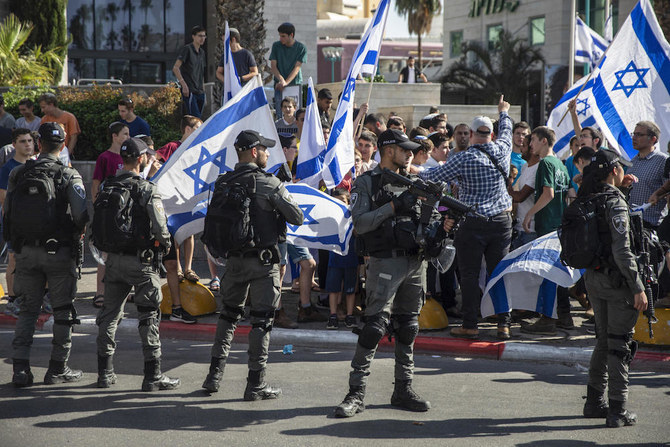
Dozens of right-wing Israelis demonstrated on Tuesday in the west Jerusalem neighborhood of Givat Shaul, mostly inhabited by observant Jews, against a shop that employs Arabs.
They held signs reading “Don’t support terrorists” and “This branch employs terrorists.”
Police prevented the protesters from entering the shop and eventually dispersed them, an employee said. But around 30 Arab workers did not return the next day.
“I didn’t go to work. It’s dangerous,” said an employee identifying herself only as Huda.
“We no longer take Israeli public transportation for fear of racist attacks,” she said. “The store management told us they couldn’t guarantee our safety.”

Arab Israelis live in fear amid surging violence
Short Url
https://arab.news/9bz45
Arab Israelis live in fear amid surging violence
- Arab Israelis, roughly 20 percent of Israel’s population, say they have been living in fear because of increasing hate crimes
- The police told AFP the incident took place after the “circulation of an old publication inciting terrorism, being presented as new”
A father in Gaza searches for his family’s bones in the rubble of their home
- Using picks, shovels and his hands, Hammad has recovered bones and fragments that he keeps in a box
- Gaza’s Health Ministry says more than 700 bodies have been recovered since the ceasefire, and that some 8,000 people remain buried under the rubble
GAZA CITY: Crouching amid a pile of rubble that used to be his Gaza home, Mahmoud Hammad scoops dirt into a large sieve and shakes it, looking carefully before dumping it out.
In recent days, he was lucky. Tiny bones appeared.
He believes they belong to the unborn girl his pregnant wife was carrying when an Israeli airstrike hit the family’s building more than two years ago, killing his wife and their five children.
He added the fragments to a box of bones he has collected during months of burrowing into the wreckage on his own, using picks, shovels and his hands.
“I won’t find them all,” he said.
Some 8,000 people remain buried under the rubble of their homes destroyed by Israel’s bombardment during its campaign against Hamas, according to Gaza’s Health Ministry. While airstrikes and ground assaults raged, retrieving most was out of the question. But since a ceasefire deal in October, efforts to dig them out have increased, though hampered by the lack of heavy equipment.
‘They were martyred, and I survived’
Around 11:30 a.m. on Dec. 6, 2023, an Israeli strike smashed into the six-story building where the families of Hammad and his brother lived in Gaza City’s Sabra neighborhood.
The 39-year-old Hammad had just stepped out of the apartment to go upstairs as his wife Nema Hammad, who was nine months pregnant, and their five children, aged 8 to 16, were finishing breakfast.
In the days leading to the strike, the Israeli military had dropped leaflets over the area, ordering people to leave and head to the southern half of the strip. Mahmoud Hammad refused to leave.
For a while, Nema Hammad and the kids went to her parents’ home in the nearby Jabaliya district, while her husband stayed behind. But Nema Hammad wanted to come back. Her husband tried to discourage her, with Israeli bombardment all around. But on Dec. 5, he found his wife and kids at his door.
“Either we live together or we are martyred together,” he said his wife told him.
“They were martyred, and I survived,” he said. His brother, sister-in-law and their four sons were also all killed.
Mahmoud Hammad was taken to a nearby clinic with multiple injuries, including fractures in the chest, pelvis, knee and internal chest bleeding.
After the strike, neighbors were able to recover the body of his eldest son, Ismail, and two of his brother’s children.
The rest remained under the rubble.
Digging through his home
After recovering from his wounds, Hammad returned to his home’s ruins and set up a shelter nearby to live in.
“I stayed with them, my wife and children, in the rubble,” he said. “Every day, I am talking to them. Their scent lingered, and I felt a deep connection with them.”
He began the search for their bodies. He first sought help from Gaza’s Civil Defense corps. But rescue teams never came, either because it was too dangerous amid intense Israeli bombing or because they didn’t have the equipment and machinery to remove the rubble.
So he started digging himself. He began with the collapsed ceilings and walls, breaking them into small stones and putting them in sacks. Piles of dozens of sacks now surround the site like a wall.
In March 2024, he found some remains he believed were of his family.
“There were simple bones covered with flesh … some of which had been eaten by animals,” he said.
In late 2024, he had dug down to his brother’s apartment, which had been on the third floor, where he found the bodies of his brother and sister-in-law. He buried them in a temporary graveyard that residents of the area created during the war to hold their dead until they could be moved to a proper cemetery.
Since October, Hammad resumed digging. He drove down nine meters (30 feet). Finally, he reached his own apartment, which had been on the ground floor. Now he has been focusing on clearing rubble from the eastern side, because that’s where he knows his wife was in her last moments.
“They were eating rice pudding in the living room,” he said.
Sifting through the dirt with his sieve, he found tiny bone fragments. He shared images of the bones through WhatsApp with a doctor who said the fragments, which included a jawbone, appear to be for a small baby.
He believes it’s the remains of the baby girl they had been waiting for. They had planned to name her Haifa, after one of Hammad’s sisters-in-law who was killed by an Israeli strike just a few weeks before the strike on their home.
“All the baby’s clothes, a crib, and a room were prepared, and everyone at home was waiting for her arrival,” he said.
Discovering the bone fragments has brought him hope.
“There’s a clue that I’m reaching my wife and other children,” he said.
Once he collects enough remains, he said, he will give them a proper burial.
61 million tons of rubble
More than 700 bodies have been recovered from under buildings since the ceasefire began, Zaher Al-Waheidi, head of the Health Ministry’s records department, told The Associated Press.
Each is added to a list of the dead from the war – now more than 72,000, according to the ministry, part of the Hamas-led government that maintains detailed casualty records seen as generally reliable by UN agencies and independent experts, though it does not give a breakdown of civilians and militants.
The war began after Hamas’ Oct. 7, 2023, attack on southern Israel that killed around 1,200 people and took 251 hostage.
Israeli bombardment destroyed or damaged 81 percent of the strip’s 250,000 buildings, including schools, hospitals and private houses, according to the UN’s satellite imagery analysis unit.
That has left Gaza as one of the most devastated places on earth with 61 million tons of rubble — about as much as 15 Great Pyramids of Giza or 25 Eiffel Towers by volume, according to the UN
Digging out has been made more difficult by the lack of bulldozers and heavy equipment, which Israel often bars from entering Gaza.
Rescue work remains impossible in the more than 50 percent of the Gaza Strip that remains under Israeli military control. There, the military has been systematically blowing up and bulldozing buildings, further reducing the possibility of finding any bodies lost inside.
About two months ago, the UN and the Red Cross coordinated the entry of an excavator for the Civil Defense, said Karem Al-Dalu, a Civil Defense worker.
“But that’s not enough,” Al-Dalu said. He spoke as he and other rescue workers, using the new excavator, cleared the rubble of a building in Gaza City’s Sheikh Radwan neighborhood.
The building was leveled by an airstrike on Dec. 11, 2023, with some 120 people inside, said Rafiq Abdel-Khaleq Salem, whose immediate family was among those sheltering inside.
“Their only crime was that they didn’t leave, so they flattened the building over them,” he said.
In the days following the strike, 66 bodies were recovered, he said. Another 54 people remained buried under the rubble.
Rescue workers were finally able to come back to the site over the weekend. They managed to find 27 more bodies, but the rest remain missing, including Salem’s wife and their four children.
“It is a painful feeling,” he said. “I hoped to find my wife and children to bury them in graves and visit them.”
In recent days, he was lucky. Tiny bones appeared.
He believes they belong to the unborn girl his pregnant wife was carrying when an Israeli airstrike hit the family’s building more than two years ago, killing his wife and their five children.
He added the fragments to a box of bones he has collected during months of burrowing into the wreckage on his own, using picks, shovels and his hands.
“I won’t find them all,” he said.
Some 8,000 people remain buried under the rubble of their homes destroyed by Israel’s bombardment during its campaign against Hamas, according to Gaza’s Health Ministry. While airstrikes and ground assaults raged, retrieving most was out of the question. But since a ceasefire deal in October, efforts to dig them out have increased, though hampered by the lack of heavy equipment.
‘They were martyred, and I survived’
Around 11:30 a.m. on Dec. 6, 2023, an Israeli strike smashed into the six-story building where the families of Hammad and his brother lived in Gaza City’s Sabra neighborhood.
The 39-year-old Hammad had just stepped out of the apartment to go upstairs as his wife Nema Hammad, who was nine months pregnant, and their five children, aged 8 to 16, were finishing breakfast.
In the days leading to the strike, the Israeli military had dropped leaflets over the area, ordering people to leave and head to the southern half of the strip. Mahmoud Hammad refused to leave.
For a while, Nema Hammad and the kids went to her parents’ home in the nearby Jabaliya district, while her husband stayed behind. But Nema Hammad wanted to come back. Her husband tried to discourage her, with Israeli bombardment all around. But on Dec. 5, he found his wife and kids at his door.
“Either we live together or we are martyred together,” he said his wife told him.
“They were martyred, and I survived,” he said. His brother, sister-in-law and their four sons were also all killed.
Mahmoud Hammad was taken to a nearby clinic with multiple injuries, including fractures in the chest, pelvis, knee and internal chest bleeding.
After the strike, neighbors were able to recover the body of his eldest son, Ismail, and two of his brother’s children.
The rest remained under the rubble.
Digging through his home
After recovering from his wounds, Hammad returned to his home’s ruins and set up a shelter nearby to live in.
“I stayed with them, my wife and children, in the rubble,” he said. “Every day, I am talking to them. Their scent lingered, and I felt a deep connection with them.”
He began the search for their bodies. He first sought help from Gaza’s Civil Defense corps. But rescue teams never came, either because it was too dangerous amid intense Israeli bombing or because they didn’t have the equipment and machinery to remove the rubble.
So he started digging himself. He began with the collapsed ceilings and walls, breaking them into small stones and putting them in sacks. Piles of dozens of sacks now surround the site like a wall.
In March 2024, he found some remains he believed were of his family.
“There were simple bones covered with flesh … some of which had been eaten by animals,” he said.
In late 2024, he had dug down to his brother’s apartment, which had been on the third floor, where he found the bodies of his brother and sister-in-law. He buried them in a temporary graveyard that residents of the area created during the war to hold their dead until they could be moved to a proper cemetery.
Since October, Hammad resumed digging. He drove down nine meters (30 feet). Finally, he reached his own apartment, which had been on the ground floor. Now he has been focusing on clearing rubble from the eastern side, because that’s where he knows his wife was in her last moments.
“They were eating rice pudding in the living room,” he said.
Sifting through the dirt with his sieve, he found tiny bone fragments. He shared images of the bones through WhatsApp with a doctor who said the fragments, which included a jawbone, appear to be for a small baby.
He believes it’s the remains of the baby girl they had been waiting for. They had planned to name her Haifa, after one of Hammad’s sisters-in-law who was killed by an Israeli strike just a few weeks before the strike on their home.
“All the baby’s clothes, a crib, and a room were prepared, and everyone at home was waiting for her arrival,” he said.
Discovering the bone fragments has brought him hope.
“There’s a clue that I’m reaching my wife and other children,” he said.
Once he collects enough remains, he said, he will give them a proper burial.
61 million tons of rubble
More than 700 bodies have been recovered from under buildings since the ceasefire began, Zaher Al-Waheidi, head of the Health Ministry’s records department, told The Associated Press.
Each is added to a list of the dead from the war – now more than 72,000, according to the ministry, part of the Hamas-led government that maintains detailed casualty records seen as generally reliable by UN agencies and independent experts, though it does not give a breakdown of civilians and militants.
The war began after Hamas’ Oct. 7, 2023, attack on southern Israel that killed around 1,200 people and took 251 hostage.
Israeli bombardment destroyed or damaged 81 percent of the strip’s 250,000 buildings, including schools, hospitals and private houses, according to the UN’s satellite imagery analysis unit.
That has left Gaza as one of the most devastated places on earth with 61 million tons of rubble — about as much as 15 Great Pyramids of Giza or 25 Eiffel Towers by volume, according to the UN
Digging out has been made more difficult by the lack of bulldozers and heavy equipment, which Israel often bars from entering Gaza.
Rescue work remains impossible in the more than 50 percent of the Gaza Strip that remains under Israeli military control. There, the military has been systematically blowing up and bulldozing buildings, further reducing the possibility of finding any bodies lost inside.
About two months ago, the UN and the Red Cross coordinated the entry of an excavator for the Civil Defense, said Karem Al-Dalu, a Civil Defense worker.
“But that’s not enough,” Al-Dalu said. He spoke as he and other rescue workers, using the new excavator, cleared the rubble of a building in Gaza City’s Sheikh Radwan neighborhood.
The building was leveled by an airstrike on Dec. 11, 2023, with some 120 people inside, said Rafiq Abdel-Khaleq Salem, whose immediate family was among those sheltering inside.
“Their only crime was that they didn’t leave, so they flattened the building over them,” he said.
In the days following the strike, 66 bodies were recovered, he said. Another 54 people remained buried under the rubble.
Rescue workers were finally able to come back to the site over the weekend. They managed to find 27 more bodies, but the rest remain missing, including Salem’s wife and their four children.
“It is a painful feeling,” he said. “I hoped to find my wife and children to bury them in graves and visit them.”
© 2026 SAUDI RESEARCH & PUBLISHING COMPANY, All Rights Reserved And subject to Terms of Use Agreement.