Hong Kong mourns firefighter killed in city’s deadliest fire in decades

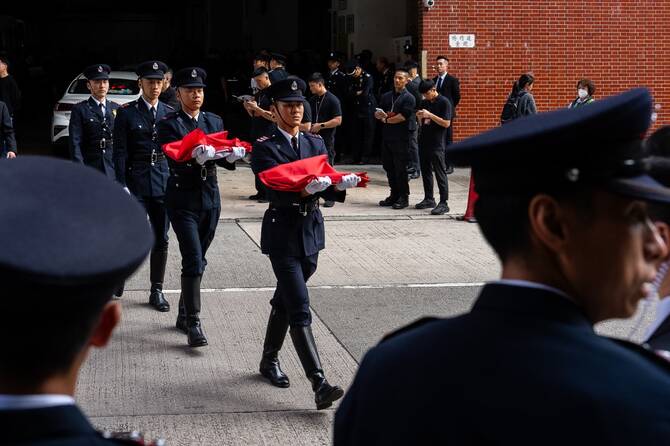
Firefighters carry Hong Kong SAR flags outside a funeral parlor to pay tribute to Ho Wai-ho, the firefighter who lost his life in the line of duty during the deadly fire at Wang Fuk Court, Hong Kong. (AP)
Short Url
Updated 19 December 2025
Follow

Hong Kong mourns firefighter killed in city’s deadliest fire in decades

  • Top officials, including Hong Kong leader John Lee, were among the funeral attendees

HONG KONG: Hong Kongers offered flowers and bowed outside a funeral parlor on Friday to pay tribute to a firefighter who was among the 160 people killed by the city’s deadliest fire in decades.
Ho Wai-ho lost his life battling the massive blaze that engulfed seven buildings of a housing complex on Nov. 26. He was 37. The fire services department has posthumously awarded him the title of senior fireman.
An array of wreaths lay outside the Universal Funeral Parlour, with thank-you cards from residents put up on its wall. Top officials, including Hong Kong leader John Lee, were among the funeral attendees.
After the ceremony, they stood outside the parlor to send off the hearse, which carried Ho’s portrait at the front. Dozens of firefighters raised a salute as Ho’s coffin, draped with a Hong Kong regional flag, departed.
Before the funeral, some black-clad residents laid flowers at a mourning area outside the venue. One woman cried when she paid respect, and a man made a salute gesture.
Resident Andy Fong, who brought yellow flowers with him, said he hoped Ho could rest in peace.
“It’s heartbreaking. Although we have never met, it has saddened every Hong Konger,” he said.
Retiree Tse Pak-yin praised Ho for his bravery.
“I hope he will be happy. He still hasn’t got married and it’s such as pity,” he said.
Ho is survived by his parents, his two brothers and his fiancée.
The hearse headed to Wang Fuk Court, the site of the fire, for another ceremony before proceeding to Ho’s fire station. At the station, colleagues paid their last tributes, with some officers marching on both sides of the hearse as it moved. He was laid to rest at Gallant Garden, a burial ground for civil servants who die in the line of duty.
In a Monday statement, the fire services department said Ho was an industrious, polite and dedicated member who was well respected by his colleagues.
The financial hub’s worst blaze since 1948 broke out November 26 at Wang Fuk Court, in the northern suburban district of Tai Po. It was undergoing a monthslong renovation project with buildings covered by bamboo scaffolding and green netting.
Authorities have pointed to the substandard plastic nylon netting and foam boards installed on windows for contributing to the fire’s rapid spread.
Thousands of affected residents have moved to transitional homes, hotels and youth hostels, struggling to recover from the loss of lives and homes that took them years to buy. The tragedy pained many residents across the city.
While arrests were made, some residents have raised concerns about government oversight in building maintenance projects and official investigation efforts.
The government last week announced a judge-led independent committee to probe the cause and expected it to conclude the work within nine months, along with new requirements for checking the standards of netting.


Palestinian envoy pledges return to UN’s founding ideals in his bid for presidency of General Assembly

Updated 5 sec ago
Follow

Palestinian envoy pledges return to UN’s founding ideals in his bid for presidency of General Assembly

  • Riyad Mansour presents a vision for his candidacy grounded in the 3 core pillars of the UN: human rights, development, and peace and security
  • World of today ‘needs more, not less, United Nations,’ he says. ‘It needs us to honor our commitments … uphold our responsibilities … respect the rules of international law’

As Palestine’s envoy to the UN, Riyad Mansour, launched his candidacy for president of the 81st session of the UN General Assembly, he urged member states to recommit, at this time of growing global division, to multilateral cooperation, the principles of international law and the founding ideals of the UN.

Mansour, whose candidacy was endorsed by the UN’s Arab Group, presented a vision grounded in the three core pillars of the UN: human rights, development, and peace and security.

In his vision statement, he said: “The world we live in today needs more, not less, United Nations. It needs us to honor our commitments, not renege on them; to uphold our responsibilities, not abandon them; to respect the rules of international law, not grow accustomed to their breach.”

The 81st session of the UN General Assembly begins in September, and the election of its president will take place on June 2 in the General Assembly Hall at the UN headquarters in New York. In accordance with the established regional rotation of the position, the next president will be chosen from among the Asia-Pacific group of states.

Two others candidates have announced their intentions to stand so far: veteran diplomats Touhid Hossain from Bangladesh and Andreas S. Kakouris from Cyprus.

Mansour, who has served as the permanent observer of the State of Palestine to the UN since 2005, framed his candidacy through the lens of personal experience, describing himself as “a refugee, a migrant, the son of a steelworker,” who had lived through conflict, poverty and displacement.

“I know what it means when the United Nations is at its best, and I know only too well its shortcomings,” he said.

In his vision, Mansour reflected on the origins of the UN in the aftermath of a global conflict, describing the institution as a response to humanity’s “darkest moments” and a platform designed to replace war with cooperation.

He credited the General Assembly with enabling collective action that has delivered tangible gains, including advances in development, health, human rights and environmental protections.

“Together, we rejected the impulses of war and destruction and chose cooperation, common security and shared prosperity,” he said, citing milestones such as the Millennium Development Goals, the 2030 Agenda for Sustainable Development, and international agreements on climate change, disarmament and gender equality.

Despite those achievements, however, Mansour warned that many pledges have not been kept and trust in the international system is eroding.

“Too many promises remain unfulfilled, and too much suffering continues,” he said. “The international order has grown increasingly uncertain, and the ideals of the United Nations are too often left unenforced.”

He cautioned against a return to a world in which “conflict prevails over dialogue” and “coercion replaces diplomacy,” arguing that the scale of present-day crises — from armed conflict and humanitarian emergencies to climate change and technological risks — requires a renewed, collective resolve.

“We cannot risk a return to a world where disorder undermines the rule of international law,” Mansour said. “We must rise above division and recommit to partnership.”

He called for reforms within the UN system itself with the aim of improving efficiency, inclusivity and engagement, saying that such changes were necessary to restore confidence in the organization’s ability to deliver peace and security.

“This moment demands engagement grounded in mutual interest and sustained by persistent action,” he said, adding that reform was essential “to restore trust in our United Nations and its enduring capacity to contribute to international peace and security.”

He described his vision as pragmatic rather than ideological, shaped by decades of multilateral diplomacy and a belief in the UN as “an anchor for a more peaceful and just world.”

He continued: “At a time of profound strain on the multilateral system, my vision seeks to mobilize member states and stakeholders to preserve and safeguard what we have accomplished, and to pursue progress with urgency, so that dignity, opportunity and hope are extended to all.”

The president of the General Assembly is elected annually and is responsible for presiding over its sessions, representing its decisions, and facilitating negotiations among member states.