

UNGA adopts Pakistan-sponsored resolution focusing world attention on Palestine, Kashmir

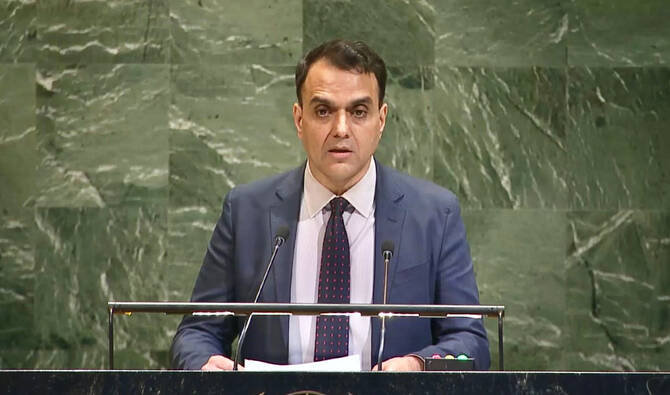
mbassador Usman Jadoon, Pakistan’s deputy permanent representative to the UN, addresses the General Assembly on the “International Day against Colonialism in All its Forms and Manifestations,” in New York, US, on December 18, 2025. (X/@PakistanUN_NY)
Short Url
Updated 19 December 2025
Follow

UNGA adopts Pakistan-sponsored resolution focusing world attention on Palestine, Kashmir

  • The resolution calls on countries to immediately cease foreign military intervention in and occupation of foreign countries and territories
  • Islamabad says the consensual adoption of the resolution manifests broad support for inalienable right of peoples facing foreign occupation

ISLAMABAD: The United Nations General Assembly (UNGA) has adopted a Pakistan-sponsored resolution on the peoples’ right to self-determination, Pakistan’s UN mission said on Friday, saying it reinforces the world attention to the Palestine and Kashmir issues.

The text, which was adopted by consensus, was recommended last month by the 193-member General Assembly’s Third Committee, which deals with social, humanitarian and cultural issues, according to Pakistani state media.

Co-sponsored by 65 countries, it called on countries to immediately cease foreign military intervention in and occupation of foreign countries and territories as well as acts of “repression, discrimination, and maltreatment.”

The resolution also declared the General Assembly’s firm opposition to acts of foreign military intervention, aggression and occupation, which have resulted in suppression of peoples’ right to self-determination in parts of the world.

“The consensual adoption of the resolution manifests broad international support for the inalienable right of the peoples facing colonialism, alien domination and foreign occupation,” Pakistan’s UN mission said on X. 

“For the people of Indian Illegally Occupied Jammu and Kashmir (IIOJK) and Palestine, the resolution reinforces international attention to their just and legitimate cause and their aspirations for freedom and dignity in accordance with UN Security Council resolutions.”

Pakistan, which does not recognize Israel, supports an independent Palestinian state based on “internationally agreed parameters” and pre-1967 borders, calling for an end to Israeli occupation of the Gaza Strip and the West Bank, including East Jerusalem.

Kashmir, on the other hand, has been divided between Pakistan and India since their independence from British rule in 1947. Both countries claim the Himalayan territory in its entirety but rule it in part and have fought multiple wars over it.

Islamabad has repeatedly urged New Delhi to hold a plebiscite in the disputed territory in line with the United Nations Security Council resolutions.

Ambassador Usman Jadoon, Pakistan’s deputy permanent representative to the UN, this week said the realization of self-determination is not merely a historical aspiration, but an enduring obligation.

“Recent developments in the Middle East demonstrate that lasting peace cannot be achieved through the continued denial and suppression of the legitimate right to self-determination of the Palestinian people,” he said on Thursday.

“Similarly, the UN Security Council has, through several resolutions, recognized the legitimate right of self-determination of the people of Jammu and Kashmir. A just resolution of the Jammu and Kashmir dispute remains central to the establishment of durable peace in South Asia.”


Pakistan deputy PM speaks with Iranian FM as Saudi Arabia intercepts missiles and drones

Updated 4 sec ago
Follow

Pakistan deputy PM speaks with Iranian FM as Saudi Arabia intercepts missiles and drones

  • Ishaq Dar expresses concern over evolving regional situation as both officials agree to remain in contact
  • Pakistan earlier reminded Tehran of its mutual defense pact with Saudi Arabia during diplomatic outreach

ISLAMABAD: Pakistan’s Deputy Prime Minister and Foreign Minister Ishaq Dar spoke with Iranian Foreign Minister Seyyed Abbas Araghchi on Friday amid escalating tensions in the Gulf, including recent missile and drone attacks targeting Saudi Arabia that were intercepted by the Kingdom’s air defenses.

The call comes as Islamabad remains in contact with both Tehran and Gulf states to prevent the widening Iran conflict from spilling further across the region, particularly after attempted strikes on Saudi territory, a sensitive development for Pakistan, which signed a mutual defense pact with the Kingdom last year.

Pakistan’s foreign ministry said Dar raised concerns about the evolving regional situation during the conversation.

“Deputy Prime Minister/Foreign Minister Senator Mohammad Ishaq Dar spoke this evening with the Foreign Minister of Iran, Seyyed Abbas Araghchi,” the ministry said in a statement.

“The DPM/FM expressed concern over the evolving regional situation. The two agreed to remain in touch on the developments,” it added.

The ministry did not share details of the conversation, though it came amid fast-moving developments in the region, with Saudi Arabia saying its air defenses intercepted multiple missiles and drones early on Friday.

Earlier this week, Prime Minister Shehbaz Sharif’s adviser on political affairs Rana Sanaullah said Pakistan was in contact with Iran to discourage attacks on Gulf countries and prevent misunderstandings.

“Such attacks should not be carried out from Iran’s side,” he told Geo TV.

Prior to that, the deputy prime minister told Pakistan’s Senate that Islamabad had engaged both Iran and Saudi Arabia at the outset of Iran’s retaliation in the region, reminding Tehran of its defense agreement with Saudi Arabia and conveying assurances from Riyadh that Saudi territory would not be used against Iran.

Pakistan says its administration is striving to end the conflict, though the United States-Israeli strikes on Iran, which triggered the war and led to its spillover, have only intensified.

Iranian President Masoud Pezeshkian said on Friday some countries had begun mediation efforts but insisted Tehran would defend its sovereignty.

Meanwhile, US President Donald Trump has called for Iran’s “unconditional surrender” on his Truth Social platform as the confrontation shows little sign of easing.