

Chile votes in presidential race expected to lurch country to the right

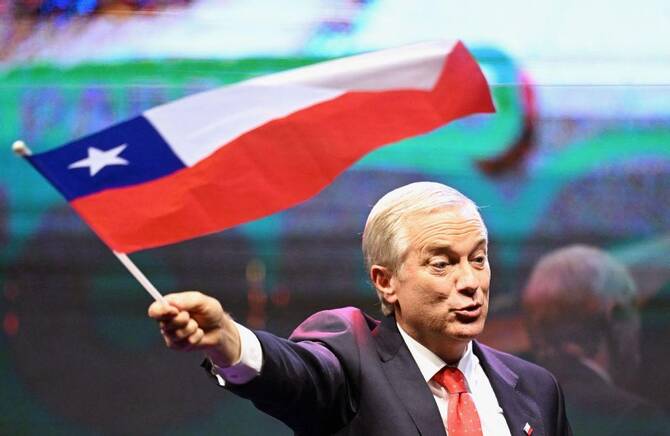
Chile's presidential candidate Jose Antonio Kast, of the Partido Republicano party, waves a Chilean flag after the first exit poll results of the general election in Santiago on November 16, 2025. (Photo by Marvin RECINOS / AFP)
Short Url
Updated 14 December 2025
Follow

Chile votes in presidential race expected to lurch country to the right

  • Right-wing candidate Jose Antonio Kast faces leftist Jeannette Jara
  • Kast is seen as most likely to triumph

SANTIAGO: Chileans will vote in a runoff presidential election on Sunday that is expected to result in the South American country’s sharpest rightward shift since the end of the military dictatorship in 1990. Nearly 15.6 million registered voters in Chile are set to cast ballots.

Polls will close at 6 p.m. local time (2100 GMT), pending voter lines, with initial results expected soon after. The runoff pits Jose Antonio Kast, from the far-right Republican Party that he founded, against Jeannette Jara, the incumbent leftist government’s coalition candidate from the Communist Party.

While Jara won November’s first round with 26.85 percent of the vote, Kast beat out an array of right-wing candidates to finish second with 23.92 percent. Most of the voters who supported those candidates are projected to go for Kast, which would give him more than 50 percent of the vote and the presidency.
CAMPAIGNS CLOSE WITH FOCUS ON CRIME
As the campaigns wound down, both candidates threw jabs at each other, but also focused on the main topic that has come to define the election: crime.
Speaking on Thursday from behind a clear protective barrier in the southern city of Temuco, the capital of a region rattled by conflict between Indigenous Mapuche groups and the government, Kast described a country in chaos and said he would restore order.

“This government caused chaos, this government caused disorder, this government caused insecurity,” the 59-year-old lawyer said.

“We’re going to do the opposite, we’re going to create order, security and trust.”

While Chile remains one of the safest countries in Latin America, a recent surge in organized crime and immigration has rattled the electorate and become the main concern among voters.

The issue quickly became a thorn in the side of leftist President Gabriel Boric, who rose to power on a wave of progressive optimism following widespread protests against inequality and promises of drafting a new constitution. Boric, who is barred from re-election because of a prohibition on consecutive presidential terms, scrambled to adjust, boosting funding for police forces, creating task forces dedicated to fighting organized crime, and deploying the military to the country’s northern border with Peru and Bolivia.

But it wasn’t enough for many voters. Boric has been struggling with low approval ratings, while Kast’s hard-line proposals against crime and immigration have attracted support.

“This country needs important reforms, we need to retake the path we’ve had for decades because we’re completely lost,” Jose Pinochet, a 55-year old lawyer, said while getting his shoes shined on a street in Santiago.

Antonia Moreno, 21, said she would vote for Jara but did not think it likely she would win.
“Regretfully we’ll be part of those countries where the far-right gains in Congress and the executive branch,” she said.
CONSISTENT HARDLINER
A Kast victory is likely to be cheered by investors who are hoping that a market-friendly government will accelerate economic reforms, including deregulation and changes to the copper-rich country’s pension system and capital markets.

The Chilean peso strengthened and MSCI’s Chile equity benchmark surged after the first-round results last month. Although no clear majority emerged in the Senate or Congress in that vote, Kast is expected to eventually be able to pass some economic reforms if he wins the runoff.

“The third time’s a charm,” he said during a speech after he made it to the runoff in November. This is his third run for president, and second runoff after losing to Boric in 2021.

Many of Kast’s views were seen as too extreme by voters in 2021, but now they have found a more sympathetic hearing among an electorate craving security and weary of the traditional political parties.

“I see the expression of the right, of the far right, as an escape valve for the rejection of politics in Chile,” said Marta Lagos, an analyst, pollster and founding director of Latinobarometro.

This is the first presidential election under a mandatory voting provision with automatic registration for those older than 18 and fines levied on anyone who doesn’t vote. That change adds an element of uncertainty, with opinion polls showing about 20 percent of voters still undecided or saying they will leave their ballots blank.

“There’s a percentage of voters who aren’t comfortable with either Jara or Kast,” said Guillermo Holzmann, a political analyst from the University of Valparaiso.

“The question is: Who do those blank or null votes favor?” During her closing campaign event on Thursday in the northern city of Coquimbo, Jara vowed to be tough on crime, touted the need for strong social programs, and urged people not to leave their ballots blank.

“Talk to people who are thinking about voting blank. There’s a lot at stake and we have to move forward, not back,” said the 51-year-old lawyer and former minister of labor in the Boric government.


Palestinian envoy pledges return to UN’s founding ideals in his bid for presidency of General Assembly

Updated 5 sec ago
Follow

Palestinian envoy pledges return to UN’s founding ideals in his bid for presidency of General Assembly

  • Riyad Mansour presents a vision for his candidacy grounded in the 3 core pillars of the UN: human rights, development, and peace and security
  • World of today ‘needs more, not less, United Nations,’ he says. ‘It needs us to honor our commitments … uphold our responsibilities … respect the rules of international law’

As Palestine’s envoy to the UN, Riyad Mansour, launched his candidacy for president of the 81st session of the UN General Assembly, he urged member states to recommit, at this time of growing global division, to multilateral cooperation, the principles of international law and the founding ideals of the UN.

Mansour, whose candidacy was endorsed by the UN’s Arab Group, presented a vision grounded in the three core pillars of the UN: human rights, development, and peace and security.

In his vision statement, he said: “The world we live in today needs more, not less, United Nations. It needs us to honor our commitments, not renege on them; to uphold our responsibilities, not abandon them; to respect the rules of international law, not grow accustomed to their breach.”

The 81st session of the UN General Assembly begins in September, and the election of its president will take place on June 2 in the General Assembly Hall at the UN headquarters in New York. In accordance with the established regional rotation of the position, the next president will be chosen from among the Asia-Pacific group of states.

Two others candidates have announced their intentions to stand so far: veteran diplomats Touhid Hossain from Bangladesh and Andreas S. Kakouris from Cyprus.

Mansour, who has served as the permanent observer of the State of Palestine to the UN since 2005, framed his candidacy through the lens of personal experience, describing himself as “a refugee, a migrant, the son of a steelworker,” who had lived through conflict, poverty and displacement.

“I know what it means when the United Nations is at its best, and I know only too well its shortcomings,” he said.

In his vision, Mansour reflected on the origins of the UN in the aftermath of a global conflict, describing the institution as a response to humanity’s “darkest moments” and a platform designed to replace war with cooperation.

He credited the General Assembly with enabling collective action that has delivered tangible gains, including advances in development, health, human rights and environmental protections.

“Together, we rejected the impulses of war and destruction and chose cooperation, common security and shared prosperity,” he said, citing milestones such as the Millennium Development Goals, the 2030 Agenda for Sustainable Development, and international agreements on climate change, disarmament and gender equality.

Despite those achievements, however, Mansour warned that many pledges have not been kept and trust in the international system is eroding.

“Too many promises remain unfulfilled, and too much suffering continues,” he said. “The international order has grown increasingly uncertain, and the ideals of the United Nations are too often left unenforced.”

He cautioned against a return to a world in which “conflict prevails over dialogue” and “coercion replaces diplomacy,” arguing that the scale of present-day crises — from armed conflict and humanitarian emergencies to climate change and technological risks — requires a renewed, collective resolve.

“We cannot risk a return to a world where disorder undermines the rule of international law,” Mansour said. “We must rise above division and recommit to partnership.”

He called for reforms within the UN system itself with the aim of improving efficiency, inclusivity and engagement, saying that such changes were necessary to restore confidence in the organization’s ability to deliver peace and security.

“This moment demands engagement grounded in mutual interest and sustained by persistent action,” he said, adding that reform was essential “to restore trust in our United Nations and its enduring capacity to contribute to international peace and security.”

He described his vision as pragmatic rather than ideological, shaped by decades of multilateral diplomacy and a belief in the UN as “an anchor for a more peaceful and just world.”

He continued: “At a time of profound strain on the multilateral system, my vision seeks to mobilize member states and stakeholders to preserve and safeguard what we have accomplished, and to pursue progress with urgency, so that dignity, opportunity and hope are extended to all.”

The president of the General Assembly is elected annually and is responsible for presiding over its sessions, representing its decisions, and facilitating negotiations among member states.