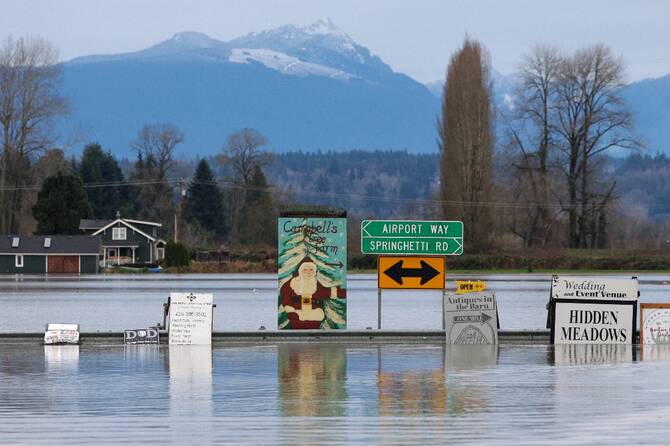
MOUNT VERNON: Days of torrential rain in Washington state has caused historic floods that have stranded families on rooftops, washed over bridges and ripped at least two homes from their foundations, and experts warned that even more flooding expected Friday could be catastrophic.
Washington is under a state of emergency and evacuation orders are in place for tens of thousands of residents. Gov. Bob Ferguson on Thursday urged everyone to follow evacuation instructions as yet another river neared record levels.
“I understand that many in our state have experienced significant floods in the past,” he said on the social platform X. “However, we’re looking at a historic situation.”
About 78,000 residents of a major agricultural region north of Seattle were ordered to evacuate the floodplain of the Skagit River, which was expected to crest Friday morning.
The floods were impacting large parts of the state, with several bridges flooded and some major roads inundated or washed out. Some roads had no alternate routes and no estimated reopening time, including a large part of state Route 410.
A landslide blocked part of Interstate 90 east of Seattle, with photos showing vehicles trapped by tree trunks, branches, mud and standing water.
In the north near the US-Canada border, the cities of Sumas, Nooksack and Everson were evacuated after being inundated. The border crossing at Sumas was closed and Amtrak suspended trains between Seattle and Vancouver, B.C.
Sumas Mayor Bruce Bosch said much of the city has been “devastated” by the high waters just four years after a similar flood.
Flooding rivers break records
The Snohomish River surged nearly a foot (30 centimeters) higher than its record Thursday in the picturesque city that shares its name, while the Skagit River rose just above its record Thursday night in Mount Vernon, according to the National Water Prediction Service.
Earlier Thursday, the Skagit just missed its previous record as flooding surged through the mountain town of Concrete.
The waters stopped just short of getting inside Mariah Brosa’s raised riverfront home in Concrete, but the raging river still slapped debris against her home and totaled her fiancé’s work car, she said.
“I didn’t think it would come this high,” she said.
Flooding from the Skagit has long plagued Mount Vernon, the largest city in Skagit County with some 35,000 residents. Flooding in 2003 displaced hundreds of people.
A floodwall that protects downtown passed a major test in 2021, when the river crested near record levels. Water was at the foot of the floodwall as of late Thursday morning, Mayor Peter Donovan said.
In nearby Burlington, officials hoped dikes and other systems would protect their community from catastrophe, said Michael Lumpkin, with the police department.
Officials respond to flooding
Authorities across Washington state in recent days have rescued people from cars and homes after an atmospheric river soaked the region.
Helicopters rescued two families on Thursday from the roofs of homes in Sumas that had been flooded by about 15 feet (4.6 meters) of water, while the city’s fire station had 3 feet (91 centimeters) of water, according Frank Cain JR., battalion chief for Whatcom County Fire District 14.
In nearby Welcome, erosion from the floodwaters caused at least two houses to collapse into the Nooksack River, he said. No one was inside at the time.
In a football field in Snoqualmie, a herd of elk swam and waded through neck-high water.
East of Seattle, residents along Issaquah Creek used water pumps as rushing floodwaters filled yards Thursday morning. Yellow tape blocked off a hazardous area along the creek.
Climate change has been linked to some intense rainfall. Scientists say that without specific study they cannot directly link a single weather event to climate change, but in general it’s responsible for more intense and more frequent extreme storms, droughts, floods and wildfires.
Another storm system is expected to bring more rain starting Sunday.


![]()

Washington state faces historic floods that have washed away homes and stranded families
Short Url
https://arab.news/r63j7
Washington state faces historic floods that have washed away homes and stranded families
- About 78,000 residents of a major agricultural region north of Seattle were ordered to evacuate the floodplain of the Skagit River


Latest updates


© 2026 SAUDI RESEARCH & PUBLISHING COMPANY, All Rights Reserved And subject to Terms of Use Agreement.